Showing posts with label Zimbabwe. Show all posts

Sunday, February 21, 2010

Purple

A favorite color of mine as of late, especially the lilac-y, amethyst hues...and yet funny because I have almost no photos that feature purple. I'm tempted to paint my home-office walls a brownish purple but haven't found the exact shade I want quite yet. Perhaps that will be my spring break project, along with learning how to use QuickBooks Premier Edition. The former obviously more fun than the latter.

On the beach along the Garden Route - South Africa

Jacarandas in bloom (taken through the car window) - near Chipinge, Zimbabwe

Street art in Santa Teresa, Rio de Janeiro

Tara modeling my jewelry in the midst of lavender in our garden - Casa Cali

Passion flower - one of my favorites from the street vendors in Maputo

Antique French wall sconce against light orchid bathroom wall - Casa Rosa, Rio de Janeiro

Giant beached jellyfish - near Cape Town, South Africa

Recycle-chic placemats at a guesthouse in Bilene, Mozambique

Carpet of asters - Pacifica, California

Making paper-thin rice flour wrappers for spring rolls - Can Tho, Vietnam

Saturday, April 19, 2008

Shameful

Thankfully, Maputo was not the next port of call for the ship carrying arms from China bound for Zimbabwe. The latest news we've heard is that it is heading for Luanda, Angola. I sincerely hope that the reaction to the ship's cargo is similar in that country, and that port workers refuse to unload the weaponry, and that government officials do the right thing on a higher level and recognize that 77 tons of arms arriving in Harare right now would exponentially facilitate the human rights absuses against the Zimbabwean people by ZANU-PF.

Sunday, March 30, 2008

Even with Confirmed Election Irregularities, There Is Hope for Change in Zimbabwe

The biggest thing on my mind these days is the election in Zimbabwe. Supposedly results will be posted today. The early word was that the opposition party, MDC, led by Morgan Tsvangirai, was on track to win the elections. However, this projection was based on publicly posted results from about 1/3 of the polling stations in the country. An official count is necessary to determine the winner, and many fear that the delay in announcing a result is in order to cover up election rigging.

ZANU-PF and Mugabe have notoriously tampered in past elections in Zimbabwe, and there is evidencet his has happened yet agaion in this one. We know of at least one story first-hand...

You may remember when I first moved to Chimoio, I was working on a project to establish a tea plantation and processing unit in Mozambique. The project was to be carried out in conjunction with a Zimbabwean partner, a family who had been running a tea operation in the Eastern Highlands of that country for many years. They had managed to avoid expropration of their land, a somewhat miraculous feat given the fate of the majority of Zimbabwe's other white commercial farmers, but were nervous about the future and thus interested in establishing operations across the border in Mozambique.

We got word from this family that they were forced off their tea plantation in Zim last week by a group of police thugs sent from the government. Apparently, the police claimed all of the family's equipment and assets, and made them leave the country. No, this was not a land claim...this intimidation was done in order to "secure voter loyalty". Basically, vote for Mugabe and you can come back home and have your farm back. Vote for the opposition, and you can imagine how the story will end.

As I sit today and periodically check the news waiting for official election results, I can't help but feel hopeful that change will finally come to Zimbabwe. Despite intimidation tactics, despite outright vote rigging (there were reports that ZANU-PF managed to cast thousands of ghost ballots), despite people arriving at polling places to find their names strangely missing from the voter lists...despite all of this, I believe that Zimbabwe is at a point where they can no longer bear the economic burden.

I hope that the official result is that Mugabe has lost the election. Either one of the alternate candidates will do; the main point is that the old man must step down...lest he be forced out of power, for I believe that Zimbabwe's people are prepared to engage in Kenya-style violence should the results be rigged once again. Violence is never something I wish for, but in this case, I can't help but see how it would be necessary if Zimbabwe's people want to have any hope for their immediate future.

Monday, October 22, 2007

Vision of Humanity: What Creates Peace?

I found this fascinating:


Brazil and the US are both ranked as having Low states of peace. Not surprising.

South Africa and Zimbabwe, two of Mozambique's neighbors, are glaringly red with Very Low states of peace. Again, no surprise here, especially with the violence in South Africa and the political and economic meltdown of Zimbabwe.

Mozambique, one of the world's poorest countries where a brutal civil war was fought between 1975 and 1992, has a Medium peace ranking.

I find this fascinating, and it helps answer the question that Ricardo and I so often struggle to answer: Why do you live in Mozambique if you have "better" (read: more developed and comfortable) options elsewhere?

We choose to stay here, among other reasons, because we have a quality of life that is unparallelled in any of our other potential homes. Not to say we won't eventually live elsewhere, it's simply that the outside perception of what life in Mozambique is like is quite different from reality.

I don't think I'll ever cease to be amused when a carioca asks, with a shocked expression and genuine concern for our well-being, "But isn't it awfully violent in Mozambique?"

For more information on the Vision of Humanity, visit here.

Sunday, June 10, 2007

Speaking of Great Books...

While on my way from Mozambique to Rio, and then from Rio to San Francisco, I had ample time to catch up on my reading. I love to read for pleasure, but do surprisingly little of it at home in Maputo, perhaps because so much of my time is spent reading for professional reasons. Not that work-reading can't be pleasurable - I am honestly interested in many of the market research and development-world news I keep up on - but it just takes time and effort, and at the end of the day I'd rather make something with my hands like jewelry or a great meal than sit buried with my nose in a book.

So with two 10-hour flights and an equal number of 12-hour layovers on this trip, I had plenty of opportunity to read some great books.

The first one I read was "A World of Strangers" by Nadine Gordimer, a South African author. Although this book was written in 1958, and the main character is a man who works in publishing, I found I related quite a bit to the story on a personal level.

This was the second book by Nadine Gordimer that I'd read. The first one was her critically acclaimed 2001 novel "The Pickup", which I enjoyed immensely once I'd managed to get used to her sometimes difficult style of writing.

I find she writes in a similar manner to the way I catch myself talking sometimes. I'll begin a sentence in the middle, then loop around to the part that actually makes sense, making my conversation partner pay particular attention to see what on earth I'm talking about. I think I tend to do this because I talk as I think a lot of the time, and don't bother to rearrange the language in my head to make it more digestible for a listener.

With a lot of Nadine Gordimer's writing, I found I had to speak sentences aloud to understand what her characters were trying to say. She also has a strange habit with comma use, putting commas in places you wouldn't expect according to proper grammar rules, but that make perfect sense when considering the natural rhythm of spoken word.

The other great book I read was "Don't Let's Go to the Dogs Tonight" by Alexandra Fuller, a Zimbabwean author who spent her childhood in what was then Rhodesia. She wrote from a child's perspective what it was like to grow up the daughter of white farmers during that country's struggle for independence. It was, like "The Power of One" and "The Poisonwood Bible", a poignant but also very funny take on some of history's most difficult chapters.

I think I will pick up additional books by both Nadine Gordimer and Alexandra Fuller when I am in the Johannesburg airport on my layover at the end of the month. Since Ricardo will be spending some significant time in Rio again this year, I imagine I'll have more of an inclination to read in the quest to make time pass as fast as possible in his absence.

Tuesday, March 20, 2007

Unbelievably Dark Days

Do you know what is happening in Zimbabwe? What has been happening for many years now, without any consequences for the man responsible for massive oppression and death?

Please click here and see what is going on. Warning: this is graphic material.

For the last 2 years, since arriving in Mozambique, I have had feelings of anger and indignance bubbling up inside me regarding the situation in neighboring Zimbabwe. Before coming here I admit I knew extremely little about Zimbabwe...about how the country used to be the agricultural star of Africa and was considered even more "developed" than South Africa...about the struggle for independence and the rule of Ian Smith...about how a former national hero is now the very person responsible for beating his country into the ground.

But now, strangely, I feel very passionate about what is happening in Zimbabwe. The country is not my own, I have never lived there. Still, among all of the horrific situations in the world today - Sudan, Iraq, Afghanistan, Côte d'Ivoire, etc. - there is something about the crisis next door that particularly moves me. In the past weeks, the violence and tension in Zimbabwe has escalated. Finally we are seeing consistent coverage on the international news networks about what is happening. I am holding my breath, along with all of the other people that give a shit about the fate of that country and its people, wondering when it will finally implode.

The first thing I heard about Zimbabwe was about the land reform implemented by Mugabe. Many of the white farmers that had lost their land ended up moving to Manica Province. In the capital Chimoio, we had many clients and friends that had farms outside the town. They came to Mozambique with hopes of creating an agricultural miracle. The Government here had the same expectations, and when I arrived in Chimoio everyone was talking about how the Zimbabweans could possibly change the future of agriculture in the Province.

Now, several years later, it is apparent that this miracle never materialized. Many of the white farmers invested in tabacco and paprika and went broke, partly due to irresponsible contract farming policies by the companies, partly due to the fact that there is not an environment in Mozambique conducive to commercial agriculture, at least not now. Some farmers did make it, though, including several clients of ours that are involved in plant propagation and fruit production.

Over the course of living in Chimoio, we got to know many Zimbabweans quite well. We even had the opportunity to cross the border several times to visit clients, especially while working on the proposal for the tea processing plant. Between 2005 and 2006 I visited Zimbabwe 4 times. Even though the US State Department already had a travel warning out, and even though all sorts of "people in the know" warned us about how dangerous the situation was in Zimbabwe, we drove across to the Eastern Highlands nonetheless. Each visit was an incredibly positive experience. We were received warmly by blacks and whites, rich people and poor people alike.

Despite the great impression we had of Zimbabwe and her people, it was already apparent at that time that the country was in the throes of a serious crisis. Cars were lined up around the block to get a tank of gas. What struck me was that the lines were colorblind - whites and blacks alike turned off their car engines and leaned lazily against their vehicles to wait. Occasionally we'd pass tanker trucks on the road in Mozambique, on their way back to Zimbabwe after filling up over the border.

The streets in Mutare and Chipinge, the main cities we visited, were void of cars. Nobody had gas, except those people lucky enough to have black market connections. At one gorgeous (and deserted) lodge Rico and I stayed in, the owners were offering guests petrol to buy on-site so that people wouldn't be afraid of getting stranded in Zimbabwe and therefore give up on tourism by car.

Our client we were visiting - the tea guy - was the last white farmer in the entire Eastern Highlands region. He'd established a training program for his black workers, and made sure that a good portion of the company's management was composed of blacks. By doing this, he managed to put off the government and the war veterans coming to claim the land they saw as rightfully theirs. We toured the tea plantation and the factory, then had a delicious lunch at the sprawling home of our client. Yes, their home was a contrast to the poverty we'd seen on the road. But these people - and all of the other white Zimbabweans we'd met in Chimoio - were passionate about their country. They did not identify as colonizers, or as Englishmen. They were Africans, 100% Zimbabwean, equally as enraged as their black compatriots at the atrocities being committed.

The general feeling I got during our visit was that everything in Zimbabwe was slowly grinding to a halt. Agricultural production had all but ceased, as the black war veterans that took over the white farms did not have production techniques or management skills to run a commercial operation. Food supply dwindled. Poor neighborhoods were bulldozed over to "clean up" Harare. Civil liberties were squashed. Inflation skyrocketed, forcing the government to bleach old bills and reprint new amounts over the worn beige paper, each time adding a healthy allotment of zeros to the end of the number.

Tensions mounted as living conditions became more and more unbearable, not to mention the political absurdities going on the entire time. While watching his countrymen starve and face massive unemployment, Mugabe made sure to keep his allies happy, giving them ludicrous gifts such as brand new Mercedes and diamond-studded watches.

Opposition forces mounted, but what I still do not understand to this day is how the Zimbabwean people have managed to hang on for 7 years of total economic and political crisis. Why hasn't there been a revolution of some sort? Why has nobody tried to assassinate the old bastard? And why hasn't the international community given a rat's ass, until the severe beating of the opposition leader last week during an illegal detention?

Watching what is happening in Zimbabwe makes me feel sick. How is it that in this day and age such atrocities still exist...are permitted to exist? How much longer will the people of Zimbabwe be able to survive? And what will be necessary for a once promising and powerful country to start healing the wounds of the past, once again?

Saturday, July 01, 2006

Baobab Trees

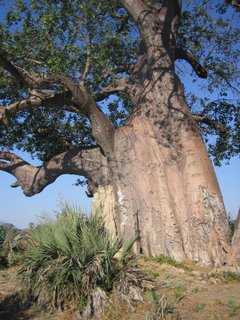
I just love myself a fat Baobab tree! The first time I saw these giants was when Ricardo and I drove from Chimoio to the little town of Espungabera where the tea project we raised $600,000 for will eventually be located. Both Chimoio and Espungabera are in Mozambique, but the roads in that part of the country are so bad that it was easier to cross the border to Zimbabwe and drive some 150km out of our way just so that we could be on tar roads and drive over 70 km/hr. It was driving through the Eastern Highlands of Zimbabwe that I first saw a Baobab. I was amazed at how large they were, big fat stumpy things jutting out of the dusty landscape, but somehow beautiful and majestic at the same time. Unfortunately, I never got a photo of a Baobab on the multiple trips to Zimbabwe we took last year.

I was grateful to have my camera charged and ready when we came across a few Baobabs in Botswana. This gigantic tree was at Seba Camp, and what I managed to capture in the photo is actually only one half of the entire tree.

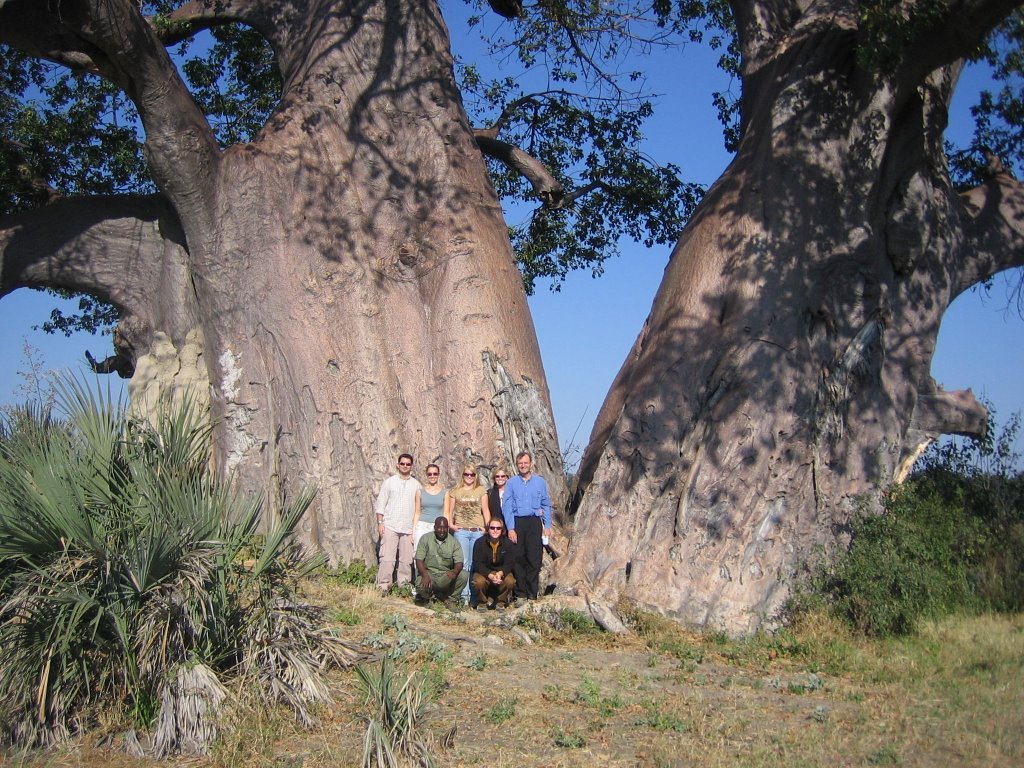
To put things in perspective, here is the entire trunk of the Baobab with my family, Ricardo, our guide Max and I lined up in front of the tree for a portrait. This thing would put the redwoods in California to shame! Max told us that this particular Baobab is more than 2,000 years old.

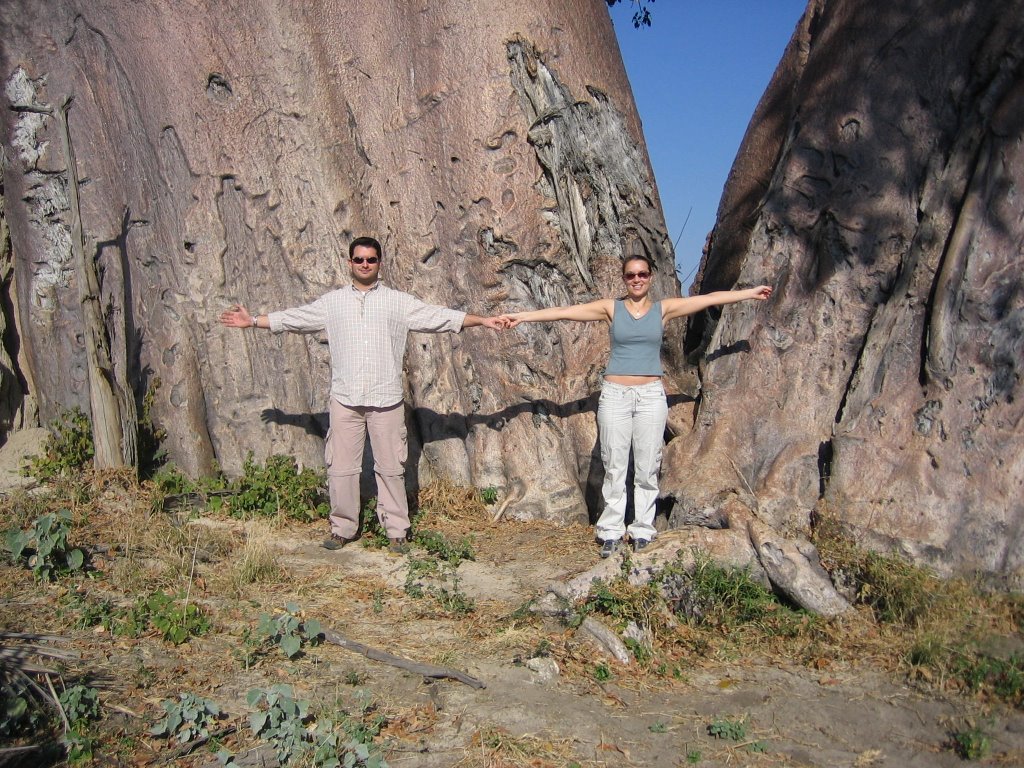
Ricardo and I decided to stretch our arms as far out as we possibly could in this photo. Even so, we were totally dwarfed by the thickness of the Baobab.

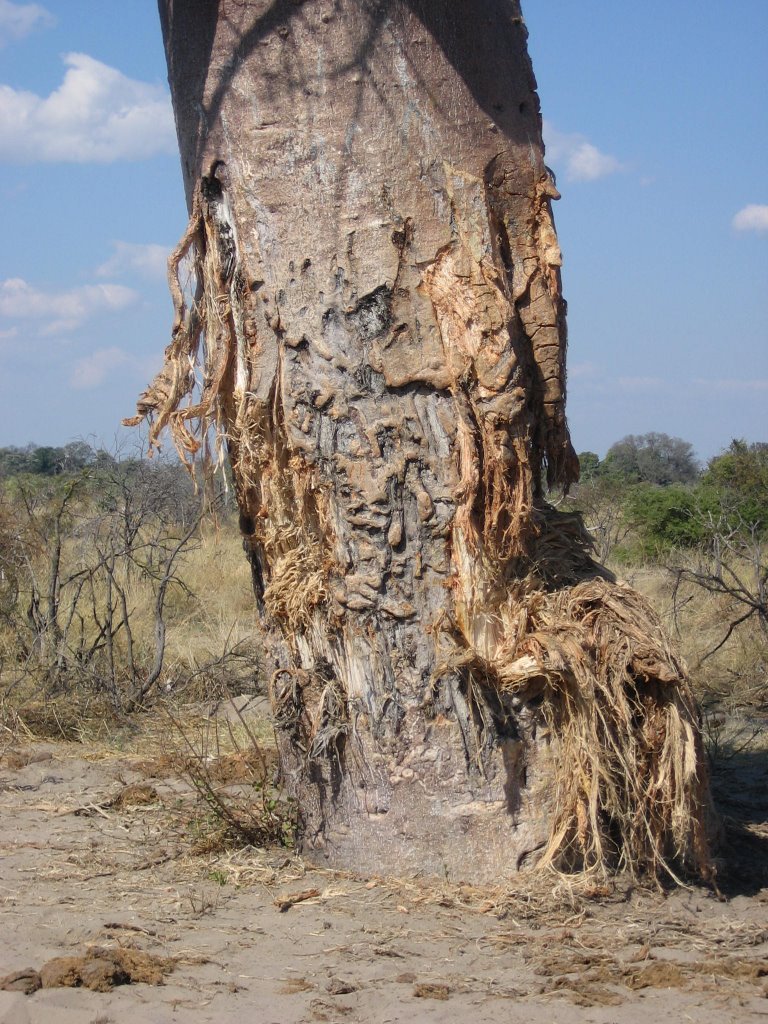
In another part of Seba Camp, we came across a slightly smaller Baobab whose trunk looked as if it had been attacked by an industrial shredder. Max informed us that the damage was caused by elephants, who have a habit of stripping the bark off trees in the bush to feed themselves. This causes a huge problem, because most trees can't regenerate their bark and once an elephant strips off the protective outer layer, the tree can't hold in moisture and eventually dies. Most of the dead trees you see in the bush are the result of elephants.

Baobabs, however, are a different story. They are one of the elephants' favorite trees because their bark and inner fibres are very fleshy, almost sponge-like. But no matter how much damage an elephant may cause, the Baobab is able to regenerate and form "scars" to heal the places where its bark and fibres have been stripped away. It's an amazing evolutionary trait, and the end result is these very cool, lumpy areas on the outside of the Baobabs. This tree has already regenerated a good part of the damage from the elephants, but even so it is in danger of toppling over should another feeding attack occur.

Here is a close-up of Rico inspecting the damage the elephants caused. You can see part of the trunk that has been regenerated from previous elephant feeding, just to the right of the torn up fibres.

This particular Baobab our guide estimated to be about 1,000 years old.

Friday, May 26, 2006

More Reality Sinking In...

(Written on Wednesday)

Today was a strange and unsettling day.

It started this morning when Rico and I were having coffee and guava cereal bars for breakfast. I took two sips of my coffee, felt my stomach bubble and groan, and promptly ran for the bathroom gagging the entire length of the hallway. I'm not the kind of person that vomits easily, and while coffee has the tendency to upset my stomach I've never had a reaction like this before. After throwing up I felt instantly better and started to go about my day as usual, reading blogs and celebrity gossip, looking over a business plan, checking my schedule.

About half an hour later Rico got a call from our colleague B. in Chimoio. "What?? Are you serious? How did it happen?" From the intonation of Rico's voice I knew it wasn't good news.

"Caralho, que sinistro cara." Holy shit, how sinister. Rico looked at me across the table with wide eyes, shaking his head in disbelief. "You're sure this really happened? God. I don't know what to say..."

Rico hung up with B. and broke the news. "Rob Dawson was killed in a car accident last night driving back to Sussundenga."

I felt like someone had thrown a brick into my stomach. Rob Dawson was a client of ours, and his project was one of the first for which Agrolink successfully raised funds about 2 years ago. I met Rob a few times while living in Chimoio but didn't know him well by any means. He was a tall thin Zimbabwean with scraggly hair and a long beard, one of the white farmers that came to Manica Province after losing his commercial farm to Mugabe's land reform program.

Perhaps a reflection of this displacement, Rob always struck me as a person who was eternally struggling - to adapt to a foreign culture and country, to make ends meet, to basically pick up and start fresh at age 55 without being consumed by rage and remorse over the hand that life had dealt him. I also got the impression that Rob's main ally in many of these struggles was a good strong whisky, sipped with a stoic face as to never hint at the pain he was trying to drown.

Along with his brother and another Zimbabwean farmer, Rob set up a flower production project outside Chimoio for which we raised several hundred thousand dollars in grant funding. When it came time to pay the company's consulting fee, however, problems arose. Rob and his partners refused to honor the amount originally agreed upon for our compensation, saying that it was too high for the services provided. Instead, Rob offered to pay us 20% of the originally determined consulting fee. I don't know if he truly thought our services weren't worth that much, or if Rob was just broke and wanting to save face. Either way, Ricardo rejected his offer and so began a dispute that would last for nearly 2 years...

Up until a few months ago, Ricardo had refused to accept any payment from Rob Dawson that weren't for the full amount owed. We were working on other projects and had other (paying) clients to dedicate our time and energy towards. Ricardo figured that when things slowed down, the company would approach Rob again and either find a solution or take him to court to enforce our agreement.

But then all the uncertainty and the shareholder fights within the company started, and we found ourselves with some cash flow problems. To tide us over, Ricardo approached Rob Dawson once again to discuss the matter of our payment. This time, Ricardo reasoned that any payment was better than no payment, and that once the company covered its expenses for the month we would start haggling again with Rob for the full payment.

The only problem was that now Rob was actively avoiding any payment, even a partial one. Ricard would call Rob just about every day to try and arrange a payment, and each time the guy would come up with some excuse as to why it wouldn't be possible. Either his car was broken, or the month's installment of the grant funds we'd raised for his project hadn't been deposited yet, or he was out of town, or he simply would avoid Ricardo's calls. This runaround lasted for over a month, then last Thursday Rob finally went by our Chimoio office and dropped off a check with B. for the partial amount owed.

We couldn't believe it! B. deposited the check in the company account and we were told that we'd have to wait 3 or 4 business days for it to clear. Then this morning, not a week after finally receiving our payment, B. received the news that Rob had been killed in a car accident as he drove home to his farm last night along the dirt road that links Chimoio with Sussundenga, a small village in the middle of the bush.

Apparently, Rob has been at a friend's house to have dinner and discuss the state of his business. According to this person, Rob was really agitated and nervous, talking about how he was having problems with his project, how the bank was giving him grief, and that he was even considering leaving the country. Rob also mentioned that he needed to speak with Ricardo, about what we will never know.

On the way home from the friend's house, Rob's car hit a tree along an isolated stretch of the road. He managed to get out of the vehicle after the accident, walked about 20 meters towards a grassy patch, they laid down and covered himself with vegetation for protection from the cold night. Rob passed away a few hours later. The next morning some local villagers found his body, and the news began to travel through the close-knit farming community in Chimoio.

After Ricardo finished telling me the story, we both sat at our desks in silence for several minutes, wrapping our minds around the sudden and unfortunate nature of Rob's death. With a slightly sheepish look on his face, Ricardo wondered out loud, "So do you think his check will clear?"

"I think so," I answered. "Why would he pay if he didn't have the money in his account to back up the check?"

"I don't know. Maybe that was what he wanted to talk to us about, to let us know that the payment wouldn't come through?"

"Who knows. I guess we'll find out soon enough."

What an awful situation. On the one hand, we were touched by the sad news of Rob's death and reminded that it could have been any of us on that dirt road at night. How many times, on road trips through isolated areas of Mozambique, have I not contemplated death myself, accepting the fact that if an accident happened we wouldn't be able to reach a hospital and would likely die in the middle of nowhere. On the other hand, Rob's money would bring a much-needed cushion to our company's cash flow. Ricardo and I discussed the palpable guilt we each felt waiting for a dead man's check to clear, as if in the face of this tragedy money should cease to matter at all...

B. called and was apparently thinking about the same thing. "Look on the bright side," he said. "If Rob's check bounces we can always tape it on the wall and put a sign underneath that says 'The first client that gave us a bad check died one day later.'"

Ricardo and I groaned at B.'s cynical take on the situation, permitting ourselves a quick laugh to relieve some of the tension caused by waiting for a dead man's money. At least B. found a way to deal with Rob's death - black humor. Sometimes I wish I could do the same, just make a cynical joke and move on with life, but I'm just not made that way. Even though I didn't know Rob very well at all, I feel so touched by his death. I can't stop thinking about it, imagining him on the side of the road, wondering what was going through his mind in those cold hours alone. Did he know death was coming? Was he in pain? Did he make amends and find peace with himself?

I can't help but think my early morning vomiting session was somehow related to this news...

(Update: Yesterday Ricardo went to the bank and found out that Rob Dawson's check cleared. Despite having solved our cash flow problem, I still feel horribly unsettled.)

Sunday, August 07, 2005


A hill covered with tea fields in Chipinge, Zimbabwe, taken from the car window after our meeting yesterday.

Friday, August 05, 2005

Saudades and another trip to Zimbabwe

Ricardo and I are heading to Zimbabwe again tomorrow morning for our final meeting with the tea client. We have to hit the road at 5am in order to have sufficient time to cross the border at Mutare, get our visas and car registration papers in order, and navigate the 200km of poorly-paved road to Chipinge. With no wrong turns, we should make it in just over 5 hours.

We rented a car for the trip from a friend's sister and Ricardo is out right now filling up 3 big plastic containers with extra gasoline. Due to the political and economic crisis, there are chronic fuel shortages in Zimbabwe and you have to take your own fuel for any trip over a few miles. Just to be safe, we are taking 60 liters of extra gas with us! The shortages are to the point that many Zimbabweans make the trek into Mozambique just to import fuel. It reminds me of the many trips my mom across the border from Italy to Slovenia to get gas for Bibi, my grandmother's old Saab. Gas used to be ridiculously cheaper in Slovenia; things have changed now that the country is part of the EU, but nonetheless the lines at the filling stations here evoke similar memories.

If everything goes well, I'll spend the rest of the weekend finalizing the proposal, then mail it out on Monday (via DHL, of course!). I am trying to raise over US$ 600.000 in funding from a program called PSOM, an initiative of the Dutch government to increase investments in developing countries. If approved, the project we are working on stands to significantly improve the lives of smallholder tea growers in the region. Lots of if's and maybe's in the way, but I think we have a good chance of getting the grant.

Tonight for dinner we tried some of the big fish that Ricardo is holding up in the photo. Our friend said it is red mackerel, but I honestly have no clue whether that is accurate or not. Regardless of the name, the fish was delicious. Flaky white meat, fresh flavor. It was perfect in a stew with jasmine rice, tomatoes, garlic, and bits of leftover squid from last night.

For some reason, I was hit with a wave of homesickness today. Ricardo noticed I was looking a bit down and asked what "casa" I missed. I had no idea how to answer. I miss bits and pieces of all my homes, past and present. Most of all, though, I miss the people that have become so important in my life despite the fact that we only see each other once every few years. The majority of the regular readers here are people I haven't met up with in ages. Lambros I met in Greece when I was 14 and saw for the last time in Athens in 1999. Gaby was my exchange student sidekick in Albuquerque in 2000; our most recent adventures together were in Umuarama, Paraná in 2001. Angel and I haven't hung out since 2002. Then there are my friends from high school in Albuquerque, people like Jenna and Tomás, who I totally lost contact with only to discover we've been leading similar paths this whole time.

It's funny, many of these people I still consider to be my best friends even though our only form of contact is an occasional e-mail or a blog update here and there. There is something about the community of modern nomads that permits relationships to be created and nourished independent of space or time. My friends that lead similarly disconnected lifestlyes are the ones I tend to relate to best. I know that, despite the differences in our cultures and current occupations, we all suffer from the same root pains. We are motivated by similar ideas. We drift from continent to continent searching for the same sense of fulfillment that comes from fitting in everywhere and nowhere at once. I miss my friends and family desperately, but take comfort in the fact that a good number of the people I love share my same sense of ill-defined, omnipresent SAUDADES.

Tuesday, July 26, 2005

You mean I get to go to Zimbabwe again?!?

Merdalina. Just talked to Ricardo on the phone and he is still in São Paulo. All SAA flights have been cancelled, and they are trying to reroute him on a British Airways flight to Harare through London.

Harare is 5 hours away by car. I have no idea how Ricardo is going to get back to Chimoio. The most likely scenario would be for me to drive to Zimbabwe and pick him up...But we don't have a vehicle and the car rental guy wants to charge double the amount he originally quoted to go to Beira. I would also have to register the car and get yet another visa. To fly from Harare to anywhere in Mozambique is ridiculously expensive. Ricardo's ticket from Maputo to Beira is nonrefundable and can't be changed. Merda. Merda. Merda.

I'm at the point where all I can do is laugh at our unbelievably poor luck...

One more reason I hate SAA

Puta que pariu, ninguém merece!!!

Stupid South African Airways is on strike and has cancelled nearly all domestic and international flights going in and out of Johannesburg, their hub. Ricardo is leaving Brazil today on a SAA flight and is supposed to arrive in Jo'burg tomorrow morning, with an afternoon connection, also on SAA, to Maputo. Now it looks like he may be delayed several days due to the strike...SAA's workers want higher wages since the company just declared fat profits this quarter. Management is not negotiating. The flight crews have stopped even showing up at the airport. No end in sight...Sigh.

I have already rented a car to drive to Beira and pick up Ricardo tomorrow evening. Now I'm not even sure he'll make it out of South Africa before the weekend. What a lovely way to add insult to injury after the *insane* month I've had here in his absence...

In other, better news, Agrolink is not being audited after all. This news came through the grapevine and was an excellent illustration of how facts are easily distorted when transmited from mouth to mouth over a cellhpone. Our accoutant called the company's ex-secretary who called BL who called me. BL and I both understood that there would be an audit. Apparently, the accountant was just concered that we have our books in order should someone from the finance ministry decide to drop in on Agrolink. I still think he was setting us up, trying to get a little something extra out of us to prevent the possibility of an audit. Everyone is interconnected here...the accountant could very well call the finance ministry and "request" a visit to Agrolink.

My weekend trip to Espungabera and Zimbabwe was fabulous. In comparison to my last trip, the drive was tranquilo. Stefano's driver picked me up at 5am on Friday and we bumped along the dirt road at a reasonable speed, slowing down on curves and taking care not to spin out. Espungabera is a little, little town in the mountains that has no paved roads, one restaurant, and phone service via radio waves. Totally isolated. It was great to hole up in Stefano's project headquarters and finally get some good work done on my proposal. No noise. No flatmates. Just me and my laptop and the occasional brainstorming session with Stefano.

Saturday I woke up again at the crack of dawn and got ready for the meeting with our tea client in Zimbabwe. It went amazingly well, and we were able to negotiate all the necessary details for our future joint venture and the proposal I'm currently putting together. We had lunch with the client and his family in their beautiful estate hidden in the middle of a tea plantation. We had fresh fish and bread pudding, gin and tonics after the negotiations, and lounged about in the most extravagant house I've seen since setting foot in Africa. Swimming pool and manicured gardens and sweeping verandahs - the whole works. The client and his family are very worried, though, that any day Mugabe could swoop down and expropriate not only their tea plantation and factory, but the family's home as well. Yet another reason they are interested in doing business in Mozambique - it provides an emergency exit out of Zimabwe if necessary.

So now my task is to sit down and finish the proposal. Happily, the details and overall concept of the project have finally come together in my head, and I have a clear image from which to write. I did some simple cash flow projections and budget work yesterday, and my goal is to get a draft completed before Ricardo arrives. I have a lot of work ahead of me, but I'm much less stressed out because I finally understand what the project is all about.

Our trip back to Chimoio was uneventful, except for the fact that we left at 5am and gave a lift to two of Espungabera's district administrators that hadn't bathed in a couple of days. I had to crack the window and stick my nose out into the cold dawn air as not to pass out from the ripe odor inside the 4x4. A car full of smelly men was nothing, however, compared to my last trip back from the mountains.

When BL, Gemelli and I went two weeks ago, we decided to drive back through the Zimbabwean side of the border. Even through the trip is an extra 200 km, nearly all of the roads are paved and you can make it back to Chimoio in about the same time as on the dirt trails through the interior of Mozambique. Obviously this doesn't hold true if you take a wrong turn and drive for 1.5 hours in the wrong direction. Somehow we missed the turnoff for Birkenough Bridge and ended up driving through the semi-arid savannah full of baobab trees. We were so fascinated by the huge trees - enormous, leafless beings that dominate the landscape like fat sentinels - that we didn't even notice we were off track. After finally correcting our mistake and getting on the proper highway, we got lost again in Mutare, the border town with Mozambique. It was dark, and there were no signs indicating where to go. All the street lights were burnt out, and packs of people roamed the streets, staring at the white strangers cruising around in circles. We finally asked a man on a bicycle how to get to the border and he sent us on a totally deserted road, past a looted gas station, into a thicket of trees. We were convinced it was a setup when finally I spotted a faded sign for Beira, the port in Mozambique over 300km away. Thank God. We zoomed through customs and drove the rest of the way home to Chimoio telling jokes to keep awake.

Well, it's time for me to get to work...My deadline for a draft is the 1st and the final proposal has to be mailed out on the 8th. Long days ahead, for sure.

Monday, July 25, 2005


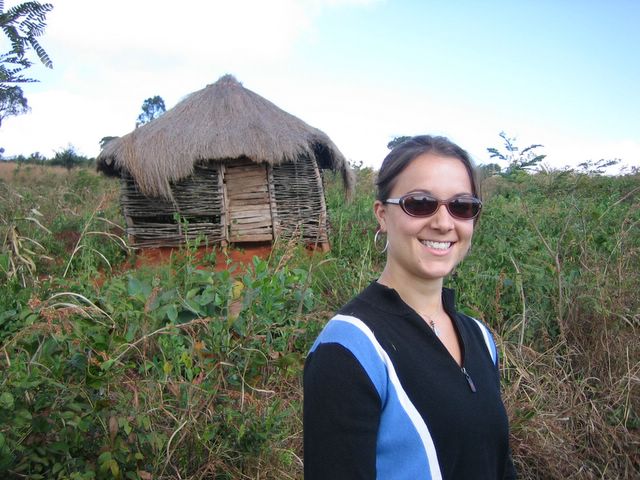
On our way up the sacred mountain in Espungabera. These huts are typical of the region...

Thursday, July 21, 2005

Tea, Chá, Té

I am tired. I was at the office by 7:30 this morning to meet with a client and finalize some contracts that were supposed to be signed two weeks ago. Managed to wiggle my way out of another visit to the notary (phew!) and headed home for some quiet time to work on a big proposal that is due in 2 weeks. I just spent over 2 hours reading about the tea industry - how tea is grown, processed, distributed...the works.

Tomorrow morning at the crack of dawn I am headed again to Espungabera and then Zimbabwe the next day for a meeting with our tea manufacturing client. Should be back in Chimoio by Sunday evening. Hopefully this trip won't be as, ahem, adventuresome as the last one...and maybe I'll actually have some time to write about these trips I keep referring to!

Big plus - since I'm leaving for the weekend on business, I've been able to escape being the responsible party to deal with the audit in Ricardo's absence. Yay!!!!!

Love to all. Saudades...