Sometimes I miss our life in Mozambique so much I could cry. Not because I wish to move back out of dissatisfaction with our new chapter at Casa Cali (although obviously part of me would love to be back with the girls for leisurely late lunches at Zambi and weekend suntanning at Hotel Cardoso). Rather, I wish we were back in Maputo because I can feel memory playing its old, funny tricks on me already. Nearly five years spent between Maputo and Chimoio, and only a handful of months here in the Bay Area, and already the crisp lembranças of the former are slipping away. Some days it all seems so distant that I can barely believe that I lived one-sixth of my life in Africa. The memories dull, the floorplan of our flat seemingly imprinted forever in my mind begins to contort, the smells fade and the luso-afro slang flutters away.
I wonder, in the midst of these memory-games, what exactly I will carry with me as permanent, faithful memories of our time in Mozambique. It makes me sad that already I am losing part of our experience there...
Perhaps this is a contributing factor to my renewed desire to write?

Showing posts with label Chimoio. Show all posts
Showing posts with label Chimoio. Show all posts
Wednesday, January 27, 2010


Monday, March 26, 2007
Sunday Scribblings - In the Kitchen

This was our kitchen in Chimoio, the place where I would spend the bulk of my time during the 9 months I lived in that crazy shared house. It was dirty and constantly in a state of disarray despite the fact that we had a maid, but I loved it despite the chaos. Cooking was somewhat of an escape for me, a chance to be away from my housemates and have some quiet moments to mull over the day's events and my general feelings about being in Mozambique. At times it felt like being in the kitchen was the only thing that kept me sane...
One day as I sauteed portabella mushrooms for an omlette (an exciting once-a-year find at Shoprite), I contemplated death.
It was the day after one of the scariest car rides of my life. I had felt completely out of control careening down a dirt road on the side of a cliff with one of our housemates driving. I suspected he was drunk and on pills. I pleaded with him to stop the Land Cruiser, to let me drive. He refused, and I cried in the front seat while trying to hold on to the door handle. There was no seat belt. At that moment I was certain we would have an accident. My mind went wild imagining the possibilities...the vehicle toppling head over tail into the banana plantation below, or perhaps slamming into a tree on the side of the road. I was anticipating the possibility that I could die out there on the dirt road from Chimoio to Espungabera. In the end, we made it with only one minor incident where we went off the road into a cane field. I never got in a car again with this particular person driving.
Cooking the mushrooms gave me a chance to decompress, to re-live and then recover from the trauma of being at the mercy of a vengeful, dangerous driver. The emotions were so strong that I started to cry. A few tears splashed into the pan with the mushrooms, sizzling briefly. As we later sat down to eat, I imagined for a moment that my tears might have an intoxicating effect on my housemates, like Tita's powerful cooking in "Like Water for Chocolate", bringing everyone at the table to silence as they accepted the concept of impermanence.

Now that Rico and I live in Maputo, cooking still is my favorite time to contemplate my life, as if chopping tomatoes, adding a touch to curry to a soup, and struggling to peel the tough outer layer of manioc root were the catalysts for introspection. Being in the kitchen now, however, is no longer an escape; rather is all about the joy of inventing new flavors, experimenting with ingredients and sharing healthy food with the person I love.
Tuesday, March 20, 2007
Unbelievably Dark Days
Do you know what is happening in Zimbabwe? What has been happening for many years now, without any consequences for the man responsible for massive oppression and death?
Please click here and see what is going on. Warning: this is graphic material.
For the last 2 years, since arriving in Mozambique, I have had feelings of anger and indignance bubbling up inside me regarding the situation in neighboring Zimbabwe. Before coming here I admit I knew extremely little about Zimbabwe...about how the country used to be the agricultural star of Africa and was considered even more "developed" than South Africa...about the struggle for independence and the rule of Ian Smith...about how a former national hero is now the very person responsible for beating his country into the ground.
But now, strangely, I feel very passionate about what is happening in Zimbabwe. The country is not my own, I have never lived there. Still, among all of the horrific situations in the world today - Sudan, Iraq, Afghanistan, Côte d'Ivoire, etc. - there is something about the crisis next door that particularly moves me. In the past weeks, the violence and tension in Zimbabwe has escalated. Finally we are seeing consistent coverage on the international news networks about what is happening. I am holding my breath, along with all of the other people that give a shit about the fate of that country and its people, wondering when it will finally implode.
The first thing I heard about Zimbabwe was about the land reform implemented by Mugabe. Many of the white farmers that had lost their land ended up moving to Manica Province. In the capital Chimoio, we had many clients and friends that had farms outside the town. They came to Mozambique with hopes of creating an agricultural miracle. The Government here had the same expectations, and when I arrived in Chimoio everyone was talking about how the Zimbabweans could possibly change the future of agriculture in the Province.
Now, several years later, it is apparent that this miracle never materialized. Many of the white farmers invested in tabacco and paprika and went broke, partly due to irresponsible contract farming policies by the companies, partly due to the fact that there is not an environment in Mozambique conducive to commercial agriculture, at least not now. Some farmers did make it, though, including several clients of ours that are involved in plant propagation and fruit production.
Over the course of living in Chimoio, we got to know many Zimbabweans quite well. We even had the opportunity to cross the border several times to visit clients, especially while working on the proposal for the tea processing plant. Between 2005 and 2006 I visited Zimbabwe 4 times. Even though the US State Department already had a travel warning out, and even though all sorts of "people in the know" warned us about how dangerous the situation was in Zimbabwe, we drove across to the Eastern Highlands nonetheless. Each visit was an incredibly positive experience. We were received warmly by blacks and whites, rich people and poor people alike.
Despite the great impression we had of Zimbabwe and her people, it was already apparent at that time that the country was in the throes of a serious crisis. Cars were lined up around the block to get a tank of gas. What struck me was that the lines were colorblind - whites and blacks alike turned off their car engines and leaned lazily against their vehicles to wait. Occasionally we'd pass tanker trucks on the road in Mozambique, on their way back to Zimbabwe after filling up over the border.
The streets in Mutare and Chipinge, the main cities we visited, were void of cars. Nobody had gas, except those people lucky enough to have black market connections. At one gorgeous (and deserted) lodge Rico and I stayed in, the owners were offering guests petrol to buy on-site so that people wouldn't be afraid of getting stranded in Zimbabwe and therefore give up on tourism by car.
Our client we were visiting - the tea guy - was the last white farmer in the entire Eastern Highlands region. He'd established a training program for his black workers, and made sure that a good portion of the company's management was composed of blacks. By doing this, he managed to put off the government and the war veterans coming to claim the land they saw as rightfully theirs. We toured the tea plantation and the factory, then had a delicious lunch at the sprawling home of our client. Yes, their home was a contrast to the poverty we'd seen on the road. But these people - and all of the other white Zimbabweans we'd met in Chimoio - were passionate about their country. They did not identify as colonizers, or as Englishmen. They were Africans, 100% Zimbabwean, equally as enraged as their black compatriots at the atrocities being committed.
The general feeling I got during our visit was that everything in Zimbabwe was slowly grinding to a halt. Agricultural production had all but ceased, as the black war veterans that took over the white farms did not have production techniques or management skills to run a commercial operation. Food supply dwindled. Poor neighborhoods were bulldozed over to "clean up" Harare. Civil liberties were squashed. Inflation skyrocketed, forcing the government to bleach old bills and reprint new amounts over the worn beige paper, each time adding a healthy allotment of zeros to the end of the number.
Tensions mounted as living conditions became more and more unbearable, not to mention the political absurdities going on the entire time. While watching his countrymen starve and face massive unemployment, Mugabe made sure to keep his allies happy, giving them ludicrous gifts such as brand new Mercedes and diamond-studded watches.
Opposition forces mounted, but what I still do not understand to this day is how the Zimbabwean people have managed to hang on for 7 years of total economic and political crisis. Why hasn't there been a revolution of some sort? Why has nobody tried to assassinate the old bastard? And why hasn't the international community given a rat's ass, until the severe beating of the opposition leader last week during an illegal detention?
Watching what is happening in Zimbabwe makes me feel sick. How is it that in this day and age such atrocities still exist...are permitted to exist? How much longer will the people of Zimbabwe be able to survive? And what will be necessary for a once promising and powerful country to start healing the wounds of the past, once again?
Thursday, October 26, 2006
Powerless at the Wheel
One of our housemates from when we lived in the community house back in Chimoio was in a car accident yesterday. Apparently he was driving in Tete Province in the north of the country when an oxcart carrying a family with lots of kids crossed the highway right in front of his vehicle. Our ex-housemate decided to swerve off the road rather than hit the oxcart, and managed to get himself seriously injured in the process. He was taken to Malawi (not far from the border - he was lucky he had access to a decent medical center) and was operated on. He's got several broken bones, lost part of his ear, had to have stitches in his leg and had to have blood pockets drained from his face.
I'm horrified by what happened to him, and I really hope that he has a quick recovery, but there's part of me that just doesn't buy this story. This housemate had some serious issues with drugs and alcohol, in addition to being bipolar and off his medication for more than a year because it's not available here in Mozambique. So he self-medicated with other substances, and generally used getting drunk and high as a way to deal with the shithole that is Chimoio. I mean, we all dealt with that environment in our own special way - I got bossy and compulsively organized, B. overate, P. was a workaholic. I'm still not sure what Rico did but I'd venture to say it had to do with being overly patient even when staying quiet wasn't the healthiest option.
Anyhow, I certainly don't want to pass judgement but the fact remains that this housemate had several addictions and was more often than not fucked up. Every night he'd drink a case of beer on his own, not to mention the joints he constantly smoked. And many times he'd go to work drunk or high, and would often drive a car in these states without considering the danger he was putting himself and others in. So the whole story about the ox and the little kids - maybe it's true, but my gut says it's just a cover for what really made him swerve off the road. God help me for saying this if I'm wrong...
Hearing about the ex-housemate's ordeal took me back to all the times here I've been seriously worried that I'd be in a car accident while driving through the bush. A couple of months ago one of our clients died on the side of the road after suffering an accident in a remote area with no cell phone signal and nobody around to call for help - the same road we'd drive on every time we had to go to Zimbabwe via Espungabera, where our tea client is located.
One of the times I was most conviced that my life was in danger was actually a trip B. and I took to Espungabera with this ex-housemate driving the old Land Cruiser ambulance we used to borrow from a friend. Our ex-housemate was being really reckless in an unreliable vehicle on a dirt road that was winding down a cliff. I asked him to stop the car multiple times, to please drive safer, and he simply wouldn't listen. We were pretty much at his mercy because B. doesn't know how to drive and at the time I wasn't confident driving a right-hand drive vehicle, much less in offroad conditions.
When I expressed my concern, the ex-housemate said I was being paranoid and basically a sissy. I was so scared that I started crying in the front seat of the vehicle. I really thought I was going to die that day and thoughts of my family and friends started passing through my head. I remember thinking, "I can't belive it's going to be like this." Now, hearing about his accident, I can't help but remember that day and how terrible it felt to be in the car completely powerless...
I wrote this about the experience and later posted it on the blog:
We finally got on the road about 2pm, the start of bumpy, teeth-clenching ride that made me remember just how terrible travel can be. Everyone has a different tolerance for the “adventure factor” in a trip; in most cases, my standards are quite liberal, but there are a couple of situations that make me balk. High-speed driving along steep, curvy roads is one of them. Even more so if I’m in a decrepit vehicle on a dirt trail through the interior of Africa.
Now I’m certainly not in a position to criticize anyone else’s abilities, but G. drives like an absolute madman. He was right at home as the back side of the Land Cruiser skidded out of control, nearly sending us off the side of a huge cliff in the middle of an elephant reserve area. B. and I, on the other hand, were scared out of our minds. We pleaded with G. to take it easy, but it took several hours and a miscalculated curve that sent us slamming into a sugarcane field for the message to sink in. I was near tears the entire time, praying to whatever being has protected me thus far to keep special watch over our car.
About halfway through the trip, there is a big river with no bridge. The dirt road comes abruptly to an end and all vehicles, livestock, and people have to pile onto a floating platform to get to the other side. The platform, o batelão, is powered by a manual cogwheel that takes three big Africans to spin and moves at a snail’s pace between the banks. We loaded onto the batelão and stared out at the shallow water, grateful for a break in the driving. The light over the river was incredible – it seemed like the sky was split directly above us, one half heavy with gray storm clouds, the other an intense, clear blue. The bottom portion of a rainbow had formed in each half and thin rays of sunlight shone over the platform, accompanying us across the water. B. and I took it as a sign that we would make it safely, aware though that it was still a good 2 hours to Espungabera and it was starting to rain…
I also wrote this and didn't post it for fear of worrying my parents:
As we tumbled down the crater-ridden dirt road to Espungabera last weekend, I thought a fair bit about death. I don't mean to be melodramatic, but it was on my mind in a very real, immediate way. At the time, the practical side of my brain responded to the fact that I was scared shitless by imagining different worst-case scenarios. Perhaps we would skid off the road into a deep valley. Perhaps G. would lose control on the next curve and we would hit a tree. Or maybe we would run over a woman carrying laundry on her head, unable to slow down in time for her to scurry out of the road.
I kept imagining what my reaction would be to each of the situations. What if someone was seriously wounded? What if I got hurt? What if I suffered, pinned under the vehicle or left to watch my friends moan in pain unable to do anything to help. What if nobody found us? What would it be like to die in the middle of the bush in Africa, half a world away from family and loved ones?
I thought of my mom several years ago on a Zodiac boat ride we took while on vacation in Kauai. We were in a big, motorized raft in the open ocean along the Na Pali coast, speeding over every swell and catching air on the whitecaps. My mom was scared out of her mind. For the first hour, she was miserable, trying to dominate her fear and wrestle control over the situation. At some point, however, she had an epiphany and began to release her white-knuckled grip on the ropes. She looked out at the water, a deep swirling blue. She felt the wind on her face and the salt tangling her hair. She concentrated on the beaches and the tall green cliffs in front of us. At one point my mom leaned over to me and laughed, visibly enjoying the Zodiac adventure. “At least if I die it will be in a beautiful place together with my beautiful daughter.” I smiled and held her hand. She was able to recognize her fear, honor it, but also let it go. We had a great time on the raft.
I remembered this episode and tried hard to tune into a different wavelength as we bumped along the muddy road to Espungabera. I looked out at the landscape, long stretches of scraggly vegetation broken by the occasional granite boulder and odd patch of dark green jungle. Every few kilometers we would pass people walking alongside the road, going to and from small farm plots. I observed women carrying gravity-defying bundles of firewood or laundry on their heads, backs perfectly straight, bare feet making slow progress along the path home.
I watched groups of children walk down the road together, all wide-eyed and wearing rags, the older ones taking care of the younger ones. Some children carried hoes or tended small herds of goats. Many others walked along the road with nothing except a resilient smile and a friendly wave, chasing after our Land Cruiser as if it were the most exciting thing they’d ever seen. I wondered how many children had parents to go home to, what they would eat that night for dinner, if they would ever go to school.
After a while I, too, was able to make peace with my fear. It didn’t go away – I still felt my stomach in my throat every time we lost traction on a curve – but it certainly became more manageable. Like my mom several years ago in Hawaii, I accepted being powerless. I made friends with the idea that I might die right then and there.
There is something about the rawness of the surroundings here in Mozambique that brings you close to the fundamental questions of what it means to be human. Life is a blessing, and it is our duty each day to live it out to its fullest...
We are always at death's door. It feels pretty dramatic to come out and say it like that, but it's true. I've felt like my time is almost up on a couple of occasions, always to come out on the other side okay. I'm painfully aware, though, that it could be any of us, anytime.
I'm horrified by what happened to him, and I really hope that he has a quick recovery, but there's part of me that just doesn't buy this story. This housemate had some serious issues with drugs and alcohol, in addition to being bipolar and off his medication for more than a year because it's not available here in Mozambique. So he self-medicated with other substances, and generally used getting drunk and high as a way to deal with the shithole that is Chimoio. I mean, we all dealt with that environment in our own special way - I got bossy and compulsively organized, B. overate, P. was a workaholic. I'm still not sure what Rico did but I'd venture to say it had to do with being overly patient even when staying quiet wasn't the healthiest option.
Anyhow, I certainly don't want to pass judgement but the fact remains that this housemate had several addictions and was more often than not fucked up. Every night he'd drink a case of beer on his own, not to mention the joints he constantly smoked. And many times he'd go to work drunk or high, and would often drive a car in these states without considering the danger he was putting himself and others in. So the whole story about the ox and the little kids - maybe it's true, but my gut says it's just a cover for what really made him swerve off the road. God help me for saying this if I'm wrong...
Hearing about the ex-housemate's ordeal took me back to all the times here I've been seriously worried that I'd be in a car accident while driving through the bush. A couple of months ago one of our clients died on the side of the road after suffering an accident in a remote area with no cell phone signal and nobody around to call for help - the same road we'd drive on every time we had to go to Zimbabwe via Espungabera, where our tea client is located.
One of the times I was most conviced that my life was in danger was actually a trip B. and I took to Espungabera with this ex-housemate driving the old Land Cruiser ambulance we used to borrow from a friend. Our ex-housemate was being really reckless in an unreliable vehicle on a dirt road that was winding down a cliff. I asked him to stop the car multiple times, to please drive safer, and he simply wouldn't listen. We were pretty much at his mercy because B. doesn't know how to drive and at the time I wasn't confident driving a right-hand drive vehicle, much less in offroad conditions.
When I expressed my concern, the ex-housemate said I was being paranoid and basically a sissy. I was so scared that I started crying in the front seat of the vehicle. I really thought I was going to die that day and thoughts of my family and friends started passing through my head. I remember thinking, "I can't belive it's going to be like this." Now, hearing about his accident, I can't help but remember that day and how terrible it felt to be in the car completely powerless...
I wrote this about the experience and later posted it on the blog:
We finally got on the road about 2pm, the start of bumpy, teeth-clenching ride that made me remember just how terrible travel can be. Everyone has a different tolerance for the “adventure factor” in a trip; in most cases, my standards are quite liberal, but there are a couple of situations that make me balk. High-speed driving along steep, curvy roads is one of them. Even more so if I’m in a decrepit vehicle on a dirt trail through the interior of Africa.
Now I’m certainly not in a position to criticize anyone else’s abilities, but G. drives like an absolute madman. He was right at home as the back side of the Land Cruiser skidded out of control, nearly sending us off the side of a huge cliff in the middle of an elephant reserve area. B. and I, on the other hand, were scared out of our minds. We pleaded with G. to take it easy, but it took several hours and a miscalculated curve that sent us slamming into a sugarcane field for the message to sink in. I was near tears the entire time, praying to whatever being has protected me thus far to keep special watch over our car.
About halfway through the trip, there is a big river with no bridge. The dirt road comes abruptly to an end and all vehicles, livestock, and people have to pile onto a floating platform to get to the other side. The platform, o batelão, is powered by a manual cogwheel that takes three big Africans to spin and moves at a snail’s pace between the banks. We loaded onto the batelão and stared out at the shallow water, grateful for a break in the driving. The light over the river was incredible – it seemed like the sky was split directly above us, one half heavy with gray storm clouds, the other an intense, clear blue. The bottom portion of a rainbow had formed in each half and thin rays of sunlight shone over the platform, accompanying us across the water. B. and I took it as a sign that we would make it safely, aware though that it was still a good 2 hours to Espungabera and it was starting to rain…
I also wrote this and didn't post it for fear of worrying my parents:
As we tumbled down the crater-ridden dirt road to Espungabera last weekend, I thought a fair bit about death. I don't mean to be melodramatic, but it was on my mind in a very real, immediate way. At the time, the practical side of my brain responded to the fact that I was scared shitless by imagining different worst-case scenarios. Perhaps we would skid off the road into a deep valley. Perhaps G. would lose control on the next curve and we would hit a tree. Or maybe we would run over a woman carrying laundry on her head, unable to slow down in time for her to scurry out of the road.
I kept imagining what my reaction would be to each of the situations. What if someone was seriously wounded? What if I got hurt? What if I suffered, pinned under the vehicle or left to watch my friends moan in pain unable to do anything to help. What if nobody found us? What would it be like to die in the middle of the bush in Africa, half a world away from family and loved ones?
I thought of my mom several years ago on a Zodiac boat ride we took while on vacation in Kauai. We were in a big, motorized raft in the open ocean along the Na Pali coast, speeding over every swell and catching air on the whitecaps. My mom was scared out of her mind. For the first hour, she was miserable, trying to dominate her fear and wrestle control over the situation. At some point, however, she had an epiphany and began to release her white-knuckled grip on the ropes. She looked out at the water, a deep swirling blue. She felt the wind on her face and the salt tangling her hair. She concentrated on the beaches and the tall green cliffs in front of us. At one point my mom leaned over to me and laughed, visibly enjoying the Zodiac adventure. “At least if I die it will be in a beautiful place together with my beautiful daughter.” I smiled and held her hand. She was able to recognize her fear, honor it, but also let it go. We had a great time on the raft.
I remembered this episode and tried hard to tune into a different wavelength as we bumped along the muddy road to Espungabera. I looked out at the landscape, long stretches of scraggly vegetation broken by the occasional granite boulder and odd patch of dark green jungle. Every few kilometers we would pass people walking alongside the road, going to and from small farm plots. I observed women carrying gravity-defying bundles of firewood or laundry on their heads, backs perfectly straight, bare feet making slow progress along the path home.
I watched groups of children walk down the road together, all wide-eyed and wearing rags, the older ones taking care of the younger ones. Some children carried hoes or tended small herds of goats. Many others walked along the road with nothing except a resilient smile and a friendly wave, chasing after our Land Cruiser as if it were the most exciting thing they’d ever seen. I wondered how many children had parents to go home to, what they would eat that night for dinner, if they would ever go to school.
After a while I, too, was able to make peace with my fear. It didn’t go away – I still felt my stomach in my throat every time we lost traction on a curve – but it certainly became more manageable. Like my mom several years ago in Hawaii, I accepted being powerless. I made friends with the idea that I might die right then and there.
There is something about the rawness of the surroundings here in Mozambique that brings you close to the fundamental questions of what it means to be human. Life is a blessing, and it is our duty each day to live it out to its fullest...
We are always at death's door. It feels pretty dramatic to come out and say it like that, but it's true. I've felt like my time is almost up on a couple of occasions, always to come out on the other side okay. I'm painfully aware, though, that it could be any of us, anytime.
Monday, June 19, 2006
Zeca
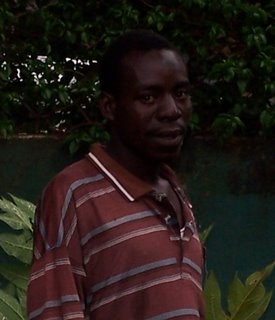
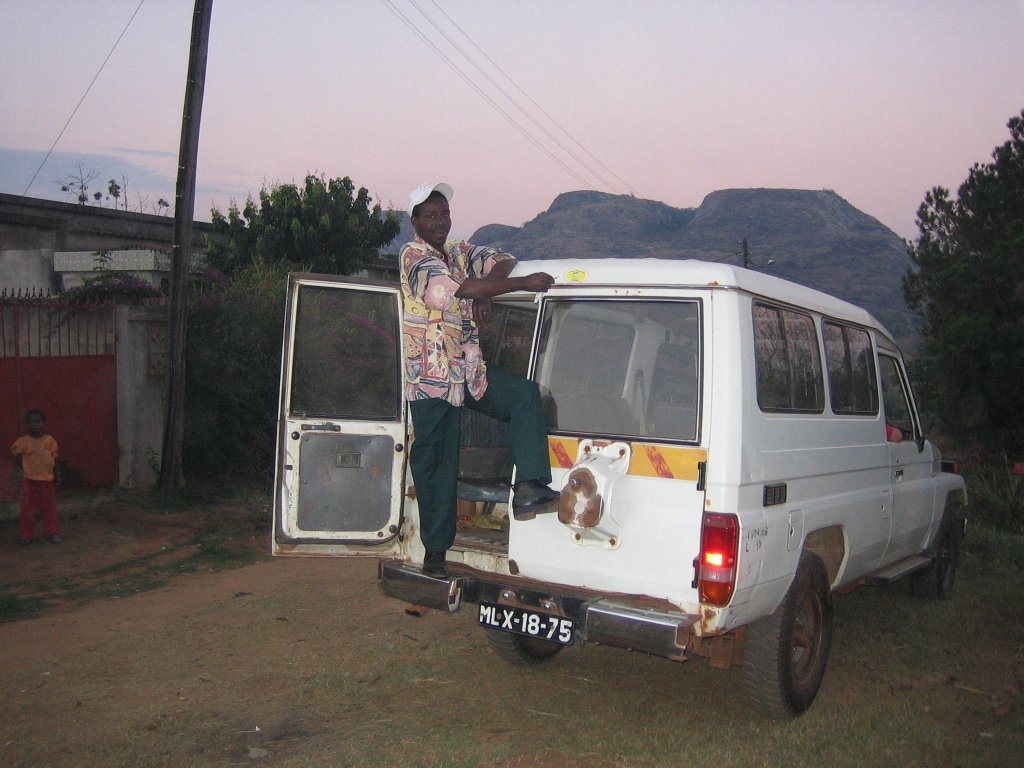
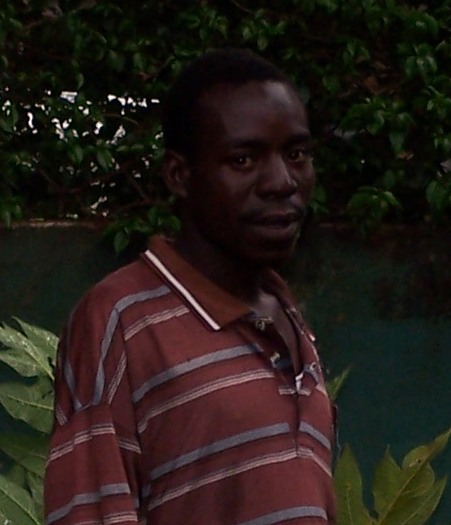
Sunday, June 18, 2006
The Inevitable
Last week, while Ricardo and I were on safari in Botswana, Zeca passed away. He was 26 years old. Zeca had been sick with visible symptoms for at least a year, but only received his HIV+ diagnosis last month when urged by our friend B. to go to the clinic for a free blood test. Our friends back in Chimoio pooled money to pay for Zeca's funeral, and are trying to establish a bank account where Zeca's widow can withdraw about $50 each month to support herself and their children.
I am deeply saddened by the loss of the local person in Chimoio with whom I felt the greatest connection, but more than anything Zeca's death makes me feel angry. How is it possible that billions and billions of dollars are pledged anually to fight HIV/AIDS in Africa and yet a person like Zeca can go up to 1 month of his death without getting an HIV test??? Every time Zeca would get sick we'd pay for him to have a consultations with western practitioners either at the local public hospital or at the Clínica Fátima, supposedly the best private clinic in Chimoio. Zeca would also meet with traditional healers, and I find it OUTRAGEOUS that between both western and traditional doctors NOBODY recommended that Zeca have an HIV test. I also feel a fair amount of guilt that I never did more to help, given my background in HIV prevention. I simply assumed that Zeca already knew his status and, out of a desire not to offend him, never probed any deeper into the matter until it was already way too late.
I understand that there are overwhelming cultural barriers to be overcome when dealing with HIV/AIDS in Africa, and in just about any community for that matter. But what makes me want to pull my hair out is that so much of the money that is donated for HIV/AIDS prevention - especially from the US - is full of conditions as to how it must be used that end up rendering the programs inefficient and ineffective. Instead of focusing on strategies that combine traditional beliefs with the best in modern medicine, prevention initiatives are filtered through the values and priorities of the western world.
Mozambique and Angola are just 2 of the many countries in Africa that, since they receive funding from the US to fight HIV/AIDS, must push the "A-B-C's of Prevention" as follows: 'A' is for Abstinence and that is the best and most recommended strategy to avoid HIV/AIDS. 'B' is for Be Faithful, what you should be to your partner if you fail the whole abstinence part. 'C' is for Condoms, third in priority and what you should do if you have (gasp!) more than one sexual partner. Thanks to a certain president's agenda of morals and family values, an HIV/AIDS program in Africa is not eligible for federal dollars unless it pushes the A-B-C's as the primary strategy for prevention.
The fight against HIV/AIDS is an industry, just like the fight against poverty or malnutrition or infant mortality. Many people are getting rich from the perpetuity of these problems, from the bureaucrats in Washington or Brussels making funding decisions and taking their respective administrative overheads (sometimes up to 34% of the program's budget), to in-country NGO directors with $10,000-a-month salaries and brand new Land Cruisers, to the local government officials lining their pockets under the table. There is not enough accountability, and the most perverse part is that once the problems at hand are tackled, there will be no need for all these government programs and NGO workers and local staff with stable jobs and good pay.
Certainly there are some people and organizations fighting the good fight, but the more time I spend here in Mozambique the more cynical I become about the whole situation. Until enough people call a spade a spade and admit that our current models for combating HIV/AIDS, malaria, food shortages, etc. are pitifully ineffective, the situation will continue to worsen and there will only be more stories like Zeca's to tell.
(I have an image to go along with this post but Blogger won't let me upload the photo. Will try again later.)
I am deeply saddened by the loss of the local person in Chimoio with whom I felt the greatest connection, but more than anything Zeca's death makes me feel angry. How is it possible that billions and billions of dollars are pledged anually to fight HIV/AIDS in Africa and yet a person like Zeca can go up to 1 month of his death without getting an HIV test??? Every time Zeca would get sick we'd pay for him to have a consultations with western practitioners either at the local public hospital or at the Clínica Fátima, supposedly the best private clinic in Chimoio. Zeca would also meet with traditional healers, and I find it OUTRAGEOUS that between both western and traditional doctors NOBODY recommended that Zeca have an HIV test. I also feel a fair amount of guilt that I never did more to help, given my background in HIV prevention. I simply assumed that Zeca already knew his status and, out of a desire not to offend him, never probed any deeper into the matter until it was already way too late.
I understand that there are overwhelming cultural barriers to be overcome when dealing with HIV/AIDS in Africa, and in just about any community for that matter. But what makes me want to pull my hair out is that so much of the money that is donated for HIV/AIDS prevention - especially from the US - is full of conditions as to how it must be used that end up rendering the programs inefficient and ineffective. Instead of focusing on strategies that combine traditional beliefs with the best in modern medicine, prevention initiatives are filtered through the values and priorities of the western world.
Mozambique and Angola are just 2 of the many countries in Africa that, since they receive funding from the US to fight HIV/AIDS, must push the "A-B-C's of Prevention" as follows: 'A' is for Abstinence and that is the best and most recommended strategy to avoid HIV/AIDS. 'B' is for Be Faithful, what you should be to your partner if you fail the whole abstinence part. 'C' is for Condoms, third in priority and what you should do if you have (gasp!) more than one sexual partner. Thanks to a certain president's agenda of morals and family values, an HIV/AIDS program in Africa is not eligible for federal dollars unless it pushes the A-B-C's as the primary strategy for prevention.
The fight against HIV/AIDS is an industry, just like the fight against poverty or malnutrition or infant mortality. Many people are getting rich from the perpetuity of these problems, from the bureaucrats in Washington or Brussels making funding decisions and taking their respective administrative overheads (sometimes up to 34% of the program's budget), to in-country NGO directors with $10,000-a-month salaries and brand new Land Cruisers, to the local government officials lining their pockets under the table. There is not enough accountability, and the most perverse part is that once the problems at hand are tackled, there will be no need for all these government programs and NGO workers and local staff with stable jobs and good pay.
Certainly there are some people and organizations fighting the good fight, but the more time I spend here in Mozambique the more cynical I become about the whole situation. Until enough people call a spade a spade and admit that our current models for combating HIV/AIDS, malaria, food shortages, etc. are pitifully ineffective, the situation will continue to worsen and there will only be more stories like Zeca's to tell.
(I have an image to go along with this post but Blogger won't let me upload the photo. Will try again later.)
Friday, May 26, 2006
More Reality Sinking In...
(Written on Wednesday)
Today was a strange and unsettling day.
It started this morning when Rico and I were having coffee and guava cereal bars for breakfast. I took two sips of my coffee, felt my stomach bubble and groan, and promptly ran for the bathroom gagging the entire length of the hallway. I'm not the kind of person that vomits easily, and while coffee has the tendency to upset my stomach I've never had a reaction like this before. After throwing up I felt instantly better and started to go about my day as usual, reading blogs and celebrity gossip, looking over a business plan, checking my schedule.
About half an hour later Rico got a call from our colleague B. in Chimoio. "What?? Are you serious? How did it happen?" From the intonation of Rico's voice I knew it wasn't good news.
"Caralho, que sinistro cara." Holy shit, how sinister. Rico looked at me across the table with wide eyes, shaking his head in disbelief. "You're sure this really happened? God. I don't know what to say..."
Rico hung up with B. and broke the news. "Rob Dawson was killed in a car accident last night driving back to Sussundenga."
I felt like someone had thrown a brick into my stomach. Rob Dawson was a client of ours, and his project was one of the first for which Agrolink successfully raised funds about 2 years ago. I met Rob a few times while living in Chimoio but didn't know him well by any means. He was a tall thin Zimbabwean with scraggly hair and a long beard, one of the white farmers that came to Manica Province after losing his commercial farm to Mugabe's land reform program.
Perhaps a reflection of this displacement, Rob always struck me as a person who was eternally struggling - to adapt to a foreign culture and country, to make ends meet, to basically pick up and start fresh at age 55 without being consumed by rage and remorse over the hand that life had dealt him. I also got the impression that Rob's main ally in many of these struggles was a good strong whisky, sipped with a stoic face as to never hint at the pain he was trying to drown.
Along with his brother and another Zimbabwean farmer, Rob set up a flower production project outside Chimoio for which we raised several hundred thousand dollars in grant funding. When it came time to pay the company's consulting fee, however, problems arose. Rob and his partners refused to honor the amount originally agreed upon for our compensation, saying that it was too high for the services provided. Instead, Rob offered to pay us 20% of the originally determined consulting fee. I don't know if he truly thought our services weren't worth that much, or if Rob was just broke and wanting to save face. Either way, Ricardo rejected his offer and so began a dispute that would last for nearly 2 years...
Up until a few months ago, Ricardo had refused to accept any payment from Rob Dawson that weren't for the full amount owed. We were working on other projects and had other (paying) clients to dedicate our time and energy towards. Ricardo figured that when things slowed down, the company would approach Rob again and either find a solution or take him to court to enforce our agreement.
But then all the uncertainty and the shareholder fights within the company started, and we found ourselves with some cash flow problems. To tide us over, Ricardo approached Rob Dawson once again to discuss the matter of our payment. This time, Ricardo reasoned that any payment was better than no payment, and that once the company covered its expenses for the month we would start haggling again with Rob for the full payment.
The only problem was that now Rob was actively avoiding any payment, even a partial one. Ricard would call Rob just about every day to try and arrange a payment, and each time the guy would come up with some excuse as to why it wouldn't be possible. Either his car was broken, or the month's installment of the grant funds we'd raised for his project hadn't been deposited yet, or he was out of town, or he simply would avoid Ricardo's calls. This runaround lasted for over a month, then last Thursday Rob finally went by our Chimoio office and dropped off a check with B. for the partial amount owed.
We couldn't believe it! B. deposited the check in the company account and we were told that we'd have to wait 3 or 4 business days for it to clear. Then this morning, not a week after finally receiving our payment, B. received the news that Rob had been killed in a car accident as he drove home to his farm last night along the dirt road that links Chimoio with Sussundenga, a small village in the middle of the bush.
Apparently, Rob has been at a friend's house to have dinner and discuss the state of his business. According to this person, Rob was really agitated and nervous, talking about how he was having problems with his project, how the bank was giving him grief, and that he was even considering leaving the country. Rob also mentioned that he needed to speak with Ricardo, about what we will never know.
On the way home from the friend's house, Rob's car hit a tree along an isolated stretch of the road. He managed to get out of the vehicle after the accident, walked about 20 meters towards a grassy patch, they laid down and covered himself with vegetation for protection from the cold night. Rob passed away a few hours later. The next morning some local villagers found his body, and the news began to travel through the close-knit farming community in Chimoio.
After Ricardo finished telling me the story, we both sat at our desks in silence for several minutes, wrapping our minds around the sudden and unfortunate nature of Rob's death. With a slightly sheepish look on his face, Ricardo wondered out loud, "So do you think his check will clear?"
"I think so," I answered. "Why would he pay if he didn't have the money in his account to back up the check?"
"I don't know. Maybe that was what he wanted to talk to us about, to let us know that the payment wouldn't come through?"
"Who knows. I guess we'll find out soon enough."
What an awful situation. On the one hand, we were touched by the sad news of Rob's death and reminded that it could have been any of us on that dirt road at night. How many times, on road trips through isolated areas of Mozambique, have I not contemplated death myself, accepting the fact that if an accident happened we wouldn't be able to reach a hospital and would likely die in the middle of nowhere. On the other hand, Rob's money would bring a much-needed cushion to our company's cash flow. Ricardo and I discussed the palpable guilt we each felt waiting for a dead man's check to clear, as if in the face of this tragedy money should cease to matter at all...
B. called and was apparently thinking about the same thing. "Look on the bright side," he said. "If Rob's check bounces we can always tape it on the wall and put a sign underneath that says 'The first client that gave us a bad check died one day later.'"
Ricardo and I groaned at B.'s cynical take on the situation, permitting ourselves a quick laugh to relieve some of the tension caused by waiting for a dead man's money. At least B. found a way to deal with Rob's death - black humor. Sometimes I wish I could do the same, just make a cynical joke and move on with life, but I'm just not made that way. Even though I didn't know Rob very well at all, I feel so touched by his death. I can't stop thinking about it, imagining him on the side of the road, wondering what was going through his mind in those cold hours alone. Did he know death was coming? Was he in pain? Did he make amends and find peace with himself?
I can't help but think my early morning vomiting session was somehow related to this news...
(Update: Yesterday Ricardo went to the bank and found out that Rob Dawson's check cleared. Despite having solved our cash flow problem, I still feel horribly unsettled.)
Today was a strange and unsettling day.
It started this morning when Rico and I were having coffee and guava cereal bars for breakfast. I took two sips of my coffee, felt my stomach bubble and groan, and promptly ran for the bathroom gagging the entire length of the hallway. I'm not the kind of person that vomits easily, and while coffee has the tendency to upset my stomach I've never had a reaction like this before. After throwing up I felt instantly better and started to go about my day as usual, reading blogs and celebrity gossip, looking over a business plan, checking my schedule.
About half an hour later Rico got a call from our colleague B. in Chimoio. "What?? Are you serious? How did it happen?" From the intonation of Rico's voice I knew it wasn't good news.
"Caralho, que sinistro cara." Holy shit, how sinister. Rico looked at me across the table with wide eyes, shaking his head in disbelief. "You're sure this really happened? God. I don't know what to say..."
Rico hung up with B. and broke the news. "Rob Dawson was killed in a car accident last night driving back to Sussundenga."
I felt like someone had thrown a brick into my stomach. Rob Dawson was a client of ours, and his project was one of the first for which Agrolink successfully raised funds about 2 years ago. I met Rob a few times while living in Chimoio but didn't know him well by any means. He was a tall thin Zimbabwean with scraggly hair and a long beard, one of the white farmers that came to Manica Province after losing his commercial farm to Mugabe's land reform program.
Perhaps a reflection of this displacement, Rob always struck me as a person who was eternally struggling - to adapt to a foreign culture and country, to make ends meet, to basically pick up and start fresh at age 55 without being consumed by rage and remorse over the hand that life had dealt him. I also got the impression that Rob's main ally in many of these struggles was a good strong whisky, sipped with a stoic face as to never hint at the pain he was trying to drown.
Along with his brother and another Zimbabwean farmer, Rob set up a flower production project outside Chimoio for which we raised several hundred thousand dollars in grant funding. When it came time to pay the company's consulting fee, however, problems arose. Rob and his partners refused to honor the amount originally agreed upon for our compensation, saying that it was too high for the services provided. Instead, Rob offered to pay us 20% of the originally determined consulting fee. I don't know if he truly thought our services weren't worth that much, or if Rob was just broke and wanting to save face. Either way, Ricardo rejected his offer and so began a dispute that would last for nearly 2 years...
Up until a few months ago, Ricardo had refused to accept any payment from Rob Dawson that weren't for the full amount owed. We were working on other projects and had other (paying) clients to dedicate our time and energy towards. Ricardo figured that when things slowed down, the company would approach Rob again and either find a solution or take him to court to enforce our agreement.
But then all the uncertainty and the shareholder fights within the company started, and we found ourselves with some cash flow problems. To tide us over, Ricardo approached Rob Dawson once again to discuss the matter of our payment. This time, Ricardo reasoned that any payment was better than no payment, and that once the company covered its expenses for the month we would start haggling again with Rob for the full payment.
The only problem was that now Rob was actively avoiding any payment, even a partial one. Ricard would call Rob just about every day to try and arrange a payment, and each time the guy would come up with some excuse as to why it wouldn't be possible. Either his car was broken, or the month's installment of the grant funds we'd raised for his project hadn't been deposited yet, or he was out of town, or he simply would avoid Ricardo's calls. This runaround lasted for over a month, then last Thursday Rob finally went by our Chimoio office and dropped off a check with B. for the partial amount owed.
We couldn't believe it! B. deposited the check in the company account and we were told that we'd have to wait 3 or 4 business days for it to clear. Then this morning, not a week after finally receiving our payment, B. received the news that Rob had been killed in a car accident as he drove home to his farm last night along the dirt road that links Chimoio with Sussundenga, a small village in the middle of the bush.
Apparently, Rob has been at a friend's house to have dinner and discuss the state of his business. According to this person, Rob was really agitated and nervous, talking about how he was having problems with his project, how the bank was giving him grief, and that he was even considering leaving the country. Rob also mentioned that he needed to speak with Ricardo, about what we will never know.
On the way home from the friend's house, Rob's car hit a tree along an isolated stretch of the road. He managed to get out of the vehicle after the accident, walked about 20 meters towards a grassy patch, they laid down and covered himself with vegetation for protection from the cold night. Rob passed away a few hours later. The next morning some local villagers found his body, and the news began to travel through the close-knit farming community in Chimoio.
After Ricardo finished telling me the story, we both sat at our desks in silence for several minutes, wrapping our minds around the sudden and unfortunate nature of Rob's death. With a slightly sheepish look on his face, Ricardo wondered out loud, "So do you think his check will clear?"
"I think so," I answered. "Why would he pay if he didn't have the money in his account to back up the check?"
"I don't know. Maybe that was what he wanted to talk to us about, to let us know that the payment wouldn't come through?"
"Who knows. I guess we'll find out soon enough."
What an awful situation. On the one hand, we were touched by the sad news of Rob's death and reminded that it could have been any of us on that dirt road at night. How many times, on road trips through isolated areas of Mozambique, have I not contemplated death myself, accepting the fact that if an accident happened we wouldn't be able to reach a hospital and would likely die in the middle of nowhere. On the other hand, Rob's money would bring a much-needed cushion to our company's cash flow. Ricardo and I discussed the palpable guilt we each felt waiting for a dead man's check to clear, as if in the face of this tragedy money should cease to matter at all...
B. called and was apparently thinking about the same thing. "Look on the bright side," he said. "If Rob's check bounces we can always tape it on the wall and put a sign underneath that says 'The first client that gave us a bad check died one day later.'"
Ricardo and I groaned at B.'s cynical take on the situation, permitting ourselves a quick laugh to relieve some of the tension caused by waiting for a dead man's money. At least B. found a way to deal with Rob's death - black humor. Sometimes I wish I could do the same, just make a cynical joke and move on with life, but I'm just not made that way. Even though I didn't know Rob very well at all, I feel so touched by his death. I can't stop thinking about it, imagining him on the side of the road, wondering what was going through his mind in those cold hours alone. Did he know death was coming? Was he in pain? Did he make amends and find peace with himself?
I can't help but think my early morning vomiting session was somehow related to this news...
(Update: Yesterday Ricardo went to the bank and found out that Rob Dawson's check cleared. Despite having solved our cash flow problem, I still feel horribly unsettled.)
Monday, May 22, 2006
The Reality of Africa Finally Sinks In
Zeca, our night guard from Chimoio and the local person with whom I felt the greatest connection during the 9 months I lived in that crazy shared house, just found out today he is HIV positive. He was convinced to take the blood test by one of my ex-housemates. I question whether or not Zeca would have ever found out his positive status had our friend not urged him to go to the clinic.
Zeca has been quite ill for several months, a fact he attributes to a curse put on him by jealous neighbors. Back in March, when he was feeling especially sick, Zeca went to the local healer for a consultation. The traditional doctor said that a curse had been put on Zeca because he enjoys a relatively good life for a night guard from a dirt poor village. And it's true - the members of the collective household where Rico and I used to live make a special effort to look out for Zeca, and for Dona Margarida the maid, and for everyone who has worked to make our lives a bit better.
We would always give Zeca small presents, things that for us were insignificant but to him made a huge difference and were meaningful tokens of our friendship and respect. His favorites were the free socks that South African Airways puts in their international flight kits in economy class. These socks are knee-high and come in not-so-subtle colors like highlighter orange, grass green, sunshine yellow, and turquoise. Zeca loves those socks and proudly wears them, stretched up to his knees, with shorts and a beat-up pair of sneakers and a knit beanie on his head to keep warm.
In addition to the small gifts and a higher-than-average wage, we also all pitched in to give Zeca the money necessary to build a house, an upgrade from the mud hut where he lived with his daughters (we did the same for Dona Margarida). Because of all these luxuries, the traditional doctor said that Zeca's neighbors cast an evil eye on him, causing his health to deteriorate. Without a treatment, the healer said that Zeca would only get worse.
According to Zeca, in an excited play-by-play recount of the events the next day, the traditional healer pulled all sorts of strange objects out of Zeca's body including feathers, bones, animal claws, and hairballs. Zeca wasn't clear in his narrative as to how or where these things had exited his body, but there was no doubt in his mind: his neighbors had cursed him and the spell was manifested in these strange objects in his entrails.
After the first treatment by the traditional doctor, Zeca's health improved slightly. At the time, we all were unsure what to believe. Perhaps Zeca's illness had been psychosomatic, and the treatment by the healer had been sufficient to cure him because he believed that it would. On the other hand, maybe Zeca really had been cursed and this was the necessary remedy. Or maybe he was sick with some other illness and had gotten slightly better because, once again, of his faith in the traditional doctor's treatment.
A few weeks ago Zeca's condition began to worsen. He started losing weight, had diarrhea and stomach problems. Once again, Zeca consulted the local healer who told him that the neighbors had re-cast their curse and that the only solution was to receive a treatment from a traditional doctor in Cabo Delgado, the province where Zeca was born. So Zeca asked our ex-housemates for permission to miss work for a week so that he could travel to his homeland and consult with a healer. At this point, seeing Zeca's fragile state, one of our friends convinced him that perhaps it would be prudent to get an HIV test before spending so much money and time on a trip back to Cabo Delgado.
Zeca agreed, and this afternoon he went to the local health clinic for a blood test. Not surprisingly, it came back positive. Zeca will go back later this week to determine his T-cell (CD4) count, and only then will we have an idea of how severely the virus has attacked his immune system, and whether or not he already has an AIDS diagnosis. I don't know whether or not Zeca will have access to anti-retroviral medicines. With all the billions of dollars that are being donated and spent in Africa on the war on AIDS, it is an outrage to me that there would even be the chance of a seropositive person not having access to proper treatment. Unfortunately, this is the reality...
In the central region of Mozambique where Chimoio is located, more than 26% of the population is HIV+. One in four people. And Zeca is now part of an unfortunate statistic. With this news my heart grows heavy with a cloud of rage and indignation and sadness. I wonder how Zeca became infected, whether his daughters are also positive, whether he will ever receive the treatments so easily accessible to patients in the developed world, whether he will die before I am able to see him again and let him know that he was the person with whom I felt the greatest connection in Chimoio.
Zeca and I didn't communicate much, the result of language barriers and, quite honestly, social barriers as much as that disturbs me and leaves me feeling guilty. But the interactions we did have were always energetic and upbeat, full of smiles and genuine laughter, the result more than anything of Zeca's incredible charisma. Just today I was looking at one of the few pictures I have of him, remembering fondly one of the few highlights of my time in Chimoio.
And now this...
Were I back in the US, in my previous job as Director of HIV Prevention Programs at The Wright House Wellness Center, I would have such a different perspective regarding Zeca's diagnosis. I would think, if Zeca walked into my office, "Well, this is terrible news but with the right medical care and the support of community, family and friends, Zeca will be able to live a good life for another 10, 20, who knows even 30 years." I would offer Zeca references to counseling and support groups, and would encourage him to become a client of the Center so that he could receive low or no cost acupuncture, massage, reiki, and other energy treatments to help improve his quality of life and lessen the effects of the virus and of the medications. I would encourage him to become a volunteer with the Center, to share his story with others and find power and peace in knowing that his words and experiences could save another person's life. I would hope to witness Zeca walking the path of so many friends and clients that I've known, people that refuse to be limited by a virus and who have seized the opportunity to transform their lives.
But I live in Mozambique, and Zeca is a poor Mozambican, and the situation couldn't be more different. My hope for Zeca is that he has access to treatment, that his daughters are not infected and that they will be cared for, that he is able to live his last days with dignity, that he does not suffer, and that he is able to find peace with this diagnosis before his death. I fear that it will be sooner rather than later, and the undeniable injustice of the entire situation makes me feel sick myself.
I wish there were something I could do. I'm sure there is, but I am lost at the moment and don't know where to start.
Zeca has been quite ill for several months, a fact he attributes to a curse put on him by jealous neighbors. Back in March, when he was feeling especially sick, Zeca went to the local healer for a consultation. The traditional doctor said that a curse had been put on Zeca because he enjoys a relatively good life for a night guard from a dirt poor village. And it's true - the members of the collective household where Rico and I used to live make a special effort to look out for Zeca, and for Dona Margarida the maid, and for everyone who has worked to make our lives a bit better.
We would always give Zeca small presents, things that for us were insignificant but to him made a huge difference and were meaningful tokens of our friendship and respect. His favorites were the free socks that South African Airways puts in their international flight kits in economy class. These socks are knee-high and come in not-so-subtle colors like highlighter orange, grass green, sunshine yellow, and turquoise. Zeca loves those socks and proudly wears them, stretched up to his knees, with shorts and a beat-up pair of sneakers and a knit beanie on his head to keep warm.
In addition to the small gifts and a higher-than-average wage, we also all pitched in to give Zeca the money necessary to build a house, an upgrade from the mud hut where he lived with his daughters (we did the same for Dona Margarida). Because of all these luxuries, the traditional doctor said that Zeca's neighbors cast an evil eye on him, causing his health to deteriorate. Without a treatment, the healer said that Zeca would only get worse.
According to Zeca, in an excited play-by-play recount of the events the next day, the traditional healer pulled all sorts of strange objects out of Zeca's body including feathers, bones, animal claws, and hairballs. Zeca wasn't clear in his narrative as to how or where these things had exited his body, but there was no doubt in his mind: his neighbors had cursed him and the spell was manifested in these strange objects in his entrails.
After the first treatment by the traditional doctor, Zeca's health improved slightly. At the time, we all were unsure what to believe. Perhaps Zeca's illness had been psychosomatic, and the treatment by the healer had been sufficient to cure him because he believed that it would. On the other hand, maybe Zeca really had been cursed and this was the necessary remedy. Or maybe he was sick with some other illness and had gotten slightly better because, once again, of his faith in the traditional doctor's treatment.
A few weeks ago Zeca's condition began to worsen. He started losing weight, had diarrhea and stomach problems. Once again, Zeca consulted the local healer who told him that the neighbors had re-cast their curse and that the only solution was to receive a treatment from a traditional doctor in Cabo Delgado, the province where Zeca was born. So Zeca asked our ex-housemates for permission to miss work for a week so that he could travel to his homeland and consult with a healer. At this point, seeing Zeca's fragile state, one of our friends convinced him that perhaps it would be prudent to get an HIV test before spending so much money and time on a trip back to Cabo Delgado.
Zeca agreed, and this afternoon he went to the local health clinic for a blood test. Not surprisingly, it came back positive. Zeca will go back later this week to determine his T-cell (CD4) count, and only then will we have an idea of how severely the virus has attacked his immune system, and whether or not he already has an AIDS diagnosis. I don't know whether or not Zeca will have access to anti-retroviral medicines. With all the billions of dollars that are being donated and spent in Africa on the war on AIDS, it is an outrage to me that there would even be the chance of a seropositive person not having access to proper treatment. Unfortunately, this is the reality...
In the central region of Mozambique where Chimoio is located, more than 26% of the population is HIV+. One in four people. And Zeca is now part of an unfortunate statistic. With this news my heart grows heavy with a cloud of rage and indignation and sadness. I wonder how Zeca became infected, whether his daughters are also positive, whether he will ever receive the treatments so easily accessible to patients in the developed world, whether he will die before I am able to see him again and let him know that he was the person with whom I felt the greatest connection in Chimoio.
Zeca and I didn't communicate much, the result of language barriers and, quite honestly, social barriers as much as that disturbs me and leaves me feeling guilty. But the interactions we did have were always energetic and upbeat, full of smiles and genuine laughter, the result more than anything of Zeca's incredible charisma. Just today I was looking at one of the few pictures I have of him, remembering fondly one of the few highlights of my time in Chimoio.
And now this...
Were I back in the US, in my previous job as Director of HIV Prevention Programs at The Wright House Wellness Center, I would have such a different perspective regarding Zeca's diagnosis. I would think, if Zeca walked into my office, "Well, this is terrible news but with the right medical care and the support of community, family and friends, Zeca will be able to live a good life for another 10, 20, who knows even 30 years." I would offer Zeca references to counseling and support groups, and would encourage him to become a client of the Center so that he could receive low or no cost acupuncture, massage, reiki, and other energy treatments to help improve his quality of life and lessen the effects of the virus and of the medications. I would encourage him to become a volunteer with the Center, to share his story with others and find power and peace in knowing that his words and experiences could save another person's life. I would hope to witness Zeca walking the path of so many friends and clients that I've known, people that refuse to be limited by a virus and who have seized the opportunity to transform their lives.
But I live in Mozambique, and Zeca is a poor Mozambican, and the situation couldn't be more different. My hope for Zeca is that he has access to treatment, that his daughters are not infected and that they will be cared for, that he is able to live his last days with dignity, that he does not suffer, and that he is able to find peace with this diagnosis before his death. I fear that it will be sooner rather than later, and the undeniable injustice of the entire situation makes me feel sick myself.
I wish there were something I could do. I'm sure there is, but I am lost at the moment and don't know where to start.
Sunday, February 12, 2006
Movin' On Out!
Today is the big day. Ricardo and I are finally moving to Maputo!!!!! What started out as a month-long business trip has become the catalyst for us to get the hell out of dodge. We are going to start looking for an apartment first thing Monday morning. Hopefully we will find something in a good neighborhood and within our price range without too much of a delay.
This is a very different move from anything I've ever experienced. I think instead of "moving", it's more accurate to say we are changing our "home base". We will still come back here to Chimoio with some frequency for our responsibilities with Agrolink and our tea company, MozTea. I'm guessing that for every 6 weeks we spend in Maputo, we will spend 1 in Chimoio. I think it is the ideal balance, and will allow me to keep my sanity and enjoy my living environment, but not cut all ties with the work we have going here.
Yesterday I packed two suitcases with the essentials - work stuff, clothes, incense, 2 kinds of tea, Splenda, creams and perfumes, and *only* 7 pairs of shoes. Part of me was reluctant to pack everything up because I still don't believe that this move will really happen...everything in Africa goes wrong when you plan it out, you can't trust that anything will run smoothly. I have hopes that we will find an apartment and have an easy move to Maputo, but I'll have to see it all work out to believe it...
For as much complaining as I've done in the last week, I realized this weekend that I am actually going to miss several things about Chimoio. I will miss some parts of the chaos of sharing a home with 3, 4, or 5 people depending on the month. I will miss cooking for everyone, and sitting around all together to watch a DVD and shoot the shit. I will miss Zeca and our dogs, and the lovely climate here (Manica is the most mountainous province in Mozambique). I'm actually sort of sad that we are not going to spend as much time here anymore. And then I fall back into reality. I'm relieved and happy and excited to be moving on...
Our plane leaves at 2pm, then we will stay at a client's flat in Maputo until we find our own place. I won't have daily internet access, but hopefully will manage to check e-mail and blog 3 or 4 times a week...
So this is it...WISH US LUCK!!!
This is a very different move from anything I've ever experienced. I think instead of "moving", it's more accurate to say we are changing our "home base". We will still come back here to Chimoio with some frequency for our responsibilities with Agrolink and our tea company, MozTea. I'm guessing that for every 6 weeks we spend in Maputo, we will spend 1 in Chimoio. I think it is the ideal balance, and will allow me to keep my sanity and enjoy my living environment, but not cut all ties with the work we have going here.
Yesterday I packed two suitcases with the essentials - work stuff, clothes, incense, 2 kinds of tea, Splenda, creams and perfumes, and *only* 7 pairs of shoes. Part of me was reluctant to pack everything up because I still don't believe that this move will really happen...everything in Africa goes wrong when you plan it out, you can't trust that anything will run smoothly. I have hopes that we will find an apartment and have an easy move to Maputo, but I'll have to see it all work out to believe it...
For as much complaining as I've done in the last week, I realized this weekend that I am actually going to miss several things about Chimoio. I will miss some parts of the chaos of sharing a home with 3, 4, or 5 people depending on the month. I will miss cooking for everyone, and sitting around all together to watch a DVD and shoot the shit. I will miss Zeca and our dogs, and the lovely climate here (Manica is the most mountainous province in Mozambique). I'm actually sort of sad that we are not going to spend as much time here anymore. And then I fall back into reality. I'm relieved and happy and excited to be moving on...
Our plane leaves at 2pm, then we will stay at a client's flat in Maputo until we find our own place. I won't have daily internet access, but hopefully will manage to check e-mail and blog 3 or 4 times a week...
So this is it...WISH US LUCK!!!
Friday, February 10, 2006
Sneeze it all Out
Today is a new day, and I feel much better. Not so much better that I've abandoned my plan to hightail it to Maputo to find an apartment with Rico, but I am calmer. Less moody and irritable.
Last night, right after my little breakdown, I got hit with one of the worst allergy attacks since coming to Mozambique. Usually the allergies come on in the morning, but this time they hit at nearly 11pm. I took a Benadryl hoping it would knock me out right away, but I was sneezing so much that even the drowsy medicine took nearly 3 hours to do its thing. At one point I sneezed literally 37 times in a row...All this in the crater mattress with Rico trying to sleep beside me.
We still don't have a new mattress, and likely won't buy one here in Chimoio because we're going to spend at least the next month on the road. Somehow, though I feel rested this morning, like I sneezed out all of the rage I was feeling last night.
I have a theory that my allergies are actually brought on by stress. I found a website once that referred to "emotional allergies." It's all very strange... I'd never had a single bout of allergy before moving to Austin, TX in 2003. Coincidentally, the move was in the middle of what was hands-down one of the worst situations I've ever dealt with in my entire life. I cried every day for 3 months straight, then every other day for the next 3. In the midst of all this emotion, my allergy attacks started. Since Austin is the "Allergy Capital of the World" I chalked it up to oak pollen, seemingly the worst culprit in central Texas, and went on dealing with my life. After the first year, my emotional situation resolved (a.k.a. the relationship ended) and, mysteriously, that next spring I didn't have a single allergy attack.
Then, when I moved to Chimoio 9 months ago the allergies started again. I am fine for 5 days, then all of a sudden I get an attack. At first I thought I was allergic to some pollen here, or the dust in our house, but if that were the case one would expect me to sneeze and wheeze every single day, which is not the case. Furthermore, I get allergy attacks no matter where I am lately: Maputo, Rio de Janeiro, California... It's the same random, once weekly bout independent of the environment I'm in.
So, in the coming month I'll be able to test out my theory and see if my allergies improve as my stress level diminishes. Check out my schedule for the next few weeks:
Week 1 - Maputo with Rico, working on a banana proposal. We leave Chimoio day after tomorrow, thank God.
Week 2 - I'm going to Cape Town for a week-long Nia training so I can become a certified teacher. Nia is a dance form that connects mind and body and promotes both physical and emotional balance. Just what I need right now. I'm hoping to be able to give classes in Maputo where there is a meditation/yoga/tai chi center.
Week 3 - Maputo again. Ricardo and I will be fundraising for the timber project we just finished, and I will start writing a new proposal for a mango project.
Week 4 - Johannesburg with Rico to meet with a group of MBA students from the University of Texas that are doing a marketing plan for the Fairtrade certified products that our tea company, MozTea, will produce.
Week 5 - Rio de Janeiro! Rico and I are going back to Brasil for about 10 days to be in his best friend's wedding. My mom is flying in from the US to hang out with us, and to meet all of Rico's family. I can't wait!!
Week 6 - Maputo. According to my ideal scenario, we would already have an apartment and would stay in the capital for good...
Seeing it all on paper makes me realize that my situation is going to improve drastically starting Sunday. I can make it till the weekend without falling apart, right? Right??? Yeah.
Thank you all for your kind words and positive vibrations.
Last night, right after my little breakdown, I got hit with one of the worst allergy attacks since coming to Mozambique. Usually the allergies come on in the morning, but this time they hit at nearly 11pm. I took a Benadryl hoping it would knock me out right away, but I was sneezing so much that even the drowsy medicine took nearly 3 hours to do its thing. At one point I sneezed literally 37 times in a row...All this in the crater mattress with Rico trying to sleep beside me.
We still don't have a new mattress, and likely won't buy one here in Chimoio because we're going to spend at least the next month on the road. Somehow, though I feel rested this morning, like I sneezed out all of the rage I was feeling last night.
I have a theory that my allergies are actually brought on by stress. I found a website once that referred to "emotional allergies." It's all very strange... I'd never had a single bout of allergy before moving to Austin, TX in 2003. Coincidentally, the move was in the middle of what was hands-down one of the worst situations I've ever dealt with in my entire life. I cried every day for 3 months straight, then every other day for the next 3. In the midst of all this emotion, my allergy attacks started. Since Austin is the "Allergy Capital of the World" I chalked it up to oak pollen, seemingly the worst culprit in central Texas, and went on dealing with my life. After the first year, my emotional situation resolved (a.k.a. the relationship ended) and, mysteriously, that next spring I didn't have a single allergy attack.
Then, when I moved to Chimoio 9 months ago the allergies started again. I am fine for 5 days, then all of a sudden I get an attack. At first I thought I was allergic to some pollen here, or the dust in our house, but if that were the case one would expect me to sneeze and wheeze every single day, which is not the case. Furthermore, I get allergy attacks no matter where I am lately: Maputo, Rio de Janeiro, California... It's the same random, once weekly bout independent of the environment I'm in.
So, in the coming month I'll be able to test out my theory and see if my allergies improve as my stress level diminishes. Check out my schedule for the next few weeks:
Week 1 - Maputo with Rico, working on a banana proposal. We leave Chimoio day after tomorrow, thank God.
Week 2 - I'm going to Cape Town for a week-long Nia training so I can become a certified teacher. Nia is a dance form that connects mind and body and promotes both physical and emotional balance. Just what I need right now. I'm hoping to be able to give classes in Maputo where there is a meditation/yoga/tai chi center.
Week 3 - Maputo again. Ricardo and I will be fundraising for the timber project we just finished, and I will start writing a new proposal for a mango project.
Week 4 - Johannesburg with Rico to meet with a group of MBA students from the University of Texas that are doing a marketing plan for the Fairtrade certified products that our tea company, MozTea, will produce.
Week 5 - Rio de Janeiro! Rico and I are going back to Brasil for about 10 days to be in his best friend's wedding. My mom is flying in from the US to hang out with us, and to meet all of Rico's family. I can't wait!!
Week 6 - Maputo. According to my ideal scenario, we would already have an apartment and would stay in the capital for good...
Seeing it all on paper makes me realize that my situation is going to improve drastically starting Sunday. I can make it till the weekend without falling apart, right? Right??? Yeah.
Thank you all for your kind words and positive vibrations.
Thursday, February 09, 2006
Thursday Night Rant
I think something in the universe must have aligned yesterday and today that has made all of my frustrations and resentments for Chimoio come to surface. I just had a major breakdown with Rico and cried till snot ran down my face. The whole crisis ended up with me blubbering, "I can't stand it here anymore!" and crying on the bed for an hour.
I am seeing red. I hate this place and I am sick of the people I live with. Chimoio is depressing. The people here are depressing and boring and petty. In 9 months I have honestly not met a single local person I'd want to consider being friends with. The person here I have the best relationship with is our night guard Zeca, who barely speaks Portuguese and answers everything with an animated but blindly subservient, "Sim patrão, sim patrão, obrigado, obrigado." Yes, Boss. Thank you. You ask Zeca to unload a truck-full of bricks and he says thank you. Zeca is charismatic and charming, but I hate the relationship we all have with him. The sad part is that try as we might to change things, it's of no use. Zeca will always do whatever we tell him to and thank us in the process. We will always be the latest incarnation of the colonial assholes that ran this place for 500 years before they were chased out in 1975.
My housemates are driving me insane. I want them to shut up and go away. I can't stand to look at them or hear them speak. I'm at this level right now. It's all quite immature.
Rico, as always, is unbelievably patient. I'm aware of what a bitch I must be to be around right now, and it makes me feel even worse. I feel like I have no control over this rage and frustration I feel. I try and think about being non-judgemental, breathing, letting go of things that don't matter, trying to determine if the problem is my environment or if it's me.
Some days I have no doubt it's the environment. Nobody can stand Chimoio. We all deal with this hellhole in our own special ways. One of my housemates drinks and takes pills to zone out of life. Another is a workaholic and won't shut her mouth. She talks and talks and talks and carries both sides of the conversation out loud by herself. Another housemate gets angry and does things like slam doors, or he overeats to smother his anger. I think Rico deals by being unnecessarily patient, borderline ignoring the situation until he explodes. I become compulsively organized with my things. My closet is full of perfectly folded clothes, organized by color and style. My creams are all organized by tube size. My books are in alphabetical order. My computer files and directories make perfect organized sense. These are the things I can control in my life at the moment. The problem is that I get stressed and try and make my housemates be neat and clean as well. Obviously being bossy and compuslive only makes the discomfort I feel that much worse.
Other days...well, other days I have no doubt the problem is me. Today is one of them.
I want to go to Maputo this Sunday and never come back to Chimoio.
I am seeing red. I hate this place and I am sick of the people I live with. Chimoio is depressing. The people here are depressing and boring and petty. In 9 months I have honestly not met a single local person I'd want to consider being friends with. The person here I have the best relationship with is our night guard Zeca, who barely speaks Portuguese and answers everything with an animated but blindly subservient, "Sim patrão, sim patrão, obrigado, obrigado." Yes, Boss. Thank you. You ask Zeca to unload a truck-full of bricks and he says thank you. Zeca is charismatic and charming, but I hate the relationship we all have with him. The sad part is that try as we might to change things, it's of no use. Zeca will always do whatever we tell him to and thank us in the process. We will always be the latest incarnation of the colonial assholes that ran this place for 500 years before they were chased out in 1975.
My housemates are driving me insane. I want them to shut up and go away. I can't stand to look at them or hear them speak. I'm at this level right now. It's all quite immature.
Rico, as always, is unbelievably patient. I'm aware of what a bitch I must be to be around right now, and it makes me feel even worse. I feel like I have no control over this rage and frustration I feel. I try and think about being non-judgemental, breathing, letting go of things that don't matter, trying to determine if the problem is my environment or if it's me.
Some days I have no doubt it's the environment. Nobody can stand Chimoio. We all deal with this hellhole in our own special ways. One of my housemates drinks and takes pills to zone out of life. Another is a workaholic and won't shut her mouth. She talks and talks and talks and carries both sides of the conversation out loud by herself. Another housemate gets angry and does things like slam doors, or he overeats to smother his anger. I think Rico deals by being unnecessarily patient, borderline ignoring the situation until he explodes. I become compulsively organized with my things. My closet is full of perfectly folded clothes, organized by color and style. My creams are all organized by tube size. My books are in alphabetical order. My computer files and directories make perfect organized sense. These are the things I can control in my life at the moment. The problem is that I get stressed and try and make my housemates be neat and clean as well. Obviously being bossy and compuslive only makes the discomfort I feel that much worse.
Other days...well, other days I have no doubt the problem is me. Today is one of them.
I want to go to Maputo this Sunday and never come back to Chimoio.
Clarification
Thanks for your comments. In response...
I think that my work will be a million times more effective in Maputo, the capital where everything happens in this country, as opposed to Chimoio, a small, backwater town where not much happens beyond agricultural projects and NGO handouts.
I did not come here to work directly with communities and smallholder farmers. I did not come here to teach or train staff. While I am good at providing knowledge to people in a way that is meaningful to them, it is not the best use of my talents. Writing proposals and business plans, however, is.
Chimoio is simply not an efficient home base to carry out the kind of work Ricardo and I do together. He takes care of the commercial relationships and negotiations with clients; I then write business plans and proposals and together we present everything to potential funding organizations.
We can work from Chimoio, but it's not the right environment for me. I don't feel like I'm abandoning the work I set out to accomplish, or that I've found my limitations with regard to what I can do professionaly. Rather, I am abandoning what is, for me, an unhealthy and unbearable environment: community living with people that don't respect the natural give-and-take of living together, a small town full of small-minded people, and a set of factors in general that bring out my very worst (while obviously providing growth opportunities as well).
It's been well worth it. I've learned a lot. But I'm just not happy living in Chimoio in a household where I feel powerless. I don't think the problem is Africa. I venture to say I'd be just as unhappy living in a small town in Iowa in a shared house with people that don't hold the same values as I do regarding how a community should function. It is suffocating, and I am tired.
I like living alone, or with a partner or friend with common values.
I like urban environments.
I like communities full of culture, diversity, and smart, open-minded people.
I like having a life of my own - friends, activities, restaurants, bars.
I like being in an environment that doesn't aggressively bring out my worst.
I think that my work will be a million times more effective in Maputo, the capital where everything happens in this country, as opposed to Chimoio, a small, backwater town where not much happens beyond agricultural projects and NGO handouts.
I did not come here to work directly with communities and smallholder farmers. I did not come here to teach or train staff. While I am good at providing knowledge to people in a way that is meaningful to them, it is not the best use of my talents. Writing proposals and business plans, however, is.
Chimoio is simply not an efficient home base to carry out the kind of work Ricardo and I do together. He takes care of the commercial relationships and negotiations with clients; I then write business plans and proposals and together we present everything to potential funding organizations.
We can work from Chimoio, but it's not the right environment for me. I don't feel like I'm abandoning the work I set out to accomplish, or that I've found my limitations with regard to what I can do professionaly. Rather, I am abandoning what is, for me, an unhealthy and unbearable environment: community living with people that don't respect the natural give-and-take of living together, a small town full of small-minded people, and a set of factors in general that bring out my very worst (while obviously providing growth opportunities as well).
It's been well worth it. I've learned a lot. But I'm just not happy living in Chimoio in a household where I feel powerless. I don't think the problem is Africa. I venture to say I'd be just as unhappy living in a small town in Iowa in a shared house with people that don't hold the same values as I do regarding how a community should function. It is suffocating, and I am tired.
I like living alone, or with a partner or friend with common values.
I like urban environments.
I like communities full of culture, diversity, and smart, open-minded people.
I like having a life of my own - friends, activities, restaurants, bars.
I like being in an environment that doesn't aggressively bring out my worst.
Tuesday, February 07, 2006
And Then There Were Four...
What at it’s peak was a communal crash pad for 4 brasilian guys, a girl from Portugal, a pregnant Mozambican, and moi, is now being slowly reduced to what looks like, from the outside at least, a normal household. Over the past few months, the baby was born and she and her mother moved to an apartment down the street, and one of the brasilian guys completed his volunteer assignment and went home. We found out today that our housemate Gemelli got an IT job in Tete, the province just to the north of us here in Manica, and will be moving there on Sunday to start a 1-year contract. So that leaves four of us…
Ricardo and I have been talking for some time now about the possibility of moving to Maputo and working from there. For business reasons alone, it makes sense. Agrolink’s main business is doing fundraising for projects, for which we have to establish good relationships with the donor community, banks, investment funds, and other people that influence how money is distributed in Mozambique. All of these people and entities are in Maputo, the capital. Right now we are constantly on the road between Chimoio and Maputo to meet with clients and find potential funding sources for our projects, and it is tiring and expensive.
Beyond the business reasons, living in Chimoio – for me at least – is simply not sustainable for much longer. Living in a small, underdeveloped town with no people other than my housemates that I can relate to makes me feel horribly desperate. Desperate for friends, for intelligent conversation outside work, for museums, live music, shops, and the kind of environment where I look around and recognize my values and interests in the people and places that surround me.
Here I walk out of the house and am stared at by people on the street in a way that makes me sick with Western guilt. I feel foreign here in the most ample sense of the word. I have not connected with Chimoio, nor with any Chimoioans since I arrived here nearly 9 months ago. I’ve found it horribly complicated to establish relationships with people here in Mozambique, even though everyone is friendly and open on the surface. The problems here are so deeply rooted in history, so complex and painful to confront, that they end up influencing all interactions in a way that makes me very, very uncomfortable.
Instead, I have retreated into this isolated world of work and communal living where a whole new set of problems come up. Learning to live with other people has proved to be excruciatingly difficult for me, drawing all the worst aspects of my personality to the surface. I feel completely powerless in this environment, and my way of coping isn’t always the most pleasant to say the least. But for all my compulsively organized and bossy moments, I can definitely say I’ve learned a hell of a lot about myself and what it takes to live and work in peace with other people. Chimoio has been an overwhelming experience, mostly positive in the end, but I am soooooooooo ready to leave it behind.
So with the exit of several housemates and business picking up, Ricardo and I are starting to form a concrete plan for moving to Maputo. It no longer makes sense, both financially and emotionally, for us to stay in Chimoio much longer. We are going to Maputo on Friday to present the final timber proposal to potential investors, and are going to take advantage of our time in the capital to start apartment-hunting. Ideally, we would move to Maputo in April but the timeline is still a bit uncertain…
Ah, on a somewhat unrelated note, we finished the timber proposal this morning at 2:30am. The Executive Summary kicks ass.
Ricardo and I have been talking for some time now about the possibility of moving to Maputo and working from there. For business reasons alone, it makes sense. Agrolink’s main business is doing fundraising for projects, for which we have to establish good relationships with the donor community, banks, investment funds, and other people that influence how money is distributed in Mozambique. All of these people and entities are in Maputo, the capital. Right now we are constantly on the road between Chimoio and Maputo to meet with clients and find potential funding sources for our projects, and it is tiring and expensive.
Beyond the business reasons, living in Chimoio – for me at least – is simply not sustainable for much longer. Living in a small, underdeveloped town with no people other than my housemates that I can relate to makes me feel horribly desperate. Desperate for friends, for intelligent conversation outside work, for museums, live music, shops, and the kind of environment where I look around and recognize my values and interests in the people and places that surround me.
Here I walk out of the house and am stared at by people on the street in a way that makes me sick with Western guilt. I feel foreign here in the most ample sense of the word. I have not connected with Chimoio, nor with any Chimoioans since I arrived here nearly 9 months ago. I’ve found it horribly complicated to establish relationships with people here in Mozambique, even though everyone is friendly and open on the surface. The problems here are so deeply rooted in history, so complex and painful to confront, that they end up influencing all interactions in a way that makes me very, very uncomfortable.
Instead, I have retreated into this isolated world of work and communal living where a whole new set of problems come up. Learning to live with other people has proved to be excruciatingly difficult for me, drawing all the worst aspects of my personality to the surface. I feel completely powerless in this environment, and my way of coping isn’t always the most pleasant to say the least. But for all my compulsively organized and bossy moments, I can definitely say I’ve learned a hell of a lot about myself and what it takes to live and work in peace with other people. Chimoio has been an overwhelming experience, mostly positive in the end, but I am soooooooooo ready to leave it behind.
So with the exit of several housemates and business picking up, Ricardo and I are starting to form a concrete plan for moving to Maputo. It no longer makes sense, both financially and emotionally, for us to stay in Chimoio much longer. We are going to Maputo on Friday to present the final timber proposal to potential investors, and are going to take advantage of our time in the capital to start apartment-hunting. Ideally, we would move to Maputo in April but the timeline is still a bit uncertain…
Ah, on a somewhat unrelated note, we finished the timber proposal this morning at 2:30am. The Executive Summary kicks ass.
Monday, February 06, 2006
Blah.
We're in the final stretch of the timber proposal. Deadline is in approximately 1 hour to send the narrative and financial models to our client. The only thing left between me and a nice, cold glass of juice is the stupid Executive Summary. I hate Executive Summaries. I have especially little motivation to write this one, as I have serious "issues" with the timber client and I am really, really tired after a not so fabulous day.
To start, I moved from the mattress crater back down to the floor with Rico last night without much success in sleeping. Then my dad, bless his heart, made his first international call in - oh, I don't know - 45 years and managed to wake me up at 3:15am. Dad, it was wonderful to talk to you, but please remember the next time you call that there is a 9-hour time difference between New Mexico and Mozambique!!!
So I work up in a horrible mood with a backache...And then I had to run for the toilet. We ate pizza yesterday from one of the two restaurants in Chimoio, and it didn't go so well for the old digestive system. Everyone in the house got the runs. I got hit particularly bad, and have spent the rest of the day drinking juice and orange Fanta and having everything go right on through my bowels in a matter of minutes.
Also, I realized today that I haven't been out of the house in 7 WHOLE DAYS.
I am stir-crazy and tired and ill in the gut...not a good combination. Now, on to that Executive Summary!
Ah, by the way - I don't drink gin and tonic copiously every day. I re-read my post and felt pangs of guilt as I imagined my relatives reading this and thinking that Africa has turned me into an alkie.
To start, I moved from the mattress crater back down to the floor with Rico last night without much success in sleeping. Then my dad, bless his heart, made his first international call in - oh, I don't know - 45 years and managed to wake me up at 3:15am. Dad, it was wonderful to talk to you, but please remember the next time you call that there is a 9-hour time difference between New Mexico and Mozambique!!!
So I work up in a horrible mood with a backache...And then I had to run for the toilet. We ate pizza yesterday from one of the two restaurants in Chimoio, and it didn't go so well for the old digestive system. Everyone in the house got the runs. I got hit particularly bad, and have spent the rest of the day drinking juice and orange Fanta and having everything go right on through my bowels in a matter of minutes.
Also, I realized today that I haven't been out of the house in 7 WHOLE DAYS.
I am stir-crazy and tired and ill in the gut...not a good combination. Now, on to that Executive Summary!
Ah, by the way - I don't drink gin and tonic copiously every day. I re-read my post and felt pangs of guilt as I imagined my relatives reading this and thinking that Africa has turned me into an alkie.
Saturday, February 04, 2006
Oh, the Horror!
A short list of things that I didn’t used to eat/use/consume before moving to Africa and now do so copiously, on a weekly if not daily basis.
Gin and Tonic – Back when my high school boyfriend had the habit of hiding bottles of gin in his laundry hamper and taking swigs straight from the bottle, I couldn’t even smell the juniper-infused liquor without wanting to vomit. Now, in the land of poorly stocked restaurants and Malaria, gin and tonic is my new favourite, a drink for all occasions.
Canned Vienna Sausages – Sometimes cocktail, sometimes full-sized wieners. Sometimes cooked, sometimes taken right out of the can and placed inside a roll with ketchup, brine and all.
Canned Tuna with Mayonnaise – I hate mayonnaise. I hate canned tuna. I eat them mixed together with onions to make a gourmet filling for sandwiches at least weekly.
Vegetables that Appear to be Slightly Rotten – Before I’d throw away the whole tomato or onion or whatever that was sporting mold or a mushy bruise on the outside. Now I cut away the nasty parts and – voilá – a perfectly good vegetable is salvaged. I’d say that my criteria in general for when something is spoiled or expired or is unfit for human consumption has changed dramatically.
Sodas – In a land where there is chronic malnutrition and poverty, there isn’t much of a market for diet sodas. I am now a regular guzzler of Coke, Fanta, and Lemon Twist (the local version of Sprite, much like Squirt which I miss dearly from my childhood in the US).
Bar Soap as Shampoo – Okay, I have only done this 4 or 5 times since moving to Chimoio, usually when we travel and our hosts fail to provide us with guest toiletries. But for someone with fine hair that tangles like there’s no tomorrow, this is quite the low point.
Insect Repellent with DEET – My mom tells a story about how she and her husband went fishing in the Amazon and the DEET repellent they used ate the paint off the fishing rods. Part of my nightly ritual is to slather my legs, arms, and torso in oily repellent. Scary…
Do-It-Yourself Wax Strips – Suffice to say the last time I went to a salon in Mozambique to get waxed, the woman managed to pull off a layer of my skin.
Dial-Up Internet – Oh, how I took my high speed connection for granted. I used to think paying for a wireless connection was absurd. Now I gladly pay $150 per month to use a shitty dial-up connection that 85% of the time won’t open pages that have photos or images.
Pirated B-Grade Films on DVD – These are everywhere. Guys walk around on the streets with big stacks of DVDs that come with 5 feature films per disc. We’re talking quality films by actors like Steven Segal, Wesley Snipes, and The Rock. My initial guess was that the DVDs were manufactured in China but after an enlightening conversation with a street vendor, we discovered that they are, in fact, made in Colombia. Like the vegetables, my criteria for what classifies as a good movie has plummeted big time.
Gin and Tonic – Back when my high school boyfriend had the habit of hiding bottles of gin in his laundry hamper and taking swigs straight from the bottle, I couldn’t even smell the juniper-infused liquor without wanting to vomit. Now, in the land of poorly stocked restaurants and Malaria, gin and tonic is my new favourite, a drink for all occasions.
Canned Vienna Sausages – Sometimes cocktail, sometimes full-sized wieners. Sometimes cooked, sometimes taken right out of the can and placed inside a roll with ketchup, brine and all.
Canned Tuna with Mayonnaise – I hate mayonnaise. I hate canned tuna. I eat them mixed together with onions to make a gourmet filling for sandwiches at least weekly.
Vegetables that Appear to be Slightly Rotten – Before I’d throw away the whole tomato or onion or whatever that was sporting mold or a mushy bruise on the outside. Now I cut away the nasty parts and – voilá – a perfectly good vegetable is salvaged. I’d say that my criteria in general for when something is spoiled or expired or is unfit for human consumption has changed dramatically.
Sodas – In a land where there is chronic malnutrition and poverty, there isn’t much of a market for diet sodas. I am now a regular guzzler of Coke, Fanta, and Lemon Twist (the local version of Sprite, much like Squirt which I miss dearly from my childhood in the US).
Bar Soap as Shampoo – Okay, I have only done this 4 or 5 times since moving to Chimoio, usually when we travel and our hosts fail to provide us with guest toiletries. But for someone with fine hair that tangles like there’s no tomorrow, this is quite the low point.
Insect Repellent with DEET – My mom tells a story about how she and her husband went fishing in the Amazon and the DEET repellent they used ate the paint off the fishing rods. Part of my nightly ritual is to slather my legs, arms, and torso in oily repellent. Scary…
Do-It-Yourself Wax Strips – Suffice to say the last time I went to a salon in Mozambique to get waxed, the woman managed to pull off a layer of my skin.
Dial-Up Internet – Oh, how I took my high speed connection for granted. I used to think paying for a wireless connection was absurd. Now I gladly pay $150 per month to use a shitty dial-up connection that 85% of the time won’t open pages that have photos or images.
Pirated B-Grade Films on DVD – These are everywhere. Guys walk around on the streets with big stacks of DVDs that come with 5 feature films per disc. We’re talking quality films by actors like Steven Segal, Wesley Snipes, and The Rock. My initial guess was that the DVDs were manufactured in China but after an enlightening conversation with a street vendor, we discovered that they are, in fact, made in Colombia. Like the vegetables, my criteria for what classifies as a good movie has plummeted big time.
Lizard, Lizard in the Yard
So the superstitions continue...
On the heels of the goat story, my housemates and I were enjoying a bit of late afternoon sun in our dirt lot of a backyard when one of our Rhodesian Ridebacks, Capitu, suddenly started snarling at what looked like a fat twig on the ground. As we approached to check out what on earth was wrong with the dog, she suddenly yiped and pulled her paw back, limping slightly as she retreated away from what we now recognized as a very strange lizard.
This thing was sinister - perfect gray-green camoflauge, back arched, mouth fully open to reveal an almost hot orange lining, hissing and assuming what looked to me like a full-on attack position. The lizard was maybe 5 inches long at the most, but all of us kept a respectful distance. Like snakes and spiders, the lizard struck at some primeval part of our brain that instinctively makes us feel fear and retreat.
I suppose that same primitive part of the brain was behind BL's reaction to pick up a huge rock and hurl it at the lizard. As soon as I realized he was intent on smashing the little beast, I freaked out. I pleaded with him to find a better solution, that the lizard was harmless, there was no need to kill it... For as much as the lizard freaked me out, I certainly didn't want to witness it being smashed by a rock. We finally came to a consensus: Rico got a piece of paper, rolled it up a bit, and managed to scoop up the lizard and relocate it on the neighbor's side of the fence.
Later, curious about the lizard, I spent about an hour searching on the internet until I found a match. Apparently, it was a Flap-Necked Chameleon, an animal regarded by many Africans as having supernatural powers and you'd be hard pressed to find a rural Mozambican willing to relocate the chameleon, much less think about smashing it with a rock.
I choose to interpret it as a good omen that the chameleon appeared in the first place, and an ever better sign that we spared its life...
In other news, our cable TV was cut off yesterday. Why? Oh, come on. You know why...
THE BILL WASN'T PAID!
Unlike electricity and water and a phone line, having TV isn't something I particularly care about, so I'm not going to step in and pay the damn bill. Rico and I usually play the responsible roles of mom and dad in our little community and pay the bills on time, insist on a mimimal level of order in the house, and keep everything and everyone in line. Not this time! I'm curious to see for how long my housemates' laziness is stronger than the desire to watch the models on Fashion TV or the latest episode of PowerPuff Girls (BL and Gemelli have especially strange tastes when it comes to entertainment).
Personally, this is the one late bill that doesn't bother me in the least. I like my life in Chimoio much better when there is no TV to distract me. I spend less time sitting on the fake leather couches watching trash, procrastinate less, go to sleep earlier, and dedicate my time to much more productive activities like art projects and reading.
That said, I'm off to have some cereal and knit a few rows in the latest scarf I'm making. Tchau!
On the heels of the goat story, my housemates and I were enjoying a bit of late afternoon sun in our dirt lot of a backyard when one of our Rhodesian Ridebacks, Capitu, suddenly started snarling at what looked like a fat twig on the ground. As we approached to check out what on earth was wrong with the dog, she suddenly yiped and pulled her paw back, limping slightly as she retreated away from what we now recognized as a very strange lizard.
This thing was sinister - perfect gray-green camoflauge, back arched, mouth fully open to reveal an almost hot orange lining, hissing and assuming what looked to me like a full-on attack position. The lizard was maybe 5 inches long at the most, but all of us kept a respectful distance. Like snakes and spiders, the lizard struck at some primeval part of our brain that instinctively makes us feel fear and retreat.
I suppose that same primitive part of the brain was behind BL's reaction to pick up a huge rock and hurl it at the lizard. As soon as I realized he was intent on smashing the little beast, I freaked out. I pleaded with him to find a better solution, that the lizard was harmless, there was no need to kill it... For as much as the lizard freaked me out, I certainly didn't want to witness it being smashed by a rock. We finally came to a consensus: Rico got a piece of paper, rolled it up a bit, and managed to scoop up the lizard and relocate it on the neighbor's side of the fence.
Later, curious about the lizard, I spent about an hour searching on the internet until I found a match. Apparently, it was a Flap-Necked Chameleon, an animal regarded by many Africans as having supernatural powers and you'd be hard pressed to find a rural Mozambican willing to relocate the chameleon, much less think about smashing it with a rock.
I choose to interpret it as a good omen that the chameleon appeared in the first place, and an ever better sign that we spared its life...
In other news, our cable TV was cut off yesterday. Why? Oh, come on. You know why...
THE BILL WASN'T PAID!
Unlike electricity and water and a phone line, having TV isn't something I particularly care about, so I'm not going to step in and pay the damn bill. Rico and I usually play the responsible roles of mom and dad in our little community and pay the bills on time, insist on a mimimal level of order in the house, and keep everything and everyone in line. Not this time! I'm curious to see for how long my housemates' laziness is stronger than the desire to watch the models on Fashion TV or the latest episode of PowerPuff Girls (BL and Gemelli have especially strange tastes when it comes to entertainment).
Personally, this is the one late bill that doesn't bother me in the least. I like my life in Chimoio much better when there is no TV to distract me. I spend less time sitting on the fake leather couches watching trash, procrastinate less, go to sleep earlier, and dedicate my time to much more productive activities like art projects and reading.
That said, I'm off to have some cereal and knit a few rows in the latest scarf I'm making. Tchau!
Thursday, February 02, 2006
The Goat with the Coin Necklace
Rico and I were supposed to go to Beira yesterday to get the mattress and office furniture but, as so often happens in Africa, things did not go as planned. The Land Cruiser we were going to borrow for the trip was in even worse shape than the last time we drove it, and Rico didn't want to take the chance. Apparently the suspension or the shocks or something along those lines was totally broken (I don't understand much about how cars work, although I can check my oil level, put water in the radiator, and add windshield wiper fluid).
So we stayed in Chimoio for yet another monotonous day of VH1, internet, sweaty fake leather couches, and work on a proposal that has me pretty burned out. Last night I slept alone in the mattress crater, while Ricardo took over my side of the floor bed with the added cushioning from the yoga mat. We both slept reasonably well, but I was so looking forward to a new mattress. We likely won't make it to Beira until next week, though, because we have to finalize the timber proposal and turn in the narrative and financial model to the client by Monday.
Yesterday was actually declared a holiday in Chimoio because the President of Mozambique, Armando Guebuza, payed a visit to our fair town. Unfortunately, we didn't get to observe the holiday...
Anyhow, our brasilian friend Leo who teaches occasionally at the Chimoio Agricultural Institute just down the road told us a hilarious story related to President Guebuza's visit. Apparently, the students and teachers at the Agricultural Institute have been plagued with a pretty serious run of bad luck. The rain was late, crops dried and then became water-logged when it finally did rain buckets two weeks ago, families have been stricken with Malaria, business has been slow, and grades were apparently pretty poor all around. So everyone decided that Chimoio is under some sort of curse that was causing all the recent bad luck.
To remedy the situation, the Agricultural Institute called in a healer who told them what had to be done. First, he called for a goat. The healer then instructed each person suffering from the curse to get a coin and transfer all their misfortune inside the metal. Then, all the bad luck coins were strung together into a necklace of sorts and placed around the goat's neck in such a fashion that it would never fall off. The healer then directed that the goat be set free inside the Institute. He then gave a final word of advice: if anyone tried to take the necklace of coins from the goat, all of the back luck and curses affecting Chimoio would be transferred to this person.
Rural Mozambicans tend to be a pretty supersticious lot, so not only is everyone at the Agricultural Institute afraid to take the goat's coin necklace, they are all afraid to even *touch* the goat. I suppose this wouldn't be a problem, but the goat has taken a liking to the campus and has stubbornly stuck around for the past 2 weeks. Worse than a cursed goat hanging around, President Guebuza's tour of Chimoio yesterday was supposed to include the Agricultural Institute.
Leo told us that everyone was getting pretty desperate: they were too afraid to touch to goat or even shoo it away, but even more afraid of the shame that they would pass should the President see an old billy running around the classrooms and helping himself to the plants in the experimental farm on the campus. What a predicament! I can't wait to find out what happened the next time Leo comes over for a visit.
Okay, time to shower and get to work... Hope you all have a great day.
So we stayed in Chimoio for yet another monotonous day of VH1, internet, sweaty fake leather couches, and work on a proposal that has me pretty burned out. Last night I slept alone in the mattress crater, while Ricardo took over my side of the floor bed with the added cushioning from the yoga mat. We both slept reasonably well, but I was so looking forward to a new mattress. We likely won't make it to Beira until next week, though, because we have to finalize the timber proposal and turn in the narrative and financial model to the client by Monday.
Yesterday was actually declared a holiday in Chimoio because the President of Mozambique, Armando Guebuza, payed a visit to our fair town. Unfortunately, we didn't get to observe the holiday...
Anyhow, our brasilian friend Leo who teaches occasionally at the Chimoio Agricultural Institute just down the road told us a hilarious story related to President Guebuza's visit. Apparently, the students and teachers at the Agricultural Institute have been plagued with a pretty serious run of bad luck. The rain was late, crops dried and then became water-logged when it finally did rain buckets two weeks ago, families have been stricken with Malaria, business has been slow, and grades were apparently pretty poor all around. So everyone decided that Chimoio is under some sort of curse that was causing all the recent bad luck.
To remedy the situation, the Agricultural Institute called in a healer who told them what had to be done. First, he called for a goat. The healer then instructed each person suffering from the curse to get a coin and transfer all their misfortune inside the metal. Then, all the bad luck coins were strung together into a necklace of sorts and placed around the goat's neck in such a fashion that it would never fall off. The healer then directed that the goat be set free inside the Institute. He then gave a final word of advice: if anyone tried to take the necklace of coins from the goat, all of the back luck and curses affecting Chimoio would be transferred to this person.
Rural Mozambicans tend to be a pretty supersticious lot, so not only is everyone at the Agricultural Institute afraid to take the goat's coin necklace, they are all afraid to even *touch* the goat. I suppose this wouldn't be a problem, but the goat has taken a liking to the campus and has stubbornly stuck around for the past 2 weeks. Worse than a cursed goat hanging around, President Guebuza's tour of Chimoio yesterday was supposed to include the Agricultural Institute.
Leo told us that everyone was getting pretty desperate: they were too afraid to touch to goat or even shoo it away, but even more afraid of the shame that they would pass should the President see an old billy running around the classrooms and helping himself to the plants in the experimental farm on the campus. What a predicament! I can't wait to find out what happened the next time Leo comes over for a visit.
Okay, time to shower and get to work... Hope you all have a great day.
Tuesday, January 31, 2006
No Sleep 'Till Brooklyn!
Oh, dear. It's 4am and I am wide awake. I was unable to sleep from the moment I curled up in our nest of towels, blankets, and yoga mat around 11pm, and spent the ensuing hours tossing and turning the best one can manage on a hardwood floor. My body was sore from sleeping on the floor (although my back still feels better than with the crater mattress), I was hungry, and for some odd reason I wasn't even tired. For those of you that know me, or for those of you that simply share the go-to-sleep-late-wake-up-even-later gene that dominates my rest patterns, you understand that waking up voluntarily at 4am is just plain wrong.
But here I am in our living room, listening to our night guard Zeca snore on the wicker couch on the porch when he is supposed to be alert and defending our house. It's very strange because here in Chimoio the sun starts to rise about 4:45am and by 5:15am it is totally light outside. By the look of things out the window, were I back in New Mexico I'd swear it was about 7:30am. So to try and make myself sleepy despite the light outside, I had some cereal and am now killing time on the internet. I'm actually still quite awake and it's been a full hour since I hauled myself off the floor. I feel lovely now - I'm even thinking about taking a run on the treadmill - but I have no illusions that this sleepless night will quickly catch up with me.
Rico and I are supposed to go to Beira today in Canas' beat-up old Land Cruiser. The truck is in pretty horrible shape (think no shocks, no 2nd or 5th gears, no radio, no air conditioning), and the road to Beira is even worse. It's the rainy season now, and the already severely potholed road has washed out completely in some places so you have to drive on dirt or, depending on the weather, mud. Never a fun way to pass 3 hours, and I'm sure that with my pending sleep hangover it will only be that much worse.
Maybe this is all in anticipation of a new mattress and office furniture, like a little kid that can't sleep on Christmas Eve because he knows that a mound of presents is waiting to be unwrapped under the tree. Maybe I just need to stop drinking so much tea and coffee...
But here I am in our living room, listening to our night guard Zeca snore on the wicker couch on the porch when he is supposed to be alert and defending our house. It's very strange because here in Chimoio the sun starts to rise about 4:45am and by 5:15am it is totally light outside. By the look of things out the window, were I back in New Mexico I'd swear it was about 7:30am. So to try and make myself sleepy despite the light outside, I had some cereal and am now killing time on the internet. I'm actually still quite awake and it's been a full hour since I hauled myself off the floor. I feel lovely now - I'm even thinking about taking a run on the treadmill - but I have no illusions that this sleepless night will quickly catch up with me.
Rico and I are supposed to go to Beira today in Canas' beat-up old Land Cruiser. The truck is in pretty horrible shape (think no shocks, no 2nd or 5th gears, no radio, no air conditioning), and the road to Beira is even worse. It's the rainy season now, and the already severely potholed road has washed out completely in some places so you have to drive on dirt or, depending on the weather, mud. Never a fun way to pass 3 hours, and I'm sure that with my pending sleep hangover it will only be that much worse.
Maybe this is all in anticipation of a new mattress and office furniture, like a little kid that can't sleep on Christmas Eve because he knows that a mound of presents is waiting to be unwrapped under the tree. Maybe I just need to stop drinking so much tea and coffee...
Our Getaway
 Me and Rico, slightly windblown after the ride out to Chicamba in Patricia's jeep, enjoying a Coca Cola by the lakefront.
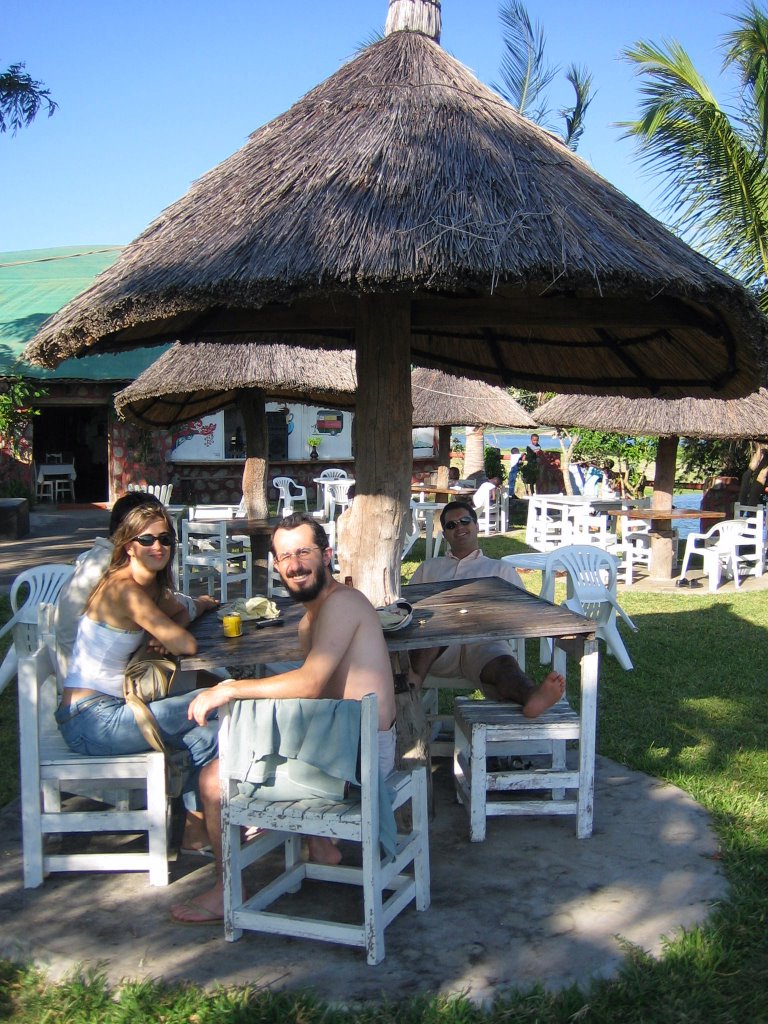 Here we are in the shade of a kiosk at a lodge on the lake called Casa Messica. In the foreground you can see Gemelli and Patricia, BL is hidden behind her, and Ricardo is in the back with his feet propped up.
 This is the view from the Casa Messica. The blue lake with the granite hills covered in forest really remind me of Rio de Janeiro, if you can imagine Rio's Lagoa Rodrigo de Freitas before it became polluted and surrounded by apartment buildings.
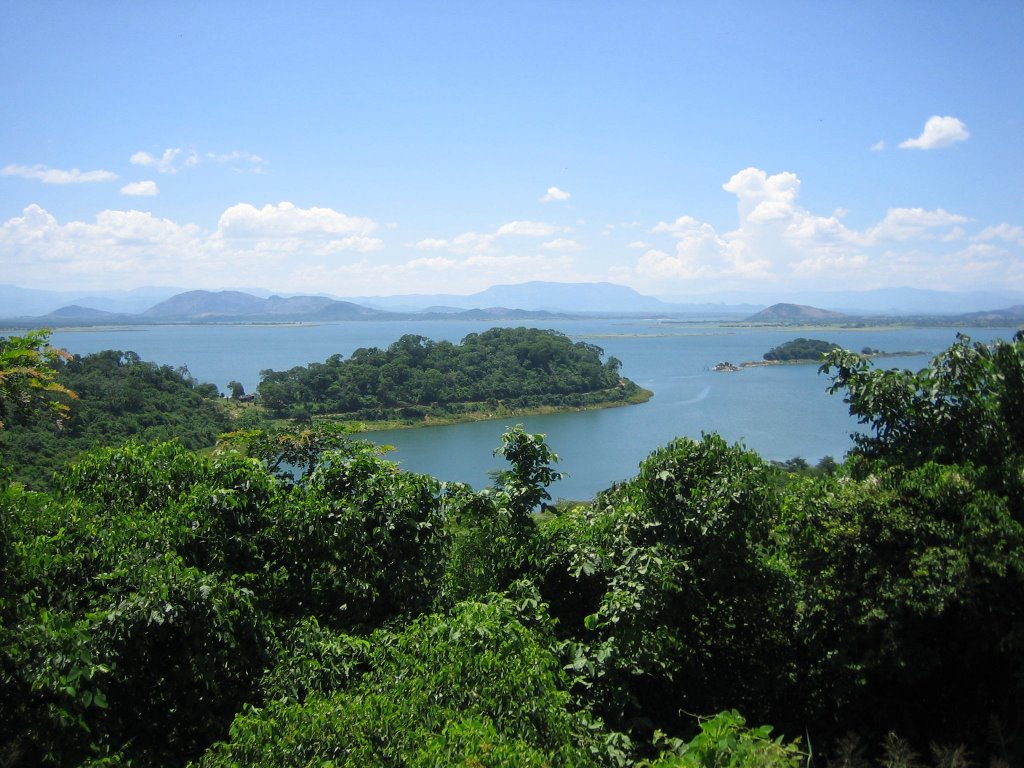 Here is a view from the dirt road that leads to the kiosk where we had lunch. Chicamba Dam is such a nice spot for a day trip, I wish we were able to go more often.
Update: here is a photo I took on our holiday trip to Rio of the Lagoa. It is taken from a road called Paineiras that links Santa Teresa to the Alto da Boa Vista and Barra da Tijuca by way of the Tijuca national forest. I think the Lagoa and Chicamba are quite similar, especially when you think about what Rio must have looked like when the Portuguese arrived...

Monday, January 30, 2006
Good Morning!
Rico and I have now been sleeping on the floor for 4 nights. We made a little nest out of all the blankets and towels that were in our drawer, plus my yoga mat underneath the whole thing. I am still adjusting to sleeping on the floor, the hardest part being that my hands seem to fall asleep multiple times each night, but overall I must say that my back feels much better. We are on a mission this week to get a new mattress.
Likely, this will involve a trip to Beira in the big white Land Cruiser that we occasionally borrow from our friend Canas. We also need to buy desks and chairs so that we can finally start working from the big colonial house that Agrolink has been renting as an office since July. We share the office with our housemate Patricia, who is Chimoio's best and busiest accountant, so the space isn't totally unoccupied. I must confess I am really looking forward to being able to work from an office that is separate from my home life. Between that an a new mattress, my quality of life seems set to drastically improve in the next week or so.
Yesterday, my housemates and I decided to get out of the house and go for a drive to Chicamba Dam, a beautiful river/lake about 30 mintues from Chimoio. It was well worth the effort. I hadn't been out of the house in 5 days (think about that for a minute. Five days without setting foot in the grocery store, the post office...nothing!) and was starting to become really irritated and depressed from the monotony of life in a small town where your only real responsibilities never take you outside the house.
So Chicamba was really beautiful. Bright blue water, some canyon-like cliffs and hills all covered in semi-tropical forests, with occasional boulders and sheer walls of granite poking out through all the green. We ate lunch at a lakeside kiosk. We all had fish from the lake (tilapia, I think), and I finally tried xima, the ubiquitous corn mush that is a staple in most southern African countries. It is also known as sadsa in Malawi, or pap in South Africa. It is basically a big, thick mound of a cream of wheat-type porridge that is cooked with no salt. I had mine with a tomato sauce and peri-peri, the local blend of peppers and oil that Mozambicans so love, smothered all over the top. It was actually quite good.
Unfortuately, today is back to business as usual. For me that means being at home all day and working on the final details of the timber proposal. Right now, I'm going to make a cup of tea. That's about all I can handle at this point...I'm still very, very sleepy!
Likely, this will involve a trip to Beira in the big white Land Cruiser that we occasionally borrow from our friend Canas. We also need to buy desks and chairs so that we can finally start working from the big colonial house that Agrolink has been renting as an office since July. We share the office with our housemate Patricia, who is Chimoio's best and busiest accountant, so the space isn't totally unoccupied. I must confess I am really looking forward to being able to work from an office that is separate from my home life. Between that an a new mattress, my quality of life seems set to drastically improve in the next week or so.
Yesterday, my housemates and I decided to get out of the house and go for a drive to Chicamba Dam, a beautiful river/lake about 30 mintues from Chimoio. It was well worth the effort. I hadn't been out of the house in 5 days (think about that for a minute. Five days without setting foot in the grocery store, the post office...nothing!) and was starting to become really irritated and depressed from the monotony of life in a small town where your only real responsibilities never take you outside the house.
So Chicamba was really beautiful. Bright blue water, some canyon-like cliffs and hills all covered in semi-tropical forests, with occasional boulders and sheer walls of granite poking out through all the green. We ate lunch at a lakeside kiosk. We all had fish from the lake (tilapia, I think), and I finally tried xima, the ubiquitous corn mush that is a staple in most southern African countries. It is also known as sadsa in Malawi, or pap in South Africa. It is basically a big, thick mound of a cream of wheat-type porridge that is cooked with no salt. I had mine with a tomato sauce and peri-peri, the local blend of peppers and oil that Mozambicans so love, smothered all over the top. It was actually quite good.
Unfortuately, today is back to business as usual. For me that means being at home all day and working on the final details of the timber proposal. Right now, I'm going to make a cup of tea. That's about all I can handle at this point...I'm still very, very sleepy!
Subscribe to:
Posts (Atom)