I saw a documentary the other day on SABC Africa, the South African broadcasting channel that is distributed throughout the continent on cable tv, about a British man that traveled to Kenya to get a taste of the country. When he arrived in Nairobi, he asked his taxi driver to take him to see some of the local culture. The driver dropped him off at a five star hotel where every night there was a buffet dinner with gazelle and antelope meat roasted on skewers, and a dance and drums show called Black Jambo. The dancers and musicians were quite talented - fabulous really - and the meat was exotic. Exactly as planned for the 100% white, affluent crowd. The tab came out to over $150 dollars. The british host of the program was somewhat disgusted and felt like just another white tool in the machine wanting a taste of Authentic Africa.
The next day he asked the cab driver to take him to see something more realistic. The driver took him to his own neighborhood, the shantytown where he had grown up and where, coincidentally, all the members of the Black Jambo dance and drum troupe lived as well. The dancers had established an informal charitable foundation and were teaching local kids how to juggle, do handsprings, play the drums, and so forth. The British host spent a day with everyone in the shantytown, feeling finally a taste of what he perceived to be Authentic Africa, and at the end of it all coming down with a big case of GUILT for being white, priviledged, etc.
The following scene in the documentary was an interview with the host of the program and a man originally from the US but who had been in Kenya since he was 5 years old. The American man had founded a giraffe sanctuary and had dedicated his life to caring for and raising awareness about the gentle animals. The host of the program asked him some questions about being white in Africa, about how he felt about his position in life seeing that he was surrounded by slums and children begging on the streets.
The giraffe man responded with an answer that really intrigued me -
The richest people in Africa, by far, are black Africans. They have the real power on the continent and enjoy wealth and luxury far beyond what the western world imagines.
Indians come after the black Africans in terms of affluence, benefiting from years as the dominant players in commerce and trade, entrepreneurial to the bone and sound financial investors in many areas.
Next come the Europeans and whites in general. Perhaps because they are a minority, their wealth is more noticeable...
Then came the statement I wish more people would understand -
All the whites in Africa are well off comparitively speaking. There are no poor Europeans on the continent. And although the blacks represent the few individuals that control the wealth and power in African society, they also represent the most destitute, hopeless majority that inhabit the urban streets and rural expanses of the continent.
Race relations in Africa has been on my mind a lot these days...Lots of paradigms being broken, admitting to myself that I bought into several stereotypes along with the rest of the world...
We have a client that is a very wealthy, white South African and one of the most staunch supporters of black economic and social empowerment that I have encontered here...
Another client is a European that, despite his cultured background and world-class education, is one of the most closed-minded bigots I´ve ever encountered...
Yet another example is an associate of ours in Chimoio that is Mozambican, born of a white Portuguese father and a black African mother. He is the worst discriminator of the lot, calling his darker compatriots uncivilized fools, convinced that because of his mixed blood he is somehow better...
This kind of attitude turns my stomach but, at the same time, I can´t help but feel sorry for our mestizo Mozambican friend or the racist Italian...
Human beings are truly pitiful, in every sense of the word.

Wednesday, November 30, 2005


Tuesday, November 22, 2005
Back in the Land of Diet Coke and Traffic
Not to mention being back in a place where, contrary to Chimoio, four goats on a sidewalk is stranger than a Mercedes in the street. From the internet cafe with a high speed connection, I can see four restaurants out the window - Japanese, Portuguese, Macao-ian (what is the adjective for something from Macao?), and Pakistani. This morning Rico and I had a croissant, cappucino, and fresh pineapple juice for breakfast at a lovely little open-air cafe. There are tons of people in the streets - black, white, brown, and every mix inbetween - all speaking different languages with different accents.
I´ll say it again - I LOVE MAPUTO!!
Ricardo and I arrived last night and will be in the big city for another 10 days. Since I finally formalized a work contract with Agrolink, I am now an official member of the team with a permanent position (not just a consultant), so I will be helping put together all of the projects the company is working on. Rico and I are here mainly to work on a timber\reforestation project and with a client that wants to expand his banana plantation and export out of Mozambique. We had a meeting this morning with the banan client and I was reminded yet again of how much happier I am when I have responsibilities, a schedule, and am forced to be accountable for the timely and quality delivery of my work.
The plan for this afternoon is to do some editing on a business plan Rico has put together, then hopefully pay a 4 dollar fee to use the lovely pool at the Hotel Cardoso just next to the flat we are staying in. The weather is hot and sunny, and I am in desperate need of some color on my body. In my current state, after 6 months of being cooped up our house in Chimoio, I am scarily white!
I´ll say it again - I LOVE MAPUTO!!
Ricardo and I arrived last night and will be in the big city for another 10 days. Since I finally formalized a work contract with Agrolink, I am now an official member of the team with a permanent position (not just a consultant), so I will be helping put together all of the projects the company is working on. Rico and I are here mainly to work on a timber\reforestation project and with a client that wants to expand his banana plantation and export out of Mozambique. We had a meeting this morning with the banan client and I was reminded yet again of how much happier I am when I have responsibilities, a schedule, and am forced to be accountable for the timely and quality delivery of my work.
The plan for this afternoon is to do some editing on a business plan Rico has put together, then hopefully pay a 4 dollar fee to use the lovely pool at the Hotel Cardoso just next to the flat we are staying in. The weather is hot and sunny, and I am in desperate need of some color on my body. In my current state, after 6 months of being cooped up our house in Chimoio, I am scarily white!
Monday, November 21, 2005
Feels Like Seven Again
Today I almost peed on the couch in the living room. I'm not kidding. I woke up with my bladder about to burst and ran to the bathroom. But, of course, one of my housemates was using the toilet. I banged on the door and pleaded with him to finish quickly. Unfortuately, though, he had just sat down to take care of some intestinal difficulties. (We got a huge box last week of beautiful yellow mangoes from a friend's plantation...suffice to say that some of us exaggerated how many mangoes we ate and later paid the price.) So unable to get into the bathroom, I sat on the couch next to Ricardo, crossed my legs, and tried to distract myself. But the situation was urgent. I could feel my bladder giving out and sat desperately deciding what to do. I couldn't run outside to pee because the yard was full of workmen and dogs. I considered getting a pot from the kitchen, but was too embarrassed to act on that thought. I sat and wiggled and felt like I was seven years old again, laughing too hard during recess and realizing that I was about to pee in front of my friends on the playground.
Blessedly, my housemate finished up his business quickly and I raced into the bathroom, oblivious to the smell left behind, making it to the toilet just in time to pee and pee and pee.
Ninguém merece isso. I hate sharing a bathroom with five other people. Thank God Ricardo and I are going to Maputo later on this afternoon...10 full days with a clean, always-available loo.
Blessedly, my housemate finished up his business quickly and I raced into the bathroom, oblivious to the smell left behind, making it to the toilet just in time to pee and pee and pee.
Ninguém merece isso. I hate sharing a bathroom with five other people. Thank God Ricardo and I are going to Maputo later on this afternoon...10 full days with a clean, always-available loo.
Sunday, November 20, 2005
Last Day of Chimoio (for a while, at least)
So I ended up not contacting any of my potential new friends... It was blisteringly hot yesterday, and I settled in front of the fan around noon and didn't really move much after that until bedtime. My body hurts from being so sedentary, but it's a horrible cycle - the more bored you are and the less options for leisure that you have, the lazier you get. I have, without a doubt, never been this lazy in my entire life. It's a bit embarrassing, really, if I sit and honestly thing about how many opportunities and activites I pass up to remain sitting in front of the fan watching our new cable TV.
In addition to my laziness, I decided that it would be best to contact everyone once I actually have a more consistent schedule. Ricardo and I are going to be on the road pretty much the entire time for the next month. Tomorrow we are going to Maputo for 10 days to work with a banana client. Then we will fly to Tete, the hot province I was talking about in an earlier post, and from there rent a car and go to Blantyre, Malawi. One of our associates is working on a microcredit and HIV/AIDS project there and we are going to work with him as consultants for about a week. Then we come back to Chimoio for a few days and in the middle of December will go to Maputo once again to catch a flight to Johannesburg and then São Paulo. So basically I have only about a week left of time to hang out in Chimoio, so I decided to put off being social until after the new year.
I can't wait to travel tomorrow. I've decided that I can successfully take Chimoio in one-month doses before the boredom, heat, and community living make me DEPRESSED!
In addition to my laziness, I decided that it would be best to contact everyone once I actually have a more consistent schedule. Ricardo and I are going to be on the road pretty much the entire time for the next month. Tomorrow we are going to Maputo for 10 days to work with a banana client. Then we will fly to Tete, the hot province I was talking about in an earlier post, and from there rent a car and go to Blantyre, Malawi. One of our associates is working on a microcredit and HIV/AIDS project there and we are going to work with him as consultants for about a week. Then we come back to Chimoio for a few days and in the middle of December will go to Maputo once again to catch a flight to Johannesburg and then São Paulo. So basically I have only about a week left of time to hang out in Chimoio, so I decided to put off being social until after the new year.
I can't wait to travel tomorrow. I've decided that I can successfully take Chimoio in one-month doses before the boredom, heat, and community living make me DEPRESSED!
Saturday, November 19, 2005

The White Party
Last night we went to a party at the house of one of Agrolink’s shareholders. Supposedly, the party was to celebrate this person’s departure from his current job with a tobacco company where he has worked for several years. Really, though, it was just an excuse to gather what could be considered the socialites of Chimoio for a little see-and-be-seen. All of the guests had to wear white (I wondered all night whether the theme was imitating New Year’s in Brazil or P. Diddy’s annual party in the Hamptons) and, coincidentally, most of the guests were also…white. To be fair, there were several black Mozambicans at the party as well, but I was shocked to see how many young, white people came out of the woodwork for a get-together where they didn’t even really know the host. I think everyone here is simply hungry for new friends, stimulating conversation, something – anything – to take away the monotony of life in Chimoio.
I have been here for six months and I can’t say that I have made any new friends outside my household. Living with five friends is a mixed blessing. On the one hand, it was great to land in a town in rural Africa and already have a support structure in place. I have built-in entertainment with a group of people that I know and trust. Given the absolute lack of things to do in Chimoio, we have little motivation to leave home. Why bother, when you already have a group of drinking buddies, DVDs to watch, music to dance to, and shit to talk? The problem is, my built-in social group has severely limited my forays into the outside world here. Other than a handful of Mozambican work associates, I literally don’t know anybody other than my housemates. I don’t call anybody on the phone. I have nobody to invite for a coffee and a chat.
Last night I realized just how nice it is to talk with people outside my housemates that have interesting stories to tell and could potentially become friends. I ended up meeting a group of people around my age that are here in Chimoio from different parts of the world, each brought here by a different, sequally compelling motive. A girl from Seattle who has great spiky, short blonde hair, suggested that we all invent three different scenarios that had brought us to Chimoio for the others in the group to decide which version was true. It was a fun game, and I turned out to be surprisingly good at it. In fact, I was the only person in the group that successfully guessed everyone’s true occupation on the first try. I correctly guessed that in my company there was a guy from Mississippi studying community water-use rights in a village near here, a girl from San Francisco who is here as a Peace Corps volunteer and works in an HIV/AIDS program with a local NGO, and a guy from South Africa that works with a commercial de-mining company. I stumped everyone with my three scenarios except the water rights researcher. They all already knew each other, and we were mutually shocked that in my time here I had never met them. It made me realize just how isolated I have been thanks to my work and my living situation.
We hung out for a while, getting to know each other a bit better, then Ricardo and I decided to head home. Poor Rico is still not fully recovered from his Hepatits A, and can’t drink any alcohol. So at parties, he drinks as much Sprite as he can stomach, then hangs out with the rest of our tipsy group until his patience runs thin. We said our goodbyes, then drove off the farm and back to the big city to watch some TV and eat fresh mangoes before hitting the sack.
I have been deliberating all day as to whether or not I should make an effort to find my new friends today and invite them for a beer of something… I’m pretty sure I will. The excitement at the possibility of having a great group of friends here – as has happened to me just about everywhere else I’ve lived – is fabulous.
Ah – I nearly forgot the coolest part of the evening. On the way out to the party, which was in a beautiful house on a farm some 15km outside Chimoio – we had to cross the railroad tracks that run along the so-called Beira Corridor (the route that connects landlocked Zimbabwe with the busy port of Beira). We were in the ’92 Land Cruiser that a friend periodically lends us, and the back of the vehicle, that had been converted to hold several people and a stretcher when in the service of the Mozambican Red Cross, was packed full of housemates and crates of beer. When we approached the railroad crossing, I noticed a man running back and forth along the length of tracks near the road holding an old, reflective lantern with a red light inside. He swung the lantern wildly, creating the effect of a flashing red light. On the opposite side of the tracks, the man had already lowered an old wooden barrier to prevent cars from entering the crossing. On our side, however, there was no barrier and the dark man with the lantern was our only warning not to go onto the tracks. Rico stopped the car and we looked to the right just in time to see a huge white headlight on the front of an old, rusted train, bearing down towards us at breakneck speed.
It was an incredible experience, one of the few since I have arrived in Africa that have totally broken my sense of time and place. Watching the old train whiz past, precariously rattling in its squeaky tracks, with no other cars or lights around, I closed my eyes and felt the wind, perfumed by a recent monsoon rain, swept over my face. This place is indescribable, completely caught between the perils and blessings of modernization, left behind, disputed, impoverished, and yet wiser in many ways than we will ever be.
I have been here for six months and I can’t say that I have made any new friends outside my household. Living with five friends is a mixed blessing. On the one hand, it was great to land in a town in rural Africa and already have a support structure in place. I have built-in entertainment with a group of people that I know and trust. Given the absolute lack of things to do in Chimoio, we have little motivation to leave home. Why bother, when you already have a group of drinking buddies, DVDs to watch, music to dance to, and shit to talk? The problem is, my built-in social group has severely limited my forays into the outside world here. Other than a handful of Mozambican work associates, I literally don’t know anybody other than my housemates. I don’t call anybody on the phone. I have nobody to invite for a coffee and a chat.
Last night I realized just how nice it is to talk with people outside my housemates that have interesting stories to tell and could potentially become friends. I ended up meeting a group of people around my age that are here in Chimoio from different parts of the world, each brought here by a different, sequally compelling motive. A girl from Seattle who has great spiky, short blonde hair, suggested that we all invent three different scenarios that had brought us to Chimoio for the others in the group to decide which version was true. It was a fun game, and I turned out to be surprisingly good at it. In fact, I was the only person in the group that successfully guessed everyone’s true occupation on the first try. I correctly guessed that in my company there was a guy from Mississippi studying community water-use rights in a village near here, a girl from San Francisco who is here as a Peace Corps volunteer and works in an HIV/AIDS program with a local NGO, and a guy from South Africa that works with a commercial de-mining company. I stumped everyone with my three scenarios except the water rights researcher. They all already knew each other, and we were mutually shocked that in my time here I had never met them. It made me realize just how isolated I have been thanks to my work and my living situation.
We hung out for a while, getting to know each other a bit better, then Ricardo and I decided to head home. Poor Rico is still not fully recovered from his Hepatits A, and can’t drink any alcohol. So at parties, he drinks as much Sprite as he can stomach, then hangs out with the rest of our tipsy group until his patience runs thin. We said our goodbyes, then drove off the farm and back to the big city to watch some TV and eat fresh mangoes before hitting the sack.
I have been deliberating all day as to whether or not I should make an effort to find my new friends today and invite them for a beer of something… I’m pretty sure I will. The excitement at the possibility of having a great group of friends here – as has happened to me just about everywhere else I’ve lived – is fabulous.
Ah – I nearly forgot the coolest part of the evening. On the way out to the party, which was in a beautiful house on a farm some 15km outside Chimoio – we had to cross the railroad tracks that run along the so-called Beira Corridor (the route that connects landlocked Zimbabwe with the busy port of Beira). We were in the ’92 Land Cruiser that a friend periodically lends us, and the back of the vehicle, that had been converted to hold several people and a stretcher when in the service of the Mozambican Red Cross, was packed full of housemates and crates of beer. When we approached the railroad crossing, I noticed a man running back and forth along the length of tracks near the road holding an old, reflective lantern with a red light inside. He swung the lantern wildly, creating the effect of a flashing red light. On the opposite side of the tracks, the man had already lowered an old wooden barrier to prevent cars from entering the crossing. On our side, however, there was no barrier and the dark man with the lantern was our only warning not to go onto the tracks. Rico stopped the car and we looked to the right just in time to see a huge white headlight on the front of an old, rusted train, bearing down towards us at breakneck speed.
It was an incredible experience, one of the few since I have arrived in Africa that have totally broken my sense of time and place. Watching the old train whiz past, precariously rattling in its squeaky tracks, with no other cars or lights around, I closed my eyes and felt the wind, perfumed by a recent monsoon rain, swept over my face. This place is indescribable, completely caught between the perils and blessings of modernization, left behind, disputed, impoverished, and yet wiser in many ways than we will ever be.
Wednesday, November 16, 2005
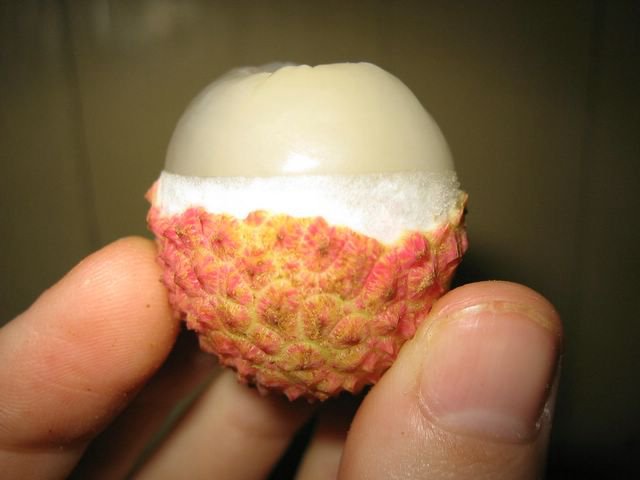
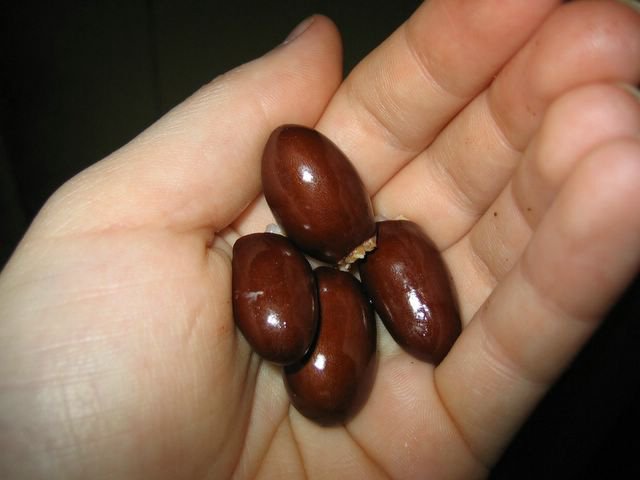
Litchis
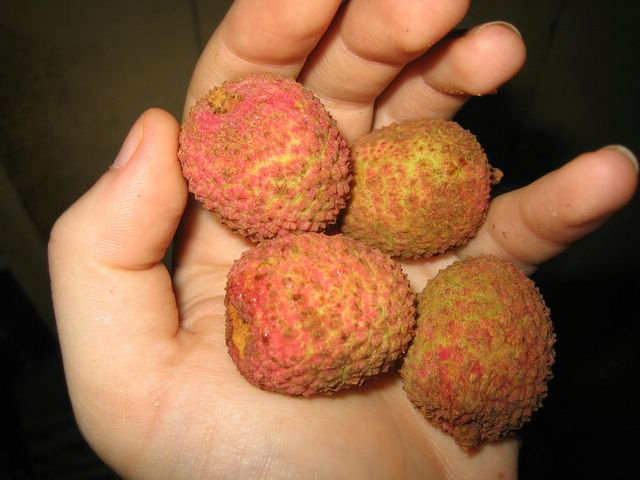
November is litchi season in Chimoio, and for a limited number of weeks these exotic fruits can be found in local markets. A bag full of 30 or so litchis costs under a dollar.
Monday, November 14, 2005
The Joys of Communal Living
Today has been a day of grossness. The first offense came early in the day when I went to take a shower and found two used Q-tips discarded on top of the stack of clean towels in the bathroom. I sat and debated for quite a while whether or not I should obey my initial instinct of common hygiene and throw the waxy swabs in the trash. In the end, my resentment towards my sloppy housemates won out and I decided to leave the Q-tips exactly where I’d found them, most likely for Dona Margarida the maid to pick up later in the afternoon.
After my shower I went to the kitchen to prepare lunch. I decided to make a pasta salad with tuna, celery, and spring onions with fresh-baked rolls on the side. I chopped all the vegetables, mixed and rolled out some dough, and boiled water for the pasta. I was excited about using a new, seemingly superior brand of pasta that showed up at Shoprite the other day – Moni’s & Fatti’s, imported from South Africa, with nice-looking packaging and recipe suggestions on the back. My anticipation quickly turned to disgust when I opened a new bag of pasta, dumped it in the boiling water, and watched dozens of small brown weevils float to the top of the pot. At first I thought the dark specks in the water might be stray pieces of oregano, but upon closer inspection they were definitely insects. Disgusting, dried-up bugs polluting my lunch plans. My stomach flip-flopped and I cursed Shoprite and whoever Moni & Fatti are for a complete lack of quality control. I ended up giving the contaminated pasta to the dogs and boiled a fresh pot of water for another try at a bug-free meal.
The true cherry on the sundae of nastiness came this evening when my housemates came home from their respective jobs (Ricardo and I are still working from home, thus my excess of domestic tasks as of late). One of my housemates, who shall remain nameless, walked in carrying a take-away styrofoam box from “Elo 4”, one of the two local restaurants here in Chimoio. My housemate, obviously quite excited about his food, announced to us that he’d purchased a Big Elo (pronounced, of course, Bigg-ie Elo), a monster of a sandwich that is composed of ham, cheese, a hamburger patty, and a fried egg all wedged in a white bun with fries on the side. Box in hand, this person sauntered into the bathroom proudly letting us know that he was going to take a cagadinha, a little shit. The rest of us, not quite believing that our otherwise sane housemate was going to enjoy his sandwich while taking a poo, looked at each other in shock. About 20 minutes later, we heard a flush and our friend in question emerged from the bathroom, nearly empty take-away box in hand, polishing off the last of his French fries and licking his fingers as if it were the most normal thing in the world.
Days like this remind me what a joy it is to live with 5 other people in the cú do mundo na África.
After my shower I went to the kitchen to prepare lunch. I decided to make a pasta salad with tuna, celery, and spring onions with fresh-baked rolls on the side. I chopped all the vegetables, mixed and rolled out some dough, and boiled water for the pasta. I was excited about using a new, seemingly superior brand of pasta that showed up at Shoprite the other day – Moni’s & Fatti’s, imported from South Africa, with nice-looking packaging and recipe suggestions on the back. My anticipation quickly turned to disgust when I opened a new bag of pasta, dumped it in the boiling water, and watched dozens of small brown weevils float to the top of the pot. At first I thought the dark specks in the water might be stray pieces of oregano, but upon closer inspection they were definitely insects. Disgusting, dried-up bugs polluting my lunch plans. My stomach flip-flopped and I cursed Shoprite and whoever Moni & Fatti are for a complete lack of quality control. I ended up giving the contaminated pasta to the dogs and boiled a fresh pot of water for another try at a bug-free meal.
The true cherry on the sundae of nastiness came this evening when my housemates came home from their respective jobs (Ricardo and I are still working from home, thus my excess of domestic tasks as of late). One of my housemates, who shall remain nameless, walked in carrying a take-away styrofoam box from “Elo 4”, one of the two local restaurants here in Chimoio. My housemate, obviously quite excited about his food, announced to us that he’d purchased a Big Elo (pronounced, of course, Bigg-ie Elo), a monster of a sandwich that is composed of ham, cheese, a hamburger patty, and a fried egg all wedged in a white bun with fries on the side. Box in hand, this person sauntered into the bathroom proudly letting us know that he was going to take a cagadinha, a little shit. The rest of us, not quite believing that our otherwise sane housemate was going to enjoy his sandwich while taking a poo, looked at each other in shock. About 20 minutes later, we heard a flush and our friend in question emerged from the bathroom, nearly empty take-away box in hand, polishing off the last of his French fries and licking his fingers as if it were the most normal thing in the world.
Days like this remind me what a joy it is to live with 5 other people in the cú do mundo na África.
Friday, November 11, 2005
Let there be Tea
Yesterday we got the big news. I was in the kitchen making a chocolate pound cake in our new oven (!) when Ricardo got a call from our contact at the EVD, the International Business and Cooperation Agency of the Dutch Government. I was so nervous I couldn’t bear to eavesdrop on the conversation, so I headed out to the backyard to distract myself until the call was over.
Five minutes passed. Then ten. Then fifteen. Why was it taking so long? My initial reaction was that a lengthy conversation was a good sign. After all, if the proposal had been rejected there wouldn’t be much to talk about. Or would there? Maybe the guy from the EVD was explaining to Ricardo exactly why the project hadn’t passed the external committee evaluation. Then again, maybe he was explaining what the next steps would be now that the project had been approved…I tried to prepare myself for either scenario, repeating in my head that what was meant to be would be, that I couldn’t afford to be depressed if it was rejected, not to be cocky if it was approved, etc., etc., etc.
After what seemed like an eternity, Ricardo hung up the phone and ran outside.
“Parabéns!!!!” Congratulations!!! He picked me up and swung me around in circles. “The proposal was approved!
I was so excited. All the hard work I had done in July while Ricardo was in Brazil had paid off. The hours of research and revision, the trips to Zimbabwe to meet with our project partner, the sleepless nights worrying that I wouldn’t get it all done in time – it was all worth it.
After dancing around the living room in celebration, Ricardo and I each set off to make a series of phone calls to notify the other shareholders in the project about the good news. I also called my mom, who whooped with joy and sent congratulatory hugs and kisses to all of us who had worked so hard to make this happen.
Then a strange thing happened. About an hour after the phone call from EVD, I became noticeably depressed. I didn’t want to drink the beer my housemates had brought from Shoprite to celebrate. I wasn’t interested in the movie we had all sat down to watch. I thought back about the afternoon’s phone calls, the excitement, the feeling of success – it all felt so far away.
I excused myself and went to the bathroom, the only place I could be alone and pensive without anybody worrying or coming to join me. I sat on the edge of the bathtub and rested my elbows on my knees, trying to figure out what was wrong.
I was irritated with BL, who earlier in the day had failed to properly screw on the lid of the pickle jar, almost causing me to drop the damn thing when I went to put it back in the refrigerator. How many times had I told him to put the lid on things? How much food had he managed to spoil by lazily leaving it out of the fridge? Does nobody listen to me in this household?? I was annoyed, but BL’s sloppy habits weren’t enough to spoil the good news about the proposal. I kept thinking…
I felt frustrated with myself for having blown off my exercise routine, making excuses instead that I was busy with work, had eaten too recently to get on the treadmill, or that it was a day for celebration and relaxation. But that wasn’t it either…
I should be excited, I told myself. It was because of my proposal that the EVD approved a project worth US$ 1 million and agreed to give us a US$ 600,000 grant to cover part of our costs for the first 2 years of operation. Because of our project, a tea processing factory will be established in an impoverished region of Mozambique. Jobs will be created for construction workers, factory managers, mechanics, and line workers, not to mention some 1,000 family-sector tea farmers that will receive technical assistance and sell their leaves to the factory for a fair wage. We will obtain FairTrade certification for the factory and its growers, promoting sustainable development in the agricultural sector. Mozambique will once again be in a position to be competitive in the international tea market (prior to the country’s civil war, it was Africa’s 3rd largest tea producer after Kenya and Malawi).
Our project will provide hope for a secure future for our Zimbabwean partner, Buzi Tea, a family-run tea plantation and processing plant that is at risk for expropriation under President Mugabe’s controversial land reform policies. And it will set the stage for me, Ricardo, BL, and our other partners to become successful investors in Mozambique, a concrete example that the private sector, when properly managed, can be a socially responsible answer to the woes of the developing world.
Then it hit me…The seriousness of it all, the real potential that this project has to change lives – ours as investors and consultants, our Zimbabwean partner’s, those of the destitute tea farmers in the highlands – that was the cause of my sombre mood.
The real work is only about to begin, and I feel a tremendous responsibility to make this project a success.
Five minutes passed. Then ten. Then fifteen. Why was it taking so long? My initial reaction was that a lengthy conversation was a good sign. After all, if the proposal had been rejected there wouldn’t be much to talk about. Or would there? Maybe the guy from the EVD was explaining to Ricardo exactly why the project hadn’t passed the external committee evaluation. Then again, maybe he was explaining what the next steps would be now that the project had been approved…I tried to prepare myself for either scenario, repeating in my head that what was meant to be would be, that I couldn’t afford to be depressed if it was rejected, not to be cocky if it was approved, etc., etc., etc.
After what seemed like an eternity, Ricardo hung up the phone and ran outside.
“Parabéns!!!!” Congratulations!!! He picked me up and swung me around in circles. “The proposal was approved!
I was so excited. All the hard work I had done in July while Ricardo was in Brazil had paid off. The hours of research and revision, the trips to Zimbabwe to meet with our project partner, the sleepless nights worrying that I wouldn’t get it all done in time – it was all worth it.
After dancing around the living room in celebration, Ricardo and I each set off to make a series of phone calls to notify the other shareholders in the project about the good news. I also called my mom, who whooped with joy and sent congratulatory hugs and kisses to all of us who had worked so hard to make this happen.
Then a strange thing happened. About an hour after the phone call from EVD, I became noticeably depressed. I didn’t want to drink the beer my housemates had brought from Shoprite to celebrate. I wasn’t interested in the movie we had all sat down to watch. I thought back about the afternoon’s phone calls, the excitement, the feeling of success – it all felt so far away.
I excused myself and went to the bathroom, the only place I could be alone and pensive without anybody worrying or coming to join me. I sat on the edge of the bathtub and rested my elbows on my knees, trying to figure out what was wrong.
I was irritated with BL, who earlier in the day had failed to properly screw on the lid of the pickle jar, almost causing me to drop the damn thing when I went to put it back in the refrigerator. How many times had I told him to put the lid on things? How much food had he managed to spoil by lazily leaving it out of the fridge? Does nobody listen to me in this household?? I was annoyed, but BL’s sloppy habits weren’t enough to spoil the good news about the proposal. I kept thinking…
I felt frustrated with myself for having blown off my exercise routine, making excuses instead that I was busy with work, had eaten too recently to get on the treadmill, or that it was a day for celebration and relaxation. But that wasn’t it either…
I should be excited, I told myself. It was because of my proposal that the EVD approved a project worth US$ 1 million and agreed to give us a US$ 600,000 grant to cover part of our costs for the first 2 years of operation. Because of our project, a tea processing factory will be established in an impoverished region of Mozambique. Jobs will be created for construction workers, factory managers, mechanics, and line workers, not to mention some 1,000 family-sector tea farmers that will receive technical assistance and sell their leaves to the factory for a fair wage. We will obtain FairTrade certification for the factory and its growers, promoting sustainable development in the agricultural sector. Mozambique will once again be in a position to be competitive in the international tea market (prior to the country’s civil war, it was Africa’s 3rd largest tea producer after Kenya and Malawi).
Our project will provide hope for a secure future for our Zimbabwean partner, Buzi Tea, a family-run tea plantation and processing plant that is at risk for expropriation under President Mugabe’s controversial land reform policies. And it will set the stage for me, Ricardo, BL, and our other partners to become successful investors in Mozambique, a concrete example that the private sector, when properly managed, can be a socially responsible answer to the woes of the developing world.
Then it hit me…The seriousness of it all, the real potential that this project has to change lives – ours as investors and consultants, our Zimbabwean partner’s, those of the destitute tea farmers in the highlands – that was the cause of my sombre mood.
The real work is only about to begin, and I feel a tremendous responsibility to make this project a success.
Tuesday, November 08, 2005
All Eyes on Thursday
Keep your fingers crossed and good luck machines on for me. We will find out on Thursday whether the proposal I wrote for the tea processing project has been approved or not. We got a bit of promising news last week that the proposal passed an evaluation by an internal review committee in Holland; now we are waiting for the results from an external review committee that includes representatives from Mozambican and Zimbabwean officials as well as officers from the Dutch Embassy in Maputo. If the external committee gives the project a thumbs up, come January we would start construction of a factory in Mozambique and the formalization of an outgrower scheme to support family-sector tea farmers.
In other news, the weather has taken a merciful turn and provided Central Mozambique with cloudy skies, cooler temperatures, and constant rainshowers. It has been an unbelievably welcome change from the past week where temperatures soared past 100F (40C) every day. In Tete, the capital of our neighboring province to the north, it got up to about 115F (45C)! Tete is regularly cited as the hottest city in the world on those maps that show ridiculously high and low temperatures that make you pity the poor suckers in Siberia or Chad (or, as the case may be, Mozambique).
Today I am happier than usual for two reasons:
1. I finally got my ass off the couch and hopped on the treadmill for a 45-minute walk. I also got out the green yoga mat I took such pains to stuff in my suitcase when I moved here and did 100 sit-ups. Hopefully, this will be the beginning of a month-long trend leading up to my trip to Rio, land of the bikini-clad gorgeous, in December.
2. I ate fresh coconut for the first time since I was about 10. My mom and I used to buy the brown, dried coconuts at the supermarket in Albuquerque and, with the help of an ice pick and a hammer, drain the milk and crack open the tough exterior to get to the white flesh inside. I love coconuts! Here in Mozambique (as well as in Brazil), it's common to see green coconuts that vendors will split open for you to drink the water inside. Água de coco is refreshing, balances your electrolytes, and is a fabulous cure for a hangover. I have green coconuts as often as possible. But it had been ages since I'd taken the time to hunt down a mature brown coconut, but there they were at Shoprite last week, right next to the giant cucumbers. Last night my housemates and I cracked open the brown shell by slamming the coconut on the countertop, then ate the sweet flesh right out of the shell. Yum!!! Definitely worth the time on the treadmill.
In other news, the weather has taken a merciful turn and provided Central Mozambique with cloudy skies, cooler temperatures, and constant rainshowers. It has been an unbelievably welcome change from the past week where temperatures soared past 100F (40C) every day. In Tete, the capital of our neighboring province to the north, it got up to about 115F (45C)! Tete is regularly cited as the hottest city in the world on those maps that show ridiculously high and low temperatures that make you pity the poor suckers in Siberia or Chad (or, as the case may be, Mozambique).
Today I am happier than usual for two reasons:
1. I finally got my ass off the couch and hopped on the treadmill for a 45-minute walk. I also got out the green yoga mat I took such pains to stuff in my suitcase when I moved here and did 100 sit-ups. Hopefully, this will be the beginning of a month-long trend leading up to my trip to Rio, land of the bikini-clad gorgeous, in December.
2. I ate fresh coconut for the first time since I was about 10. My mom and I used to buy the brown, dried coconuts at the supermarket in Albuquerque and, with the help of an ice pick and a hammer, drain the milk and crack open the tough exterior to get to the white flesh inside. I love coconuts! Here in Mozambique (as well as in Brazil), it's common to see green coconuts that vendors will split open for you to drink the water inside. Água de coco is refreshing, balances your electrolytes, and is a fabulous cure for a hangover. I have green coconuts as often as possible. But it had been ages since I'd taken the time to hunt down a mature brown coconut, but there they were at Shoprite last week, right next to the giant cucumbers. Last night my housemates and I cracked open the brown shell by slamming the coconut on the countertop, then ate the sweet flesh right out of the shell. Yum!!! Definitely worth the time on the treadmill.
Saturday, November 05, 2005
At Shoprite This Week - Giant Cucumbers
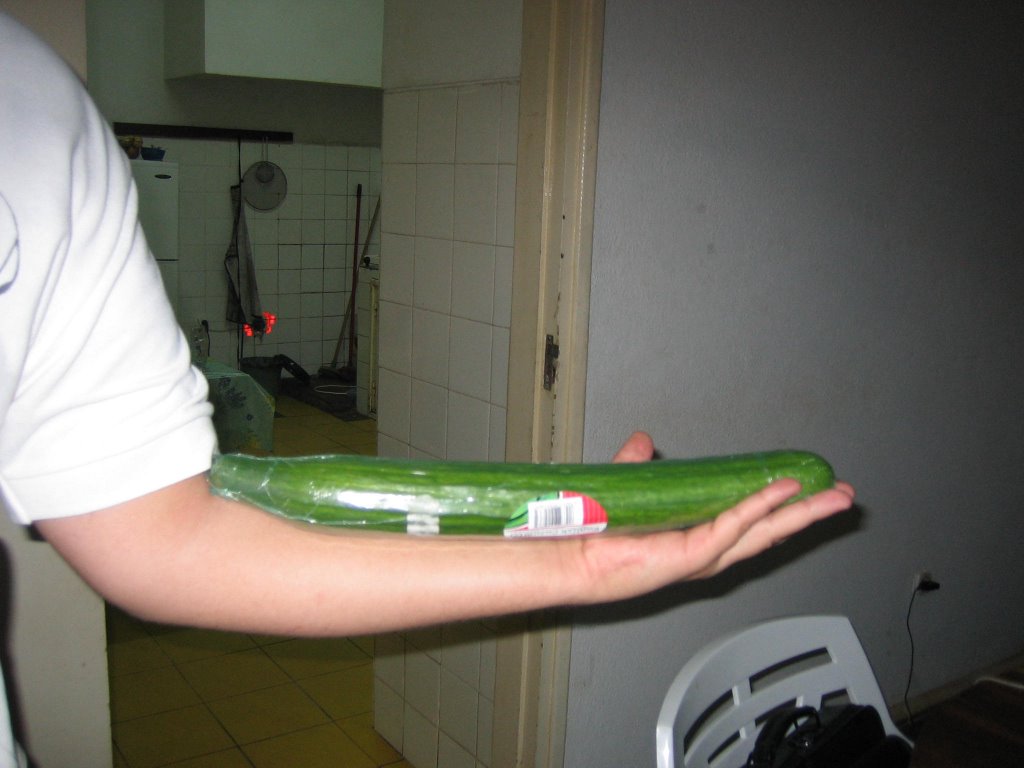
Yet another item for the list of things rumored to be bigger in Africa...
Friday, November 04, 2005
Purple and Dry for the Drips
Today has been a miserable, weezy day. I have a walloping case of allergies brought on, I am convinced, by the dust that reigns king in our house and leaves your feet a lovely reddish-brown if you forget to put on your chinelos while walking around. I seem to get an allergy attack about once a week here in Mozambique, the relentless sneezing and sniffling rendering me completely useless for at least 24 hours.
As if that weren’t enough, allergies make me hot. Not the kind of hot that would make the boys of Chimoio line up in front of our house for a glimpse of the goddess that lives behind the wall of bougainvillea and hibiscus. I mean temperature hot. The hundreds of unrealized sneezes and constant sinus pressure make my head throb and pulse rise. It’s almost the same feeling I get after a good half hour on the treadmill, only with no effort required beyond stuffing wads of toilet paper in my nostrils and occasionally going to the kitchen for a glass of water to wash down a pill or two. The only problem is that the pills bring no relief and, now that summer has hit central Mozambique with full humid force, I don’t even have the silver lining I enjoyed back in July that my allergies chase away the cold of winter.
So basically my day has consisted of sitting in front of the small fan in the living room wondering how on earth the body can produce so much mucus in such a short amount of time. Yesterday I was fine. Clear nose, non-itchy eyes, no pseudo-menopausal hot flashes. Tomorrow I will be fine again, as it goes week after week. But today…that’s another story altogether. I tried to translate a budget from Italian to English for this timber project Ricardo is putting together, but gave up after my nose dripped onto the mouse pad of my laptop. In the course of the afternoon, I managed to go through an entire roll of toilet paper!
Speaking of such things, nose-blowing became the cause for a fight amongst my housemates last week. I haven’t mentioned it yet on the blog, but we now have a 6th member in our domestic community, Rogério. Yet another one of the boys from the business school back in Rio, Rogério came to Chimoio about 2 weeks ago for a short-term volunteer assignment with ACDI/VOCA, a local organization that works with smallholder farmers’ associations (and where I did a brief stint as a volunteer during my first month here). Before coming to Mozambique, Rogério worked as an investment banker and lived with his parents in a flat in Leblon, one of Rio’s most upscale neighbourhoods. The culture shock that has come about after Rogério joining our modest household has been both amusing and supremely frustrating.
As I mentioned in an entry soon after arriving in Chimoio, one of the things sorely lacking here is the convenience of a well-stocked grocery store where you can find the same quality items week after week. Here we rely on Shoprite, a sad excuse for a supermarket where a good portion of the food is expired and you will almost never find the same selection of items from one shopping trip to the next. Shoprite can’t even be counted on for staple items like paper towels or ground beef or juice. So when something good appears, the strategy is to buy as much of it as possible and create a stockpile in our pantry, hoping that we won’t run out of whatever the item is until the next lot has been delivered to Chimoio.
The problem started when Rogério, a chronic, honking nose-blower, grabbed a handful of napkins on his way out the door to play basketball with some guys from ACDI/VOCA. Ricardo noticed the wad of napkins and yelled out after Rogério,
“Que porra é essa, cara? Você pegou metade do pacote de guardanapos!” What the hell, man? You took half the package of napkins!
Rogério, already past the porch, illustrated his intentions with a loud, snotty honk into one of the napkins. “I’m going to play basketball, bro. My nose runs when I get out of breath.”
“Porra, meu irmão, usa papel higiênico então!” Damnit, use toilet paper instead!
Rogério looked back at Ricardo as if he were crazy. “O que? Toilet paper? You’ve gotta be kidding. That stuff in the bathroom is like sandpaper. No way I’m going to make my nose raw with that shit.”
Granted, Rogério had a point. For the last month, the only toilet paper available at Shoprite has been this single-ply, perfumed, bright purple stuff, certainly a reject from the South African market. Whatever chemicals they use for scent and color have the unfortunate effect of drying out the toilet paper to the point that it feels like an industrial file on your tender parts.
Nonetheless, napkins are an especially scarce commodity at Shoprite and, in the total absence of Kleenex in Chimoio, we have all adapted to using toilet paper for blowing our noses – even if it is purple and rough. We all agree that chapped noses and bums are much less painful than the embarrassment of running out of napkins and having to provide guests with neatly folded triangles of purple toilet paper next to their dinner plates.
Not quite willing to believe that toilet paper was the only option, and suspecting that his friends were screwing with him like they often do, Rogério continued on with his stack of napkins to the basketball game. Two hours later he came back red-faced, sweaty, and wiping his nose with the back of his hand. I was sitting on the couch watching Mythbusters on our newly-fixed TV and, my attention totally fixed on the bridge about to be blown up by the scientists, barely registered Rogério walking past me. That is, until I heard the distinctive honk and snort of someone blowing their nose in the kitchen.
Blowing one’s nose in public is one of the major cultural taboos in Brazilian society. Unlike Americans – who generally feel right at home ridding themselves of snot in restaurants, in line at the bank, and in meetings – Brazilians are quite private about nose-blowing and consider an activity that should be strictly confined to the bathroom. Before Rogério’s arrival this was the practice for nose-blowing in our house, as 4 of the 5 residents were either Brazilian or, in my case, had lived in the country long enough to adopt its customs. But good old Rogério proved that, as is the case for most rules, there is always an exception.
And, as if the prospect of snot in the kitchen weren’t offensive enough, I nearly keeled over when I found Rogério using – you guessed it – NAPKINS to clean his nose. With my hands on my hips, mouth slightly agape, I just stared at him for about a minute. He wadded up the freshly-used napkins and threw them in the trash, then grabbed another handful from the package and started to walk away. I gave an exasperated sigh and threw my hands up in the air.
“Didn’t you hear what Ricardo said about using toilet paper?”
“Yeah, but I thought he was just messing around.”
“Não, Rogério. You’ll see. The next time we go to Shoprite there probably won’t be any more napkins. How’s that going to look if a client comes over for tea and there is a big roll of toilet paper in the middle of the table?.”
“Fique tranqüila, Ali.” Rogério shot me the kind of look that is generally reserved for mothers when they chide their kids about putting the cap on the toothpaste and not leaving clothes on the floor.
Whatever. I was frustrated, but decided to cut Rogério a little slack. After all, he’d only been in Chimoio for a couple of weeks and didn’t really understand yet how this place works…
The next morning I went into the kitchen to start preparing lunch for everyone. Cooking has become an integral part of my daily routine, and I actually enjoy the challenge of making a meal for 6 given the lack of ingredients and the fact that we have no oven. I was especially proud of my creation that day. I pan-fried some pork chops with spicy mustard sauce, made perfectly fluffy white rice, and prepared homemade applesauce as an accompaniment.
The food turned out so nicely that I decided to actually set the table instead of letting everyone serve themselves directly from the pot as we usually do. I organized everything on our new dining table, set out plates and silverware, and prepared a pitcher of water. Outside I heard the gate open, the heavy chain clanking against the metal, and I ran back to the kitchen to get the final touches for the meal – napkins and serving spoons. Only there were no napkins, just the empty plastic wrapper left on the pantry shelf, testament to one of my housemates who was too lazy to throw away the packaging. Just then everyone walked in the house, ready for lunch.
“Rogério!!!!” I gave him dagger eyes as I yelled, “There are no more napkins!!!!”
“Foi mal, bro. Sorry, man. I used them all yesterday.”
“Used them for what?”
“Ah, you know, I had to blow my nose. The heat here makes my snot run.”
“Seu filho da puta!!! Son of a bitch! We told you yesterday to use toilet paper instead!!”
I was furious. Letting my ego get the best of me, I stormed out of the kitchen and plopped down in front of the TV, turning on the Style Channel, something I knew was bound to irritate my male housemates. Ricardo took over the conversation in my place.
“Porra, Rogério. You know what this is? It’s something that a momma’s boy does. Someone who has lived in the lap of luxury their entire life and has never gone without. Someone who’s always had a nanny or a mom to go out and buy more napkins. This is a community, man. You don’t know how it is around here.”
Just to prove his point, Ricardo went to the bathroom and brought back a roll of the gaudy purple toilet paper. “See? This is what we have to use now.” He plunked the roll next to the pork chops and sat down at the table, tearing off an exaggeratedly large section of tissue to use in place of a napkin.
Rogério shook his head and walked away, cursing Ricardo the whole way back to his room. I gloated silently from my position on the couch, happy in an immature way that Rogério had gotten that humiliating lecture…
After an entire evening of receiving the silent treatment, Ricardo and I decided that it was time to talk things out and start behaving like adults. We asked Rogério to come to the dirt lot that doubles as our backyard, and had a long discussion about what it really means to live in a house with 6 people. At the end of it, we had all apologized and vowed to be more tolerant, more understanding. As not to be too sensitive, the boys parted by telling each other vai tomar no cú, the true sign that things are okay between guys – they tell each other to piss off.
The trick to making a community like ours truly work is that everyone must be willing to give up his or her ego, the part inside us that insists on being “right”, that latches onto feelings of jealousy and irritation and perfection, that enables a life concentrated on and fueled by the self.
We are definitely not there yet. I am definitely not there yet – be it in my role as a housemate, as a professional trying to negotiate with difficult colleagues, or as a girlfriend. But each petty fight I am able to recognize as a symptom of my ego getting the best of me, the closer I come…
The final component necessary to make a multi-cultural, multi-person household run smoothly is humor, especially since Gemelli, Rico, and Rogério would dismiss concepts such as ego and self as new agey babble. Laughing at a difficult, frustrating situation is a less abstract way of letting go of the self, rising above the situation. By finding the humor that underlies all of our daily interactions, I am able to tolerate them much better…
Rogério now goes through an entire roll of toilet paper every two days, his incessant nose-blowing echoing through our poorly-insulated walls. I managed to consume an entire roll myself today thanks to my allergies. There is still no white toilet paper (or napkins, for that matter) at Shoprite.
As if that weren’t enough, allergies make me hot. Not the kind of hot that would make the boys of Chimoio line up in front of our house for a glimpse of the goddess that lives behind the wall of bougainvillea and hibiscus. I mean temperature hot. The hundreds of unrealized sneezes and constant sinus pressure make my head throb and pulse rise. It’s almost the same feeling I get after a good half hour on the treadmill, only with no effort required beyond stuffing wads of toilet paper in my nostrils and occasionally going to the kitchen for a glass of water to wash down a pill or two. The only problem is that the pills bring no relief and, now that summer has hit central Mozambique with full humid force, I don’t even have the silver lining I enjoyed back in July that my allergies chase away the cold of winter.
So basically my day has consisted of sitting in front of the small fan in the living room wondering how on earth the body can produce so much mucus in such a short amount of time. Yesterday I was fine. Clear nose, non-itchy eyes, no pseudo-menopausal hot flashes. Tomorrow I will be fine again, as it goes week after week. But today…that’s another story altogether. I tried to translate a budget from Italian to English for this timber project Ricardo is putting together, but gave up after my nose dripped onto the mouse pad of my laptop. In the course of the afternoon, I managed to go through an entire roll of toilet paper!
Speaking of such things, nose-blowing became the cause for a fight amongst my housemates last week. I haven’t mentioned it yet on the blog, but we now have a 6th member in our domestic community, Rogério. Yet another one of the boys from the business school back in Rio, Rogério came to Chimoio about 2 weeks ago for a short-term volunteer assignment with ACDI/VOCA, a local organization that works with smallholder farmers’ associations (and where I did a brief stint as a volunteer during my first month here). Before coming to Mozambique, Rogério worked as an investment banker and lived with his parents in a flat in Leblon, one of Rio’s most upscale neighbourhoods. The culture shock that has come about after Rogério joining our modest household has been both amusing and supremely frustrating.
As I mentioned in an entry soon after arriving in Chimoio, one of the things sorely lacking here is the convenience of a well-stocked grocery store where you can find the same quality items week after week. Here we rely on Shoprite, a sad excuse for a supermarket where a good portion of the food is expired and you will almost never find the same selection of items from one shopping trip to the next. Shoprite can’t even be counted on for staple items like paper towels or ground beef or juice. So when something good appears, the strategy is to buy as much of it as possible and create a stockpile in our pantry, hoping that we won’t run out of whatever the item is until the next lot has been delivered to Chimoio.
The problem started when Rogério, a chronic, honking nose-blower, grabbed a handful of napkins on his way out the door to play basketball with some guys from ACDI/VOCA. Ricardo noticed the wad of napkins and yelled out after Rogério,
“Que porra é essa, cara? Você pegou metade do pacote de guardanapos!” What the hell, man? You took half the package of napkins!
Rogério, already past the porch, illustrated his intentions with a loud, snotty honk into one of the napkins. “I’m going to play basketball, bro. My nose runs when I get out of breath.”
“Porra, meu irmão, usa papel higiênico então!” Damnit, use toilet paper instead!
Rogério looked back at Ricardo as if he were crazy. “O que? Toilet paper? You’ve gotta be kidding. That stuff in the bathroom is like sandpaper. No way I’m going to make my nose raw with that shit.”
Granted, Rogério had a point. For the last month, the only toilet paper available at Shoprite has been this single-ply, perfumed, bright purple stuff, certainly a reject from the South African market. Whatever chemicals they use for scent and color have the unfortunate effect of drying out the toilet paper to the point that it feels like an industrial file on your tender parts.
Nonetheless, napkins are an especially scarce commodity at Shoprite and, in the total absence of Kleenex in Chimoio, we have all adapted to using toilet paper for blowing our noses – even if it is purple and rough. We all agree that chapped noses and bums are much less painful than the embarrassment of running out of napkins and having to provide guests with neatly folded triangles of purple toilet paper next to their dinner plates.
Not quite willing to believe that toilet paper was the only option, and suspecting that his friends were screwing with him like they often do, Rogério continued on with his stack of napkins to the basketball game. Two hours later he came back red-faced, sweaty, and wiping his nose with the back of his hand. I was sitting on the couch watching Mythbusters on our newly-fixed TV and, my attention totally fixed on the bridge about to be blown up by the scientists, barely registered Rogério walking past me. That is, until I heard the distinctive honk and snort of someone blowing their nose in the kitchen.
Blowing one’s nose in public is one of the major cultural taboos in Brazilian society. Unlike Americans – who generally feel right at home ridding themselves of snot in restaurants, in line at the bank, and in meetings – Brazilians are quite private about nose-blowing and consider an activity that should be strictly confined to the bathroom. Before Rogério’s arrival this was the practice for nose-blowing in our house, as 4 of the 5 residents were either Brazilian or, in my case, had lived in the country long enough to adopt its customs. But good old Rogério proved that, as is the case for most rules, there is always an exception.
And, as if the prospect of snot in the kitchen weren’t offensive enough, I nearly keeled over when I found Rogério using – you guessed it – NAPKINS to clean his nose. With my hands on my hips, mouth slightly agape, I just stared at him for about a minute. He wadded up the freshly-used napkins and threw them in the trash, then grabbed another handful from the package and started to walk away. I gave an exasperated sigh and threw my hands up in the air.
“Didn’t you hear what Ricardo said about using toilet paper?”
“Yeah, but I thought he was just messing around.”
“Não, Rogério. You’ll see. The next time we go to Shoprite there probably won’t be any more napkins. How’s that going to look if a client comes over for tea and there is a big roll of toilet paper in the middle of the table?.”
“Fique tranqüila, Ali.” Rogério shot me the kind of look that is generally reserved for mothers when they chide their kids about putting the cap on the toothpaste and not leaving clothes on the floor.
Whatever. I was frustrated, but decided to cut Rogério a little slack. After all, he’d only been in Chimoio for a couple of weeks and didn’t really understand yet how this place works…
The next morning I went into the kitchen to start preparing lunch for everyone. Cooking has become an integral part of my daily routine, and I actually enjoy the challenge of making a meal for 6 given the lack of ingredients and the fact that we have no oven. I was especially proud of my creation that day. I pan-fried some pork chops with spicy mustard sauce, made perfectly fluffy white rice, and prepared homemade applesauce as an accompaniment.
The food turned out so nicely that I decided to actually set the table instead of letting everyone serve themselves directly from the pot as we usually do. I organized everything on our new dining table, set out plates and silverware, and prepared a pitcher of water. Outside I heard the gate open, the heavy chain clanking against the metal, and I ran back to the kitchen to get the final touches for the meal – napkins and serving spoons. Only there were no napkins, just the empty plastic wrapper left on the pantry shelf, testament to one of my housemates who was too lazy to throw away the packaging. Just then everyone walked in the house, ready for lunch.
“Rogério!!!!” I gave him dagger eyes as I yelled, “There are no more napkins!!!!”
“Foi mal, bro. Sorry, man. I used them all yesterday.”
“Used them for what?”
“Ah, you know, I had to blow my nose. The heat here makes my snot run.”
“Seu filho da puta!!! Son of a bitch! We told you yesterday to use toilet paper instead!!”
I was furious. Letting my ego get the best of me, I stormed out of the kitchen and plopped down in front of the TV, turning on the Style Channel, something I knew was bound to irritate my male housemates. Ricardo took over the conversation in my place.
“Porra, Rogério. You know what this is? It’s something that a momma’s boy does. Someone who has lived in the lap of luxury their entire life and has never gone without. Someone who’s always had a nanny or a mom to go out and buy more napkins. This is a community, man. You don’t know how it is around here.”
Just to prove his point, Ricardo went to the bathroom and brought back a roll of the gaudy purple toilet paper. “See? This is what we have to use now.” He plunked the roll next to the pork chops and sat down at the table, tearing off an exaggeratedly large section of tissue to use in place of a napkin.
Rogério shook his head and walked away, cursing Ricardo the whole way back to his room. I gloated silently from my position on the couch, happy in an immature way that Rogério had gotten that humiliating lecture…
After an entire evening of receiving the silent treatment, Ricardo and I decided that it was time to talk things out and start behaving like adults. We asked Rogério to come to the dirt lot that doubles as our backyard, and had a long discussion about what it really means to live in a house with 6 people. At the end of it, we had all apologized and vowed to be more tolerant, more understanding. As not to be too sensitive, the boys parted by telling each other vai tomar no cú, the true sign that things are okay between guys – they tell each other to piss off.
The trick to making a community like ours truly work is that everyone must be willing to give up his or her ego, the part inside us that insists on being “right”, that latches onto feelings of jealousy and irritation and perfection, that enables a life concentrated on and fueled by the self.
We are definitely not there yet. I am definitely not there yet – be it in my role as a housemate, as a professional trying to negotiate with difficult colleagues, or as a girlfriend. But each petty fight I am able to recognize as a symptom of my ego getting the best of me, the closer I come…
The final component necessary to make a multi-cultural, multi-person household run smoothly is humor, especially since Gemelli, Rico, and Rogério would dismiss concepts such as ego and self as new agey babble. Laughing at a difficult, frustrating situation is a less abstract way of letting go of the self, rising above the situation. By finding the humor that underlies all of our daily interactions, I am able to tolerate them much better…
Rogério now goes through an entire roll of toilet paper every two days, his incessant nose-blowing echoing through our poorly-insulated walls. I managed to consume an entire roll myself today thanks to my allergies. There is still no white toilet paper (or napkins, for that matter) at Shoprite.
Monday, October 31, 2005
The Long Road Home
E-mail response to my friend Mark who I went to college with back in New Mexico. He is a fellow traveler at heart, and wrote a message to me recently about how difficult it is when life gets boring and slow... Not originally meant to be a blog entry, but I got inspired along the way and decided to post the end result...
Ah, Mark. Kindred spirits we are.
I think perhaps half of my time is devoted to trying to escape boredom. No matter how exciting the situation I am in may seem at the start, it always gets old, much faster for me than I think for the majority of the population. As exemplified by my track record of moving to a different state/country every 1.5 years for nearly a decade now, I am always seeking out a new situation that will bring me the next lesson, show me next step on the path of enlightenment I insist on pursuing.
Sometimes this drive to continually find the new and exciting is a blessing. I end up doing things that most people would never have the courage to do. I have lived on four continents now, have worked in multiple fields, and have friends all over the world.
It is an amazing way to live, but it has major downsides. I get bored with work and want to move on, usually after about a year. I have to put my resume together with all the care in the world to avoid coming across as a professional flake. I have had more relationships than I care to think about, all wonderful in the beginning, but then not so much as I get sick of it all and realize that the person I am with is limiting me and my dreams (until now, but that's another story). I hop around feeling like an adventurous little nomad until I realize that I have no community, am far from my friends, and haven't seen my family in nearly a year. I get lonely, but somehow the drive to keep moving on, seeking out new things, widening my horizons...it always wins out in the end.
I am the point now with my African experience where restlessness is starting to rear its head once again. I find myself perusing job listings in the back of The Economist, even though I have no plans at this time to leave my present consulting gig. I think about schemes to save money so that I can take off and travel aimlessly until I am ready for something else. I imagine going back to school, moving to India, dropping everything and isolating myself for a year to finally write a book. The urge to reinvent myself once again is strong.
Sometimes, though, I get hit with a wave of reality and start to think about pursuing a career "for real", making an attempt to consolidate all of my belongings onto one continent, much less into one house. I remember my love affair with the Casa Rosa in Santa Teresa, my desire to spend some significant time in Rio, put down some roots.
And now I have a new twist to add to the equation...a boyfriend that, if things continue the way the have been, I am quite certain I will be with for a long, long time. Thoughts of family flit through my mind even though I am light years away from wanting to have kids. Nonetheless, an image has formed that becomes clearer each day...a life together in Rio raising a couple of beautiful bilingual children, a new generation of 21st century nomads that will almost certainly struggle with the same issues.
So what do I do to fight away the boredom now that I've finally found a situation I think is worth sticking with? That, my friend, is my biggest struggle nowadays, especially since I live in the middle of nowhere. When I am working on a proposal it's not an issue. Grant writing keeps me super busy, and then I have to deal with the flip side of a schedule full of tasks - Procrastination.
When I'm in between projects, though, that's when it gets tough. I try and write, both for my blog and for myself, but most days I get lazy and put it off. I try and pursue artsy projects like knitting scarves and making jewellery, but crafts are more like therapy for me, not actual pursuits that will keep me occupied year after year. I cook lunch for 6 every day, invent recipes, walk on the treadmill, hand wash my delicate clothes...but still my days are long and, for the most part, slow. It takes a tremendous effort to be productive and purposeful when you have nobody enforcing deadlines or giving you a lecture for being a sloth. Worse yet, as I've found out in the last few months, I am quite prone to depression when I have nothing serious to which I can devote my time and efforts.
It's strange that I feel so bored at a time when my life is filled with excitement. I'm in Africa, for God's sake. I live with 5 nutcases, 2 of which are also my work associates and 1 of which is my boyfriend. I am experiencing first-hand the struggle of making your own business feasible, writing proposals for worthwhile projects, imagining myself as a modern Karen Blixen managing her coffee estate in the Ngong Hills of Kenya.
You asked how I am feeling lately. I guess the most honest answer is that I am inspired and alive 80% of the time, depressed and frustrated the other 20%. This experience is a challenge, the kind that I know I will look back on 20 years from now as the period of my life in which I grew the most as a person.
I hope you are well. Hang in there, even when times are boring and the pace of life in general is slow. If it is any solace, know that I am trying to follow my own advice half a world away.
Ah, Mark. Kindred spirits we are.
I think perhaps half of my time is devoted to trying to escape boredom. No matter how exciting the situation I am in may seem at the start, it always gets old, much faster for me than I think for the majority of the population. As exemplified by my track record of moving to a different state/country every 1.5 years for nearly a decade now, I am always seeking out a new situation that will bring me the next lesson, show me next step on the path of enlightenment I insist on pursuing.
Sometimes this drive to continually find the new and exciting is a blessing. I end up doing things that most people would never have the courage to do. I have lived on four continents now, have worked in multiple fields, and have friends all over the world.
It is an amazing way to live, but it has major downsides. I get bored with work and want to move on, usually after about a year. I have to put my resume together with all the care in the world to avoid coming across as a professional flake. I have had more relationships than I care to think about, all wonderful in the beginning, but then not so much as I get sick of it all and realize that the person I am with is limiting me and my dreams (until now, but that's another story). I hop around feeling like an adventurous little nomad until I realize that I have no community, am far from my friends, and haven't seen my family in nearly a year. I get lonely, but somehow the drive to keep moving on, seeking out new things, widening my horizons...it always wins out in the end.
I am the point now with my African experience where restlessness is starting to rear its head once again. I find myself perusing job listings in the back of The Economist, even though I have no plans at this time to leave my present consulting gig. I think about schemes to save money so that I can take off and travel aimlessly until I am ready for something else. I imagine going back to school, moving to India, dropping everything and isolating myself for a year to finally write a book. The urge to reinvent myself once again is strong.
Sometimes, though, I get hit with a wave of reality and start to think about pursuing a career "for real", making an attempt to consolidate all of my belongings onto one continent, much less into one house. I remember my love affair with the Casa Rosa in Santa Teresa, my desire to spend some significant time in Rio, put down some roots.
And now I have a new twist to add to the equation...a boyfriend that, if things continue the way the have been, I am quite certain I will be with for a long, long time. Thoughts of family flit through my mind even though I am light years away from wanting to have kids. Nonetheless, an image has formed that becomes clearer each day...a life together in Rio raising a couple of beautiful bilingual children, a new generation of 21st century nomads that will almost certainly struggle with the same issues.
So what do I do to fight away the boredom now that I've finally found a situation I think is worth sticking with? That, my friend, is my biggest struggle nowadays, especially since I live in the middle of nowhere. When I am working on a proposal it's not an issue. Grant writing keeps me super busy, and then I have to deal with the flip side of a schedule full of tasks - Procrastination.
When I'm in between projects, though, that's when it gets tough. I try and write, both for my blog and for myself, but most days I get lazy and put it off. I try and pursue artsy projects like knitting scarves and making jewellery, but crafts are more like therapy for me, not actual pursuits that will keep me occupied year after year. I cook lunch for 6 every day, invent recipes, walk on the treadmill, hand wash my delicate clothes...but still my days are long and, for the most part, slow. It takes a tremendous effort to be productive and purposeful when you have nobody enforcing deadlines or giving you a lecture for being a sloth. Worse yet, as I've found out in the last few months, I am quite prone to depression when I have nothing serious to which I can devote my time and efforts.
It's strange that I feel so bored at a time when my life is filled with excitement. I'm in Africa, for God's sake. I live with 5 nutcases, 2 of which are also my work associates and 1 of which is my boyfriend. I am experiencing first-hand the struggle of making your own business feasible, writing proposals for worthwhile projects, imagining myself as a modern Karen Blixen managing her coffee estate in the Ngong Hills of Kenya.
You asked how I am feeling lately. I guess the most honest answer is that I am inspired and alive 80% of the time, depressed and frustrated the other 20%. This experience is a challenge, the kind that I know I will look back on 20 years from now as the period of my life in which I grew the most as a person.
I hope you are well. Hang in there, even when times are boring and the pace of life in general is slow. If it is any solace, know that I am trying to follow my own advice half a world away.
Thursday, October 27, 2005
For you portuguese speakers out there...
From the site of a real estate broker in Rio de Janeiro, who offers in bold letters with animated American and British flags, customer service in native english for its customers.
We speak English!
We offer personal attendance in the English language for customers to whom desire to buy or sell immovable in the state of Rio de Janeiro. Our real estate mainly works with the quarters of Barra da Tijuca, Recreio dos Bandeirantes, Vargem Grande, Vargem Pequena and Angra dos Reis. We have a gamma of preoperty of high quality: mansions, houses, penthouses, apartments, stores and commercial room.
Do not leave of consulting us when negotiating your property in our city.Only purchase and sell. We do not work with rent.
We speak English!
We offer personal attendance in the English language for customers to whom desire to buy or sell immovable in the state of Rio de Janeiro. Our real estate mainly works with the quarters of Barra da Tijuca, Recreio dos Bandeirantes, Vargem Grande, Vargem Pequena and Angra dos Reis. We have a gamma of preoperty of high quality: mansions, houses, penthouses, apartments, stores and commercial room.
Do not leave of consulting us when negotiating your property in our city.Only purchase and sell. We do not work with rent.
Fabulous, just fabulous.
Another great one I heard the other day was about a brazilian guy from Santos that attended an exchange course in Cambridge with Ricardo several years ago. The young student came into the classroom (which was full of brazilians as well as other people from around the world studying english) and proudly announced that he had, "Passed machine two on my head."
I guess when you think about it, compared to other languages it is somewhat complicated to say that you've gotten a haircut in english!!!
Wednesday, October 26, 2005
The Aid that Hurts
This is from an interview I read recently onboard a flight from Maputo to Chimoio. Controversial, without a doubt. But I also see a large amount of truth in what Mr. Shikwati says...For what it's worth, the proposals we are trying to obtain would subsidize African-owned and operated organizations during the first 2 years of operations, giving them a chance to compete in an unequal market before going it on their own after the grant period terminates...
"For God's Sake, Please Stop the Aid!"
The Kenyan economics expert James Shikwati, 35, says that aid to Africa does more harm than good. The avid proponent of globalization spoke with SPIEGEL about the disastrous effects of Western development policy in Africa, corrupt rulers, and the tendency to overstate the AIDS problem.
Economist James Shikwati: "Despite the billions that have poured in to Africa, the continent remains poor."
SPIEGEL: Mr. Shikwati, the G8 summit at Gleneagles is about to beef up the development aid for Africa...
Shikwati: ... for God's sake, please just stop.
SPIEGEL: Stop? The industrialized nations of the West want to eliminate hunger and poverty.
Shikwati: Such intentions have been damaging our continent for the past 40 years. If the industrial nations really want to help the Africans, they should finally terminate this awful aid. The countries that have collected the most development aid are also the ones that are in the worst shape. Despite the billions that have poured in to Africa, the continent remains poor.
SPIEGEL: Do you have an explanation for this paradox?
Shikwati: Huge bureaucracies are financed (with the aid money), corruption and complacency are promoted, Africans are taught to be beggars and not to be independent. In addition, development aid weakens the local markets everywhere and dampens the spirit of entrepreneurship that we so desperately need. As absurd as it may sound: Development aid is one of the reasons for Africa's problems. If the West were to cancel these payments, normal Africans wouldn't even notice. Only the functionaries would be hard hit. Which is why they maintain that the world would stop turning without this development aid.
SPIEGEL: Even in a country like Kenya, people are starving to death each year. Someone has got to help them.
Shikwati: But it has to be the Kenyans themselves who help these people. When there's a drought in a region of Kenya, our corrupt politicians reflexively cry out for more help. This call then reaches the United Nations World Food Program -- which is a massive agency of apparatchiks who are in the absurd situation of, on the one hand, being dedicated to the fight against hunger while, on the other hand, being faced with unemployment were hunger actually eliminated. It's only natural that they willingly accept the plea for more help. And it's not uncommon that they demand a little more money than the respective African government originally requested. They then forward that request to their headquarters, and before long, several thousands tons of corn are shipped to Africa ...
SPIEGEL: ... corn that predominantly comes from highly-subsidized European and American farmers ...
Shikwati: ... and at some point, this corn ends up in the harbor of Mombasa. A portion of the corn often goes directly into the hands of unsrupulous politicians who then pass it on to their own tribe to boost their next election campaign. Another portion of the shipment ends up on the black market where the corn is dumped at extremely low prices. Local farmers may as well put down their hoes right away; no one can compete with the UN's World Food Program. And because the farmers go under in the face of this pressure, Kenya would have no reserves to draw on if there actually were a famine next year. It's a simple but fatal cycle.
SPIEGEL: If the World Food Program didn't do anything, the people would starve.
Shikwati: I don't think so. In such a case, the Kenyans, for a change, would be forced to initiate trade relations with Uganda or Tanzania, and buy their food there. This type of trade is vital for Africa. It would force us to improve our own infrastructure, while making national borders -- drawn by the Europeans by the way -- more permeable. It would also force us to establish laws favoring market economy.
SPIEGEL: Would Africa actually be able to solve these problems on its own?
Shikwati: Of course. Hunger should not be a problem in most of the countries south of the Sahara. In addition, there are vast natural resources: oil, gold, diamonds. Africa is always only portrayed as a continent of suffering, but most figures are vastly exaggerated. In the industrial nations, there's a sense that Africa would go under without development aid. But believe me, Africa existed before you Europeans came along. And we didn't do all that poorly either.
SPIEGEL: But AIDS didn't exist at that time.
Shikwati: If one were to believe all the horrorifying reports, then all Kenyans should actually be dead by now. But now, tests are being carried out everywhere, and it turns out that the figures were vastly exaggerated. It's not three million Kenyans that are infected. All of the sudden, it's only about one million. Malaria is just as much of a problem, but people rarely talk about that.
SPIEGEL: And why's that?
Shikwati: AIDS is big business, maybe Africa's biggest business. There's nothing else that can generate as much aid money as shocking figures on AIDS. AIDS is a political disease here, and we should be very skeptical.
SPIEGEL: The Americans and Europeans have frozen funds previously pledged to Kenya. The country is too corrupt, they say.
Shikwati: I am afraid, though, that the money will still be transfered before long. After all, it has to go somewhere. Unfortunately, the Europeans' devastating urge to do good can no longer be countered with reason. It makes no sense whatsoever that directly after the new Kenyan government was elected -- a leadership change that ended the dictatorship of Daniel arap Mois -- the faucets were suddenly opened and streams of money poured into the country.
SPIEGEL: Such aid is usually earmarked for a specific objective, though.
Shikwati: That doesn't change anything. Millions of dollars earmarked for the fight against AIDS are still stashed away in Kenyan bank accounts and have not been spent. Our politicians were overwhelmed with money, and they try to siphon off as much as possible. The late tyrant of the Central African Republic, Jean Bedel Bokassa, cynically summed it up by saying: "The French government pays for everything in our country. We ask the French for money. We get it, and then we waste it."
SPIEGEL: In the West, there are many compassionate citizens wanting to help Africa. Each year, they donate money and pack their old clothes into collection bags ...
Shikwati: ... and they flood our markets with that stuff. We can buy these donated clothes cheaply at our so-called Mitumba markets. There are Germans who spend a few dollars to get used Bayern Munich or Werder Bremen jerseys, in other words, clothes that that some German kids sent to Africa for a good cause. After buying these jerseys, they auction them off at Ebay and send them back to Germany -- for three times the price. That's insanity ...
SPIEGEL: ... and hopefully an exception.
Shikwati: Why do we get these mountains of clothes? No one is freezing here. Instead, our tailors lose their livlihoods. They're in the same position as our farmers. No one in the low-wage world of Africa can be cost-efficient enough to keep pace with donated products. In 1997, 137,000 workers were employed in Nigeria's textile industry. By 2003, the figure had dropped to 57,000. The results are the same in all other areas where overwhelming helpfulness and fragile African markets collide.
SPIEGEL: Following World War II, Germany only managed to get back on its feet because the Americans poured money into the country through the Marshall Plan. Wouldn't that qualify as successful development aid?
Shikwati: In Germany's case, only the destroyed infrastructure had to be repaired. Despite the economic crisis of the Weimar Republic, Germany was a highly- industrialized country before the war. The damages created by the tsunami in Thailand can also be fixed with a little money and some reconstruction aid. Africa, however, must take the first steps into modernity on its own. There must be a change in mentality. We have to stop perceiving ourselves as beggars. These days, Africans only perceive themselves as victims. On the other hand, no one can really picture an African as a businessman. In order to change the current situation, it would be helpful if the aid organizations were to pull out.
SPIEGEL: If they did that, many jobs would be immediately lost ...
Shikwati: ... jobs that were created artificially in the first place and that distort reality. Jobs with foreign aid organizations are, of course, quite popular, and they can be very selective in choosing the best people. When an aid organization needs a driver, dozens apply for the job. And because it's unacceptable that the aid worker's chauffeur only speaks his own tribal language, an applicant is needed who also speaks English fluently -- and, ideally, one who is also well mannered. So you end up with some African biochemist driving an aid worker around, distributing European food, and forcing local farmers out of their jobs. That's just crazy!
SPIEGEL: The German government takes pride in precisely monitoring the recipients of its funds.
Shikwati: And what's the result? A disaster. The German government threw money right at Rwanda's president Paul Kagame. This is a man who has the deaths of a million people on his conscience -- people that his army killed in the neighboring country of Congo.
SPIEGEL: What are the Germans supposed to do?
Shikwati: If they really want to fight poverty, they should completely halt development aid and give Africa the opportunity to ensure its own survival. Currently, Africa is like a child that immediately cries for its babysitter when something goes wrong. Africa should stand on its own two feet.
Interview conducted by Thilo ThielkeTranslated from the German by Patrick Kessler
http://service.spiegel.de/cache/international/spiegel/0,1518,363663,00.html
"For God's Sake, Please Stop the Aid!"
The Kenyan economics expert James Shikwati, 35, says that aid to Africa does more harm than good. The avid proponent of globalization spoke with SPIEGEL about the disastrous effects of Western development policy in Africa, corrupt rulers, and the tendency to overstate the AIDS problem.
Economist James Shikwati: "Despite the billions that have poured in to Africa, the continent remains poor."
SPIEGEL: Mr. Shikwati, the G8 summit at Gleneagles is about to beef up the development aid for Africa...
Shikwati: ... for God's sake, please just stop.
SPIEGEL: Stop? The industrialized nations of the West want to eliminate hunger and poverty.
Shikwati: Such intentions have been damaging our continent for the past 40 years. If the industrial nations really want to help the Africans, they should finally terminate this awful aid. The countries that have collected the most development aid are also the ones that are in the worst shape. Despite the billions that have poured in to Africa, the continent remains poor.
SPIEGEL: Do you have an explanation for this paradox?
Shikwati: Huge bureaucracies are financed (with the aid money), corruption and complacency are promoted, Africans are taught to be beggars and not to be independent. In addition, development aid weakens the local markets everywhere and dampens the spirit of entrepreneurship that we so desperately need. As absurd as it may sound: Development aid is one of the reasons for Africa's problems. If the West were to cancel these payments, normal Africans wouldn't even notice. Only the functionaries would be hard hit. Which is why they maintain that the world would stop turning without this development aid.
SPIEGEL: Even in a country like Kenya, people are starving to death each year. Someone has got to help them.
Shikwati: But it has to be the Kenyans themselves who help these people. When there's a drought in a region of Kenya, our corrupt politicians reflexively cry out for more help. This call then reaches the United Nations World Food Program -- which is a massive agency of apparatchiks who are in the absurd situation of, on the one hand, being dedicated to the fight against hunger while, on the other hand, being faced with unemployment were hunger actually eliminated. It's only natural that they willingly accept the plea for more help. And it's not uncommon that they demand a little more money than the respective African government originally requested. They then forward that request to their headquarters, and before long, several thousands tons of corn are shipped to Africa ...
SPIEGEL: ... corn that predominantly comes from highly-subsidized European and American farmers ...
Shikwati: ... and at some point, this corn ends up in the harbor of Mombasa. A portion of the corn often goes directly into the hands of unsrupulous politicians who then pass it on to their own tribe to boost their next election campaign. Another portion of the shipment ends up on the black market where the corn is dumped at extremely low prices. Local farmers may as well put down their hoes right away; no one can compete with the UN's World Food Program. And because the farmers go under in the face of this pressure, Kenya would have no reserves to draw on if there actually were a famine next year. It's a simple but fatal cycle.
SPIEGEL: If the World Food Program didn't do anything, the people would starve.
Shikwati: I don't think so. In such a case, the Kenyans, for a change, would be forced to initiate trade relations with Uganda or Tanzania, and buy their food there. This type of trade is vital for Africa. It would force us to improve our own infrastructure, while making national borders -- drawn by the Europeans by the way -- more permeable. It would also force us to establish laws favoring market economy.
SPIEGEL: Would Africa actually be able to solve these problems on its own?
Shikwati: Of course. Hunger should not be a problem in most of the countries south of the Sahara. In addition, there are vast natural resources: oil, gold, diamonds. Africa is always only portrayed as a continent of suffering, but most figures are vastly exaggerated. In the industrial nations, there's a sense that Africa would go under without development aid. But believe me, Africa existed before you Europeans came along. And we didn't do all that poorly either.
SPIEGEL: But AIDS didn't exist at that time.
Shikwati: If one were to believe all the horrorifying reports, then all Kenyans should actually be dead by now. But now, tests are being carried out everywhere, and it turns out that the figures were vastly exaggerated. It's not three million Kenyans that are infected. All of the sudden, it's only about one million. Malaria is just as much of a problem, but people rarely talk about that.
SPIEGEL: And why's that?
Shikwati: AIDS is big business, maybe Africa's biggest business. There's nothing else that can generate as much aid money as shocking figures on AIDS. AIDS is a political disease here, and we should be very skeptical.
SPIEGEL: The Americans and Europeans have frozen funds previously pledged to Kenya. The country is too corrupt, they say.
Shikwati: I am afraid, though, that the money will still be transfered before long. After all, it has to go somewhere. Unfortunately, the Europeans' devastating urge to do good can no longer be countered with reason. It makes no sense whatsoever that directly after the new Kenyan government was elected -- a leadership change that ended the dictatorship of Daniel arap Mois -- the faucets were suddenly opened and streams of money poured into the country.
SPIEGEL: Such aid is usually earmarked for a specific objective, though.
Shikwati: That doesn't change anything. Millions of dollars earmarked for the fight against AIDS are still stashed away in Kenyan bank accounts and have not been spent. Our politicians were overwhelmed with money, and they try to siphon off as much as possible. The late tyrant of the Central African Republic, Jean Bedel Bokassa, cynically summed it up by saying: "The French government pays for everything in our country. We ask the French for money. We get it, and then we waste it."
SPIEGEL: In the West, there are many compassionate citizens wanting to help Africa. Each year, they donate money and pack their old clothes into collection bags ...
Shikwati: ... and they flood our markets with that stuff. We can buy these donated clothes cheaply at our so-called Mitumba markets. There are Germans who spend a few dollars to get used Bayern Munich or Werder Bremen jerseys, in other words, clothes that that some German kids sent to Africa for a good cause. After buying these jerseys, they auction them off at Ebay and send them back to Germany -- for three times the price. That's insanity ...
SPIEGEL: ... and hopefully an exception.
Shikwati: Why do we get these mountains of clothes? No one is freezing here. Instead, our tailors lose their livlihoods. They're in the same position as our farmers. No one in the low-wage world of Africa can be cost-efficient enough to keep pace with donated products. In 1997, 137,000 workers were employed in Nigeria's textile industry. By 2003, the figure had dropped to 57,000. The results are the same in all other areas where overwhelming helpfulness and fragile African markets collide.
SPIEGEL: Following World War II, Germany only managed to get back on its feet because the Americans poured money into the country through the Marshall Plan. Wouldn't that qualify as successful development aid?
Shikwati: In Germany's case, only the destroyed infrastructure had to be repaired. Despite the economic crisis of the Weimar Republic, Germany was a highly- industrialized country before the war. The damages created by the tsunami in Thailand can also be fixed with a little money and some reconstruction aid. Africa, however, must take the first steps into modernity on its own. There must be a change in mentality. We have to stop perceiving ourselves as beggars. These days, Africans only perceive themselves as victims. On the other hand, no one can really picture an African as a businessman. In order to change the current situation, it would be helpful if the aid organizations were to pull out.
SPIEGEL: If they did that, many jobs would be immediately lost ...
Shikwati: ... jobs that were created artificially in the first place and that distort reality. Jobs with foreign aid organizations are, of course, quite popular, and they can be very selective in choosing the best people. When an aid organization needs a driver, dozens apply for the job. And because it's unacceptable that the aid worker's chauffeur only speaks his own tribal language, an applicant is needed who also speaks English fluently -- and, ideally, one who is also well mannered. So you end up with some African biochemist driving an aid worker around, distributing European food, and forcing local farmers out of their jobs. That's just crazy!
SPIEGEL: The German government takes pride in precisely monitoring the recipients of its funds.
Shikwati: And what's the result? A disaster. The German government threw money right at Rwanda's president Paul Kagame. This is a man who has the deaths of a million people on his conscience -- people that his army killed in the neighboring country of Congo.
SPIEGEL: What are the Germans supposed to do?
Shikwati: If they really want to fight poverty, they should completely halt development aid and give Africa the opportunity to ensure its own survival. Currently, Africa is like a child that immediately cries for its babysitter when something goes wrong. Africa should stand on its own two feet.
Interview conducted by Thilo ThielkeTranslated from the German by Patrick Kessler
http://service.spiegel.de/cache/international/spiegel/0,1518,363663,00.html
Tuesday, October 25, 2005
The Perfect Proposal
I wish I could go back and write the microfinance proposal again, edit the parts I know are weak, supplement the parts I know are lacking. I would tell a much more compelling story that the one contained in the 1.5 kilos of documentation couriered to Belgium last week. I would better illustrate the hardships faced by Mozambique’s micro-entrepreneurs and small-scale farmers. Write about how these people, who are already achingly poor, are severely limited in their capacity to improve their lives because they have no access to credit, no access to safe savings facilities. The soil is rich, the demand for goods and services is tremendous, yet nothing moves forward. There is no money to help the poor help themselves.
Sure, there are ample pools of donor aid set apart for Mozambique each year. But the more time I spend here, the more I am convinced that handouts are not the solution. In fact, I am truly starting to believe that they are a huge part of the problem and an ever-growing impediment for the economic empowerment of the country as a whole, not to mention the poorest segments of its population.
But I digress…The problem of donor dependency will be a topic for another blog entry, as right now I am more inclined to vent about my perfectionistic tendencies and recent work-related adventures.
Our client for the microfinance proposal is a Mozambican owned and managed credit union with a mission of providing financial services to people that do not have access to banks, particularly women. Most of the credit union’s clients are micro-entrepreneurs (market vendors, carpenters, seamstresses, etc.) and teachers; the credit union has plans to expand its outreach to include agricultural credit and increasingly target small-scale tobacco and horticultural growers. The credit union has been able to provide small loans (between US$ 50 and $175) and savings facilities to people to help them meet household expenses, grow their businesses, and prepare for crises like drought and death in the family.
Access to credit is a huge problem in Mozambique because banks have no incentive to lend to risky clients (i.e. the poor, especially the rural poor dependent on agriculture). This is because the Mozambican government offers bonds with an annual return rate of 20%. Why would any financial institution decide to loan their money out to a market vendor or a cabbage farmer (likely a small sum with a high risk of loan default associated with it) when they could invest instead in a high-return investment guaranteed by the government?
If funded, the proposal I put together would solve a small part of this dilemma. The credit union is trying to secure funds to open a new branch, develop a rural microfinance program, and expand its current offering of credit and savings products. If funded, the institution would be in a position to serve some 7,000 additional clients, most of whom currently subsist on about US$ 2 per day.
The problem is, the proposal I sent in isn’t perfect. I worked for nearly two months reading case studies, meeting with the executive director of the credit union, analyzing income statements, and developing objectives to be met and a budget with which to accomplish everything. I definitely worked hard on the proposal. I spent a good time of what was supposed to be a vacation in San Francisco in front of my laptop, and worked for 18 hours straight the night before the proposal was due to wrap up all of the last remaining details. But it wasn’t enough. I was rushed at the end because I had procrastinated during the first month of my work on the proposal, and underestimated the time it would take to finish everything. I ended up completing the document 20 minutes before our delivery deadline at DHL, and didn’t have time to thoroughly revise the proposal. I got everything in on time, but felt sick as Ricardo and I addressed the envelope and sent the huge stack of documents on its way to the European Commission. I knew I would later revise the proposal and find a dozen errors or oversights.
I finally worked up the courage to reread the proposal last night and, in fact, I came to the conclusion that my work wasn’t good enough. I forgot to describe in detail the two new savings products that the credit union will launch, and put together a sloppy justification for the project. As I looked over the document, I started to cry. I felt embarrassed that the proposal wasn’t perfect. I was afraid that Ricardo or the director of the credit union would look at my work and be disappointed or chastise me for not having done a better job. I felt guilty about the whole thing, convinced that the proposal would not be accepted and that it would be entirely my fault for not having been more disciplined.
Being a perfectionist is such a double-edged sword. On the one hand, it drives me to produce excellent work when I put my mind to it. On the other, it sets me up to never be satisfied with myself, no matter how hard I work. If every last detail isn’t perfect, the whole thing was a failure. I am a failure. I know this is no way to go about life, but it is so hard to sit back and accept that you made a mistake, that you are not perfect, that you gave it your best and that is good enough.
Ricardo sat with me as I cried, reminding me of all the time and effort I’d put into the proposal. He complimented my work, telling me that in his opinion after working in Mozambique for nearly two years, there is nobody in the country that could put together a better proposal. It was nice to get his praise, but he gave me something even more valuable. He took my face in his hands and said softly, “Ali, I’m telling you this as your boss, not as your boyfriend. The proposal has already been delivered. You can’t make any more changes. Beating yourself up for something you have no power to control will only make you bitter and unhappy. You did your best and I accept that. Now you need to accept it as well and move on, otherwise you will only be feeding the part of you that is intent on self-hatred and that is a waste of your beautiful energy.”
I wish I had another week to work on the microfinance proposal. I wish I had used my time more wisely so that I’d have less regrets right now. But more than anything I wish I could take Ricardo’s advice to heart.
Letting go of the addiction to perfection is a frequent topic of conversation between me and my mom. The night I arrived in Chimoio after my pseudo-vacation in San Francisco, Ricardo and I watched the movie “Something’s Got to Give” with Jack Nicholson and Diane Keaton on the refurbished TV (it has since exploded again, but that is also a story for another blog entry). I called my mom the next day and told her how much Diane Keaton’s character reminded me of her – the perfectly furnished home, the vases full of perfect white stones from the beach, the perfectly developed career, and the realization that the rigidity of a perfect life is supremely unsatisfying. Over the years, my mom has become impressively less perfectionistic and, I belive, a much happier person as a result. I struggle with the same issues and, while I haven’t been able to fully let go of my need to be perfect in both my professional and personal lives, at least I am conscious of where I stand in that battle.
The day after my birthday, my mom sent me a lovely e-mail with the following advice (which I hope she won’t mind me sharing here):
“After we spoke yesterday I went to the Safeway and bought myself a slice of chocolate cake - yes, they sell cake by the slice, just like pizza - and celebrated with you all from afar.
Had I been with you, I would have told you the point of the Diane Keaton movie is the most important point of all. Love and relationship are life. Perfection is not. That is the something that has got to give. Yes, love and relationship, for better and worse, are fraught with pieces of Bob, Ricardo, Bruno, Patricia, Gina, Hugh, Unc, inside of us and outside of us. No matter. Love and relationship are alive and nourishing. Even if they feel sometimes like your blog on being an American. Being alone in the perfect house can be a sometime refuge, but fulltime it is empty and deadening. Black stones belong with white stones.
Live this truth and your life will be rich with meaning while being messily imperfect.”
Sure, there are ample pools of donor aid set apart for Mozambique each year. But the more time I spend here, the more I am convinced that handouts are not the solution. In fact, I am truly starting to believe that they are a huge part of the problem and an ever-growing impediment for the economic empowerment of the country as a whole, not to mention the poorest segments of its population.
But I digress…The problem of donor dependency will be a topic for another blog entry, as right now I am more inclined to vent about my perfectionistic tendencies and recent work-related adventures.
Our client for the microfinance proposal is a Mozambican owned and managed credit union with a mission of providing financial services to people that do not have access to banks, particularly women. Most of the credit union’s clients are micro-entrepreneurs (market vendors, carpenters, seamstresses, etc.) and teachers; the credit union has plans to expand its outreach to include agricultural credit and increasingly target small-scale tobacco and horticultural growers. The credit union has been able to provide small loans (between US$ 50 and $175) and savings facilities to people to help them meet household expenses, grow their businesses, and prepare for crises like drought and death in the family.
Access to credit is a huge problem in Mozambique because banks have no incentive to lend to risky clients (i.e. the poor, especially the rural poor dependent on agriculture). This is because the Mozambican government offers bonds with an annual return rate of 20%. Why would any financial institution decide to loan their money out to a market vendor or a cabbage farmer (likely a small sum with a high risk of loan default associated with it) when they could invest instead in a high-return investment guaranteed by the government?
If funded, the proposal I put together would solve a small part of this dilemma. The credit union is trying to secure funds to open a new branch, develop a rural microfinance program, and expand its current offering of credit and savings products. If funded, the institution would be in a position to serve some 7,000 additional clients, most of whom currently subsist on about US$ 2 per day.
The problem is, the proposal I sent in isn’t perfect. I worked for nearly two months reading case studies, meeting with the executive director of the credit union, analyzing income statements, and developing objectives to be met and a budget with which to accomplish everything. I definitely worked hard on the proposal. I spent a good time of what was supposed to be a vacation in San Francisco in front of my laptop, and worked for 18 hours straight the night before the proposal was due to wrap up all of the last remaining details. But it wasn’t enough. I was rushed at the end because I had procrastinated during the first month of my work on the proposal, and underestimated the time it would take to finish everything. I ended up completing the document 20 minutes before our delivery deadline at DHL, and didn’t have time to thoroughly revise the proposal. I got everything in on time, but felt sick as Ricardo and I addressed the envelope and sent the huge stack of documents on its way to the European Commission. I knew I would later revise the proposal and find a dozen errors or oversights.
I finally worked up the courage to reread the proposal last night and, in fact, I came to the conclusion that my work wasn’t good enough. I forgot to describe in detail the two new savings products that the credit union will launch, and put together a sloppy justification for the project. As I looked over the document, I started to cry. I felt embarrassed that the proposal wasn’t perfect. I was afraid that Ricardo or the director of the credit union would look at my work and be disappointed or chastise me for not having done a better job. I felt guilty about the whole thing, convinced that the proposal would not be accepted and that it would be entirely my fault for not having been more disciplined.
Being a perfectionist is such a double-edged sword. On the one hand, it drives me to produce excellent work when I put my mind to it. On the other, it sets me up to never be satisfied with myself, no matter how hard I work. If every last detail isn’t perfect, the whole thing was a failure. I am a failure. I know this is no way to go about life, but it is so hard to sit back and accept that you made a mistake, that you are not perfect, that you gave it your best and that is good enough.
Ricardo sat with me as I cried, reminding me of all the time and effort I’d put into the proposal. He complimented my work, telling me that in his opinion after working in Mozambique for nearly two years, there is nobody in the country that could put together a better proposal. It was nice to get his praise, but he gave me something even more valuable. He took my face in his hands and said softly, “Ali, I’m telling you this as your boss, not as your boyfriend. The proposal has already been delivered. You can’t make any more changes. Beating yourself up for something you have no power to control will only make you bitter and unhappy. You did your best and I accept that. Now you need to accept it as well and move on, otherwise you will only be feeding the part of you that is intent on self-hatred and that is a waste of your beautiful energy.”
I wish I had another week to work on the microfinance proposal. I wish I had used my time more wisely so that I’d have less regrets right now. But more than anything I wish I could take Ricardo’s advice to heart.
Letting go of the addiction to perfection is a frequent topic of conversation between me and my mom. The night I arrived in Chimoio after my pseudo-vacation in San Francisco, Ricardo and I watched the movie “Something’s Got to Give” with Jack Nicholson and Diane Keaton on the refurbished TV (it has since exploded again, but that is also a story for another blog entry). I called my mom the next day and told her how much Diane Keaton’s character reminded me of her – the perfectly furnished home, the vases full of perfect white stones from the beach, the perfectly developed career, and the realization that the rigidity of a perfect life is supremely unsatisfying. Over the years, my mom has become impressively less perfectionistic and, I belive, a much happier person as a result. I struggle with the same issues and, while I haven’t been able to fully let go of my need to be perfect in both my professional and personal lives, at least I am conscious of where I stand in that battle.
The day after my birthday, my mom sent me a lovely e-mail with the following advice (which I hope she won’t mind me sharing here):
“After we spoke yesterday I went to the Safeway and bought myself a slice of chocolate cake - yes, they sell cake by the slice, just like pizza - and celebrated with you all from afar.
Had I been with you, I would have told you the point of the Diane Keaton movie is the most important point of all. Love and relationship are life. Perfection is not. That is the something that has got to give. Yes, love and relationship, for better and worse, are fraught with pieces of Bob, Ricardo, Bruno, Patricia, Gina, Hugh, Unc, inside of us and outside of us. No matter. Love and relationship are alive and nourishing. Even if they feel sometimes like your blog on being an American. Being alone in the perfect house can be a sometime refuge, but fulltime it is empty and deadening. Black stones belong with white stones.
Live this truth and your life will be rich with meaning while being messily imperfect.”
Saturday, October 22, 2005
Too Hot (Lazy?) to Write
Is it writer's block? Am I burt out from working 18-hour days and pulling an all-nighter on Monday to get the microfinance proposal finished? Is it sheer laziness? Or has the ridiculously hot weather here in Chimoio finally cooked my my brains and wiped out any capacity for writing?
Whatever the reason, the thought of sitting down to write a blog entry has been overwhelming lately. In my idle hours here, sitting with my sweaty back and legs stuck to the fake leather couch, I compose fabulous narratives in my mind. I create each sentence just like I'd want it to appear on paper, laughing alone at the funny stories I have stored away and can't quite seem to tell.
My aversion to the blog has resulted in at least one positive outcome - I've finally started to catch up on my personal e-mails. The old inbox was three pages long this morning, and I've managed to whittle it down to *only* one.
Whatever the reason, the thought of sitting down to write a blog entry has been overwhelming lately. In my idle hours here, sitting with my sweaty back and legs stuck to the fake leather couch, I compose fabulous narratives in my mind. I create each sentence just like I'd want it to appear on paper, laughing alone at the funny stories I have stored away and can't quite seem to tell.
My aversion to the blog has resulted in at least one positive outcome - I've finally started to catch up on my personal e-mails. The old inbox was three pages long this morning, and I've managed to whittle it down to *only* one.
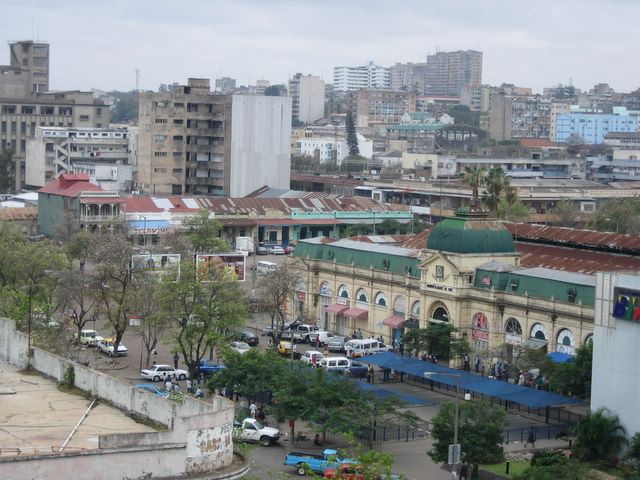
Friday, October 14, 2005
My First Surprise Party Ever!
Just when I was semi-depressed, feeling guilty for not being satisfied with my small but lovely birthday celebrations from my housemates, I walked into the living room and saw a huge cake, chocolate cupcakes, indian fried goodies, and lots of beer and wine waiting for me. My housemates threw me a surprise birthday party, organized mainly by Rico and Lucky. I cried I was so happy, then ate until I felt like popping, and drank until I was silly.
Here are some photos from the celebration.
Here are some photos from the celebration.

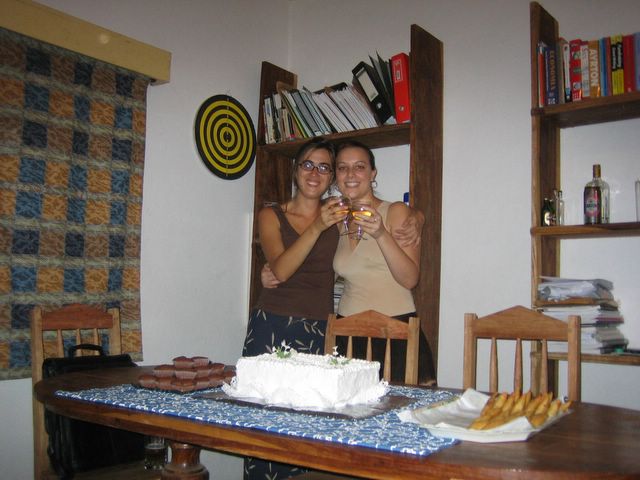
Thursday, October 13, 2005
The Big 24
Today is my birthday...happy birthday to me!
How is the day being celebrated here in Chimoio? Lots of work on the microfinance proposal, mercilessly hot weather and the drone of a small fan, breakfast in bed with mango juice, and a bacalhau dinner from Patricia tonight.
Working on a fabulous blog entry about my trip back to Africa and the 2 days Ricardo and I spent in Zimbabwe this week. Once again my promise for tuesday fell through, but good writing will be coming soon.
How is the day being celebrated here in Chimoio? Lots of work on the microfinance proposal, mercilessly hot weather and the drone of a small fan, breakfast in bed with mango juice, and a bacalhau dinner from Patricia tonight.
Working on a fabulous blog entry about my trip back to Africa and the 2 days Ricardo and I spent in Zimbabwe this week. Once again my promise for tuesday fell through, but good writing will be coming soon.
Monday, October 10, 2005
After nearly 4 days...
Just a quick note to let everyone know I'm back home in Chimoio, safe and sound despite being completely exhausted.
Working on a decent post that, despite my bad record for promising and not delivering on the blog, should be ready by the time I get back from Zimbabwe on Tuesday evening.
Until then, much love.
Working on a decent post that, despite my bad record for promising and not delivering on the blog, should be ready by the time I get back from Zimbabwe on Tuesday evening.
Until then, much love.
Wednesday, October 05, 2005
Oh, the excitement that awaits me!
This evening I will start my long journey back home to Mozambique. I leave at 8pm on the red-eye from Oakland to Atlanta, then cool my heels for 5 hours until my flight for Johannesburgb leaves at 10:30am. The only thing worse than a 17.5-hour flight at night? The same butt-busting trip during daylight hours. I will literally fly all day, arrive in Jo-burg at 10:30am on Friday, then wait for another several hours to get the LAM flight back to Maputo. (By the way, LAM was one of the airlines recently black-listed by France and Belgium...Not sure why, honestly. It seems like a pretty well-run airline to me.)
I will spend the weekend in Maputo working with the credit union that I'm putting together this rural microfiance proposal for, and hopefully accomplishing enough so that I can leave the capital with a finished document in hand. I fly back to Chimoio on Sunday (there are no flights on Friday or Saturday), then rest for one evening at home before leaving for Zimbabwe the next morning with Ricardo.
We will be near Chipinge in south-eastern Zimbabwe to prep our tea processing client (from my last proposal) for a conference call with the Dutch government, the potential source of funding for the project. Basically, if this conference call goes well and we are able to convince the funders of the company's financial stability, we will likely get the money to start a joint venture and build a tea factory in Mozambique!
I'm excited about going back to Chimoio, as odd as that seems given the isolated, boring nature of life there most of the time. I actually miss my housemates and their crazy ways. I miss the familiar mess of our living room, the bare dirt lot that we affectionately call a backyard, our dopey dogs...I even miss cooking for 5 on a regular basis.
Actually, there are some exciting changes awaiting back in Chimoio. Ricardo and Gemelli, in a surge of creative energy, decided to do a complete overhaul on our living room. They bought a new table and 6 chairs, all made of wood, so we can finally expell the plastic lawn furniture we've been using to work and eat on. They also picked up some large wicker chairs and some end tables that local artisans sell on the side of the highway from Chimoio to Tete, so now everyone has a place to sit and we can feasibly entertain company. The boys then varnished everything, repaired the holes in the wall where darts from an old dart board missed their mark, and rearranged all the furniture. Then came the final touches...Ricardo and Gemelli bought several capulanas, the colorful fabric sheets the local women use as sarongs, and turned them into curtains. Yes, curtains. Complete with measuring and sewing and color-coordination.
Finally, just to leave the decorating marathon on a masculine note, the boys decided to fix our poor tv that exploded in an electrical surge a couple of months ago. They took it completely apart, fiddled with the wiring, and somehow managed to rescussitate the whole thing. So now, not only do we have a working tv again, a household decision was made in my absence to get cable! This is so unbelievably exciting! A makeover for the living room and lots of mindless channels to fill our hours of boredom. I can't wait to go home!
I will spend the weekend in Maputo working with the credit union that I'm putting together this rural microfiance proposal for, and hopefully accomplishing enough so that I can leave the capital with a finished document in hand. I fly back to Chimoio on Sunday (there are no flights on Friday or Saturday), then rest for one evening at home before leaving for Zimbabwe the next morning with Ricardo.
We will be near Chipinge in south-eastern Zimbabwe to prep our tea processing client (from my last proposal) for a conference call with the Dutch government, the potential source of funding for the project. Basically, if this conference call goes well and we are able to convince the funders of the company's financial stability, we will likely get the money to start a joint venture and build a tea factory in Mozambique!
I'm excited about going back to Chimoio, as odd as that seems given the isolated, boring nature of life there most of the time. I actually miss my housemates and their crazy ways. I miss the familiar mess of our living room, the bare dirt lot that we affectionately call a backyard, our dopey dogs...I even miss cooking for 5 on a regular basis.
Actually, there are some exciting changes awaiting back in Chimoio. Ricardo and Gemelli, in a surge of creative energy, decided to do a complete overhaul on our living room. They bought a new table and 6 chairs, all made of wood, so we can finally expell the plastic lawn furniture we've been using to work and eat on. They also picked up some large wicker chairs and some end tables that local artisans sell on the side of the highway from Chimoio to Tete, so now everyone has a place to sit and we can feasibly entertain company. The boys then varnished everything, repaired the holes in the wall where darts from an old dart board missed their mark, and rearranged all the furniture. Then came the final touches...Ricardo and Gemelli bought several capulanas, the colorful fabric sheets the local women use as sarongs, and turned them into curtains. Yes, curtains. Complete with measuring and sewing and color-coordination.
Finally, just to leave the decorating marathon on a masculine note, the boys decided to fix our poor tv that exploded in an electrical surge a couple of months ago. They took it completely apart, fiddled with the wiring, and somehow managed to rescussitate the whole thing. So now, not only do we have a working tv again, a household decision was made in my absence to get cable! This is so unbelievably exciting! A makeover for the living room and lots of mindless channels to fill our hours of boredom. I can't wait to go home!
Monday, October 03, 2005
I'm on Vacation, I Swear
Doesn't seem like it, though. All I've done since arriving back in San Francisco is work, work, work. So much for a relaxing trip where I'd get to lounge by the pool, party with friends, and shop in the city. Other than the occasional trip out to get a latte and bagel or some sushi, all I've done here is work, stock up on essential supplies for Africa, and be prodded at by doctors and dentists. Not much fun, although it's definitely been worth it to see my mom and Azul, and talk to friends and family on the phone.
This latest proposal has me super stressed out. I've been waking up every day at 5am to work on it, which even though I have jet-lag on my side is a feat that goes totally against my nature. I have to finish everything before I leave on Wednesday, as I am supposed to meet with the microfinance client the same day I arrive in Maputo, and I still have tons spreadsheets to tool with and descriptions of program activities to write. I'm even toying with the idea of buying a spare battery for my laptop so I can get in 5 hours work on the plane instead of the mere 2 that my current battery can handle.
Just as I started to develop a true hate for all things tea-related towards the end of my last proposal, I am at the point now where I can't stand to read anything more about rural microfinance in Africa!!!!!!
This latest proposal has me super stressed out. I've been waking up every day at 5am to work on it, which even though I have jet-lag on my side is a feat that goes totally against my nature. I have to finish everything before I leave on Wednesday, as I am supposed to meet with the microfinance client the same day I arrive in Maputo, and I still have tons spreadsheets to tool with and descriptions of program activities to write. I'm even toying with the idea of buying a spare battery for my laptop so I can get in 5 hours work on the plane instead of the mere 2 that my current battery can handle.
Just as I started to develop a true hate for all things tea-related towards the end of my last proposal, I am at the point now where I can't stand to read anything more about rural microfinance in Africa!!!!!!
Saturday, October 01, 2005
On Being American
While waiting for my flight from Johannesburg to Atlanta I was, for the first time since leaving the US five months ago, surrounded by Americans. I sat in front of Gate 6 and played anthropologist, although unlike a good scientist I could not refrain from passing judgement. I watched families and couples, wearing safari hats and khaki shorts with sneakers, carrying kitchy souvenirs from the airport shop, talking in twangy accents about what they'd seen at the South African game lodges. Most of the travelers were pudgy, loud, and overly critical of everything that was not up to par with their comfortable lives back in Arkansas or Nevada.
I am different from them, I thought to myself. I am somehow better because I live in Mozambique, speak the local language, have traveled around the world, live modestly, am not a tourist, am aware of history and geography, don't wear socks and sneakers with shorts. I am not like them. I'm New Mexican. New Mexico has culture and its residents are bilingual. My family is Italian. I studied in Rio de Janeiro. My mind was on the defensive, searching for any and all justifications to illustrate that I was not just one of the flock. How dare anyone confuse me with this mass of stereotypical Americans?
I am, however, no better than any of the people waiting with me in front of Gate 6. Deep down I know this, but in my insecurity it is easy to forget. We are all American, each one of us a unique manifestation of the positive and negative attributes of our culture, our heritage, our surroundings. Being around a large group of my compatriots, especially when I'm in "international mode", awakens the deep shame of being American I've struggled with for years. It is not a reaction that I admire in myself. In fact, it brings out in me the same arrogance and feeling of superiority that I so criticize in my fellow countrymen.
What a hypocrite I can be. Some of the people, places, and things I love the most in this world are American...my family, my friends that are passionate fighters of the good fight, free speech, entrepreneurial spirit, road trips, sunsets in Albuquerque, kayaking in Austin, shopping in San Francisco.
Even more perverse is the fact that I am an ardent defender of the US when on foreign soil. I can feel my blood boil when people in other countries start to criticize America with arguments wholly based in stereotype. I turn into a crusader, out to prove to any and all that we are more than McDonald's, Republicans, ignorance about world events, obesity, oil, and unfortunate government policies. I conjure up all of the examples I can to prove that Americans can be supremely intelligent, compassionate, liberal, health-conscious, and politically and environmentally aware. I become the most patriotic person possible, proud of my country and the fact that I am, along with many others, an exception to the stereotypical rule.
I can't help but wonder what this love/hate relationship with the US must do to one's identity. How is it possible to have a truly positive sense of self when part of you detests what you are and the place where you ultimately call home?
I am different from them, I thought to myself. I am somehow better because I live in Mozambique, speak the local language, have traveled around the world, live modestly, am not a tourist, am aware of history and geography, don't wear socks and sneakers with shorts. I am not like them. I'm New Mexican. New Mexico has culture and its residents are bilingual. My family is Italian. I studied in Rio de Janeiro. My mind was on the defensive, searching for any and all justifications to illustrate that I was not just one of the flock. How dare anyone confuse me with this mass of stereotypical Americans?
I am, however, no better than any of the people waiting with me in front of Gate 6. Deep down I know this, but in my insecurity it is easy to forget. We are all American, each one of us a unique manifestation of the positive and negative attributes of our culture, our heritage, our surroundings. Being around a large group of my compatriots, especially when I'm in "international mode", awakens the deep shame of being American I've struggled with for years. It is not a reaction that I admire in myself. In fact, it brings out in me the same arrogance and feeling of superiority that I so criticize in my fellow countrymen.
What a hypocrite I can be. Some of the people, places, and things I love the most in this world are American...my family, my friends that are passionate fighters of the good fight, free speech, entrepreneurial spirit, road trips, sunsets in Albuquerque, kayaking in Austin, shopping in San Francisco.
Even more perverse is the fact that I am an ardent defender of the US when on foreign soil. I can feel my blood boil when people in other countries start to criticize America with arguments wholly based in stereotype. I turn into a crusader, out to prove to any and all that we are more than McDonald's, Republicans, ignorance about world events, obesity, oil, and unfortunate government policies. I conjure up all of the examples I can to prove that Americans can be supremely intelligent, compassionate, liberal, health-conscious, and politically and environmentally aware. I become the most patriotic person possible, proud of my country and the fact that I am, along with many others, an exception to the stereotypical rule.
I can't help but wonder what this love/hate relationship with the US must do to one's identity. How is it possible to have a truly positive sense of self when part of you detests what you are and the place where you ultimately call home?
Wednesday, September 28, 2005
Back to Cali
Puta que pariu, ninguém merece essa viagem!!!
Honestly, this trip was insane. My bunda is square from so many hours sitting in a small seat. And, as if enduring a 37-hour trip weren't enough, I had a middle seat from Atlanta to Phoenix and the woman sitting next to me had liberally doused herself in cheap, sickeningly floral perfume. I got a horrible case of allergies and am still sniffing and sneezing away even now.
So I made it back to California in one piece, and I guess all things considered I'm feeling pretty good. It's great to see my mom and Azul, and have the luxury of resting on a good bed and eating fresh sushi.
I'm going to watch some tv and then hit the sack...I promise a decent entry tomorrow.
beijos.
Ali
Honestly, this trip was insane. My bunda is square from so many hours sitting in a small seat. And, as if enduring a 37-hour trip weren't enough, I had a middle seat from Atlanta to Phoenix and the woman sitting next to me had liberally doused herself in cheap, sickeningly floral perfume. I got a horrible case of allergies and am still sniffing and sneezing away even now.
So I made it back to California in one piece, and I guess all things considered I'm feeling pretty good. It's great to see my mom and Azul, and have the luxury of resting on a good bed and eating fresh sushi.
I'm going to watch some tv and then hit the sack...I promise a decent entry tomorrow.
beijos.
Ali
Tuesday, September 27, 2005
30 more hours to San Francisco
I'm in Johannesburg airport right now, using the same internet cafe where I posted my first African blog and had my hand licked by a sleazy Pakistani that swore I looked just like his wife. In about an hour I'm going to board my flight to Atlanta. 17 and a half glorious hours over the Atlantic, complete with a stop in Sal Island, Cape Verde to refuel the plane.
I am already dead tired from several days of sleep deprivision in Maputo, mainly to be blamed on:
- updating budgets, reading case studies, and putting together objectives for the microfinance project I'm working on;
- watching total trash tv...and I do mean trash. Ricardo and I sat through episode after episode of Cheaters, The Bachelorette, Knight Rider, and Jerry Springer. Ah, the reality channel. Good times. The apartment we rented had cable, a total luxury after our tv in Chimoio exploded. Yes, that's right. We were watching a dvd last month and, all of a sudden, the lights in the entire house doubled in brightness, there was a sizzle and a pop, and acrid smoke started pouring out of the top of the tv.
- procrastinating and leaving packing to the last minute (surprise, surprise)
- telling stories late into the night with Ricardo about the devious things we used to do in middle and high school.
So I'm pooped, but glad to be going home for a visit. Hopefully there will be some good in-flight entertainment and some tomato juice (B-vitamins - I listened, Erin!) to wash down the Tylenol PM.
I am already dead tired from several days of sleep deprivision in Maputo, mainly to be blamed on:
- updating budgets, reading case studies, and putting together objectives for the microfinance project I'm working on;
- watching total trash tv...and I do mean trash. Ricardo and I sat through episode after episode of Cheaters, The Bachelorette, Knight Rider, and Jerry Springer. Ah, the reality channel. Good times. The apartment we rented had cable, a total luxury after our tv in Chimoio exploded. Yes, that's right. We were watching a dvd last month and, all of a sudden, the lights in the entire house doubled in brightness, there was a sizzle and a pop, and acrid smoke started pouring out of the top of the tv.
- procrastinating and leaving packing to the last minute (surprise, surprise)
- telling stories late into the night with Ricardo about the devious things we used to do in middle and high school.
So I'm pooped, but glad to be going home for a visit. Hopefully there will be some good in-flight entertainment and some tomato juice (B-vitamins - I listened, Erin!) to wash down the Tylenol PM.
Tuesday, September 20, 2005
Signs of a Socialist Past
You can tell a lot about a city by the names of its streets. War heroes and politicians and cultural icons become immortalized on small green and white signposts, or etched in marble on the sides of buildings, or, as in Chimoio, painted in faded yellow on the dusty curb.
Here in Maputo, the street names unabashedly tell of a socialist past. To get from our apartment uptown to the internet cafe we are using in the downtown baixa, our path was as follows -
Head down Av. Vladmir Lenine to Av. Mao Tse Tung. Take a left and continue to Av. Salvador Allende. Go past Av. Eduardo Mondlane and turn on Av. Julius Nyerere. Keep going until Av. Frederich Engels, take another left, and you have arrived.
Interesting that now, along all of these streets, you find the offices of neoliberal, market-oriented, international development organizations like the World Bank and USAID...
--------------- ------------------- ----------------
Speaking of international development projects, we just got word from the Dutch Embassy representatives that our proposal for the tea processing unit has passed Phase 1 evaluations. We will have a site visit at the end of the month, followed by a conference call with the potential funders as well as our project partners in Zimbabwe. If that all goes well, it is likely that the project will be approved!!!!
A much-needed dose of motivation as I wade through endless documents about rural microfinance initiatives in Mozambique for the current proposal I´m putting together for the European Union.
Here in Maputo, the street names unabashedly tell of a socialist past. To get from our apartment uptown to the internet cafe we are using in the downtown baixa, our path was as follows -
Head down Av. Vladmir Lenine to Av. Mao Tse Tung. Take a left and continue to Av. Salvador Allende. Go past Av. Eduardo Mondlane and turn on Av. Julius Nyerere. Keep going until Av. Frederich Engels, take another left, and you have arrived.
Interesting that now, along all of these streets, you find the offices of neoliberal, market-oriented, international development organizations like the World Bank and USAID...
--------------- ------------------- ----------------
Speaking of international development projects, we just got word from the Dutch Embassy representatives that our proposal for the tea processing unit has passed Phase 1 evaluations. We will have a site visit at the end of the month, followed by a conference call with the potential funders as well as our project partners in Zimbabwe. If that all goes well, it is likely that the project will be approved!!!!
A much-needed dose of motivation as I wade through endless documents about rural microfinance initiatives in Mozambique for the current proposal I´m putting together for the European Union.
Monday, September 19, 2005
Finally, some pictures!
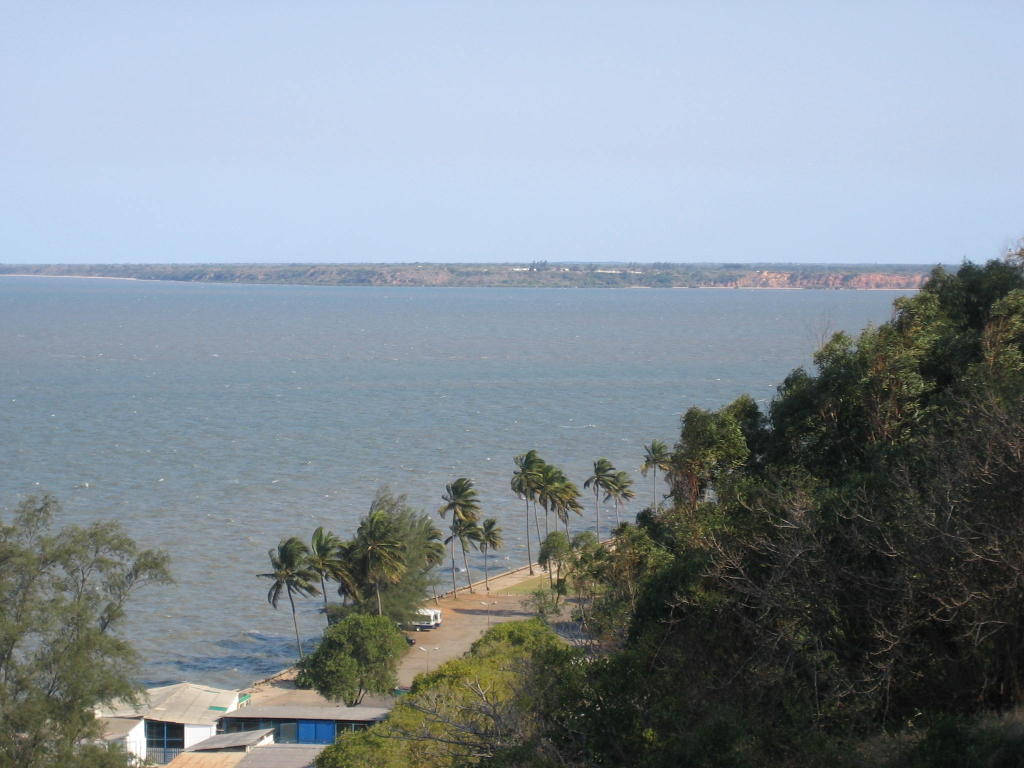
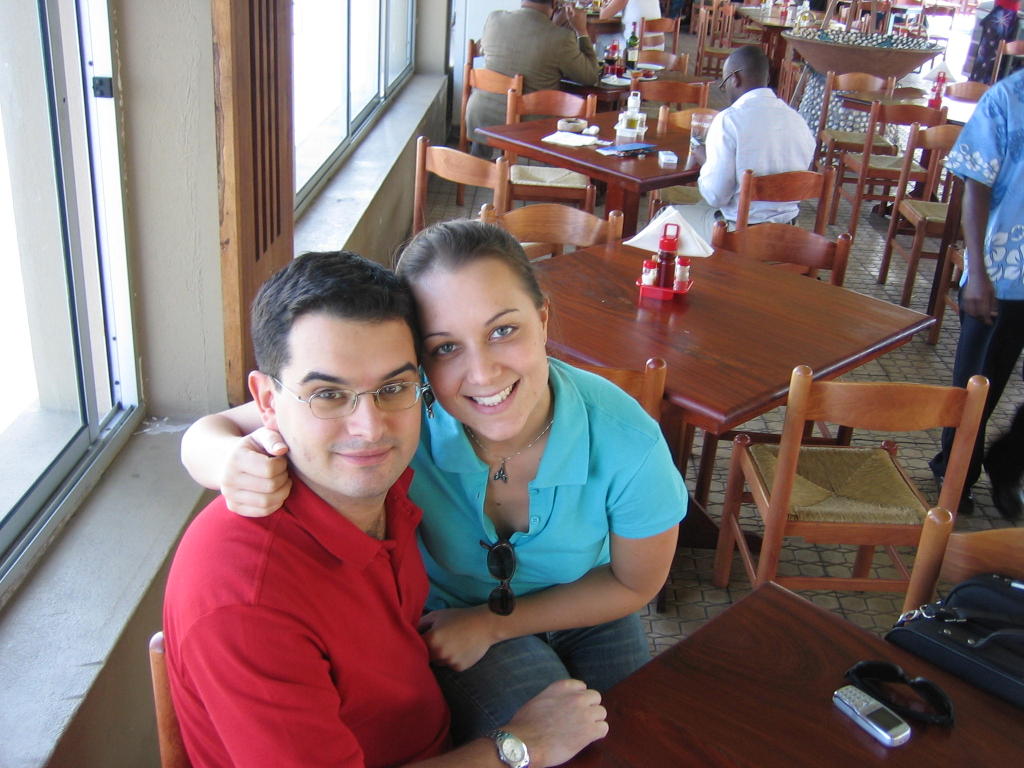
I´ve been especially lax in taking pictures here in Mozambique...I don´t know...something about walking around with a camera here makes me feel even guiltier than usual, like somehow I´m fulfilling the typical white-tourist-firstworld-exploiter role if I take photos of the Mozambicans and their daily lives as I walk around.
Anyway, I´m making an effort here in Maputo and have a couple of photos to share. Actually, this morning as Ricardo and I were riding around in Abdala´s beat-up taxi, I was lamenting the fact that I haven´t sucked it up and taken more photos. I realized that having a purpose for taking photos would make me feel better about the whole thing...some sort of pretext so that I could interact a bit with the people I´d be photographing. I need a theme, like Women of Mozambique or Market Vendors or something...a reason other than that I am a curious tourist that wants to take a snapshot.
So these photos were taken in Maputo last week...Enjoy!

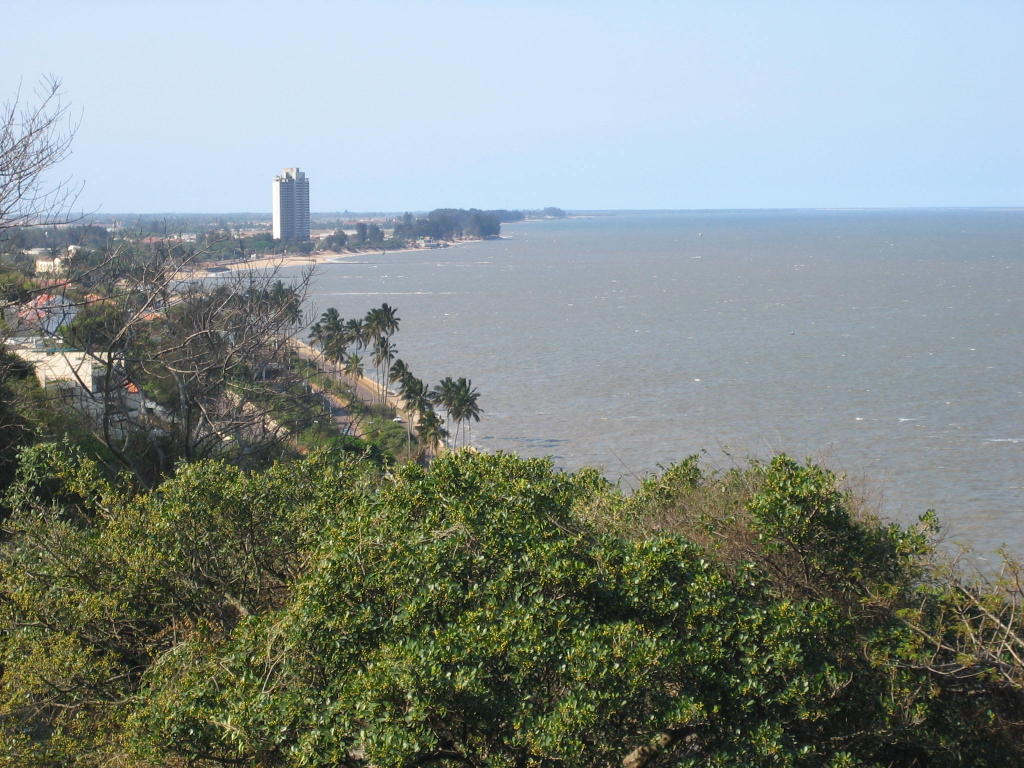

Thursday, September 15, 2005
More Maputo
What do I love about Maputo?
Lots of things, but especially those that are totally absent from my life in Chimoio...
For instance, the restaurants! In a 4 block radius from the apartment we´re staying in, there is an amazingly diverse offering of places to eat. Choices range from Nando´s, a South African fast food chain that specializes in chicken, to restaurants specializing in food from Goa, Macao, Portugal, and even Thailand. Then there are the little take away stands selling steak rolls, french fries, sodas, and other snacks. Having so many great food options is like heaven for me, especially considering that in Chimoio there are only 3 restaurants that I even take a chance with, and at each of those the food is of poor quality and the service even worse.
I also love the fact that I can walk down the street in Maputo and not be constantly stared at, followed, asked for money, or become the butt of jokes by children that are not used to seeing white people. The relative anonimity that city life offers is delicious. I like being just another face in the multi-racial mix of pedestrian traffic. It´s great to leave the house and be able to walk around the block without fearing that the next day the entire city will be gossiping about what I was wearing, why I left the apartment alone, where I was going, etc. Chimoio is gossipy like no other place I´ve ever lived, and I am sooooo tired of it!
To illustrate...last week my mom sent a DHL package to me in Chimoio. Instead of delivering it directly to the address on the box, the delivery guy went to my flatmate Patricia´s accounting business, told her that a package had arrived for me, then returned to his delivery route. Along the way he passed my friend Gemelli as he walked along the street. The delivery guy ran up to Gemelli and, for some odd reason, gave him the airbill to my package. Perhaps he thought Gemelli would see me before he had a chance to make his way around to our house...who knows. By that point, Patricia had called me, Gemelli had sent me a text message, and Ricardo and I took bets as to who would actually deliver the package. Turns out it was Gemelli, who dropped by the DHL office on his way home, intercepted the delivery guy, and carried my package on his shoulder the rest of the way. Ridiculous, especially considering I have no idea who even works at DHL. Somehow, though, they all seem to know me and my circle of friends.
So...what else do I love about Maputo? The fact that there are universities and, in general, a significant portion of well-educated people in the city. In Chimoio, unfortunately, the pickings for an intelligent conversation partner are few and far between. Here, there is an interest in literature, culture, cinema, philosophy, business, and so forth that is a welcome contrast to the country bumpkins back ´home´.
And, finally, I love the fact that there are high speed internet cafes here!!! I miss having internet at home, but quick downloads and the ability to view more than one site at once has got me spoiled!
I miss and love you all!!!!!!!
Lots of things, but especially those that are totally absent from my life in Chimoio...
For instance, the restaurants! In a 4 block radius from the apartment we´re staying in, there is an amazingly diverse offering of places to eat. Choices range from Nando´s, a South African fast food chain that specializes in chicken, to restaurants specializing in food from Goa, Macao, Portugal, and even Thailand. Then there are the little take away stands selling steak rolls, french fries, sodas, and other snacks. Having so many great food options is like heaven for me, especially considering that in Chimoio there are only 3 restaurants that I even take a chance with, and at each of those the food is of poor quality and the service even worse.
I also love the fact that I can walk down the street in Maputo and not be constantly stared at, followed, asked for money, or become the butt of jokes by children that are not used to seeing white people. The relative anonimity that city life offers is delicious. I like being just another face in the multi-racial mix of pedestrian traffic. It´s great to leave the house and be able to walk around the block without fearing that the next day the entire city will be gossiping about what I was wearing, why I left the apartment alone, where I was going, etc. Chimoio is gossipy like no other place I´ve ever lived, and I am sooooo tired of it!
To illustrate...last week my mom sent a DHL package to me in Chimoio. Instead of delivering it directly to the address on the box, the delivery guy went to my flatmate Patricia´s accounting business, told her that a package had arrived for me, then returned to his delivery route. Along the way he passed my friend Gemelli as he walked along the street. The delivery guy ran up to Gemelli and, for some odd reason, gave him the airbill to my package. Perhaps he thought Gemelli would see me before he had a chance to make his way around to our house...who knows. By that point, Patricia had called me, Gemelli had sent me a text message, and Ricardo and I took bets as to who would actually deliver the package. Turns out it was Gemelli, who dropped by the DHL office on his way home, intercepted the delivery guy, and carried my package on his shoulder the rest of the way. Ridiculous, especially considering I have no idea who even works at DHL. Somehow, though, they all seem to know me and my circle of friends.
So...what else do I love about Maputo? The fact that there are universities and, in general, a significant portion of well-educated people in the city. In Chimoio, unfortunately, the pickings for an intelligent conversation partner are few and far between. Here, there is an interest in literature, culture, cinema, philosophy, business, and so forth that is a welcome contrast to the country bumpkins back ´home´.
And, finally, I love the fact that there are high speed internet cafes here!!! I miss having internet at home, but quick downloads and the ability to view more than one site at once has got me spoiled!
I miss and love you all!!!!!!!
Monday, September 12, 2005
I Love Maupto!
I remember when I first arrived in Maputo I thought to myself - Holy Christ, I´ve just left civilization behind. It was a shock to the senses to see the somewhat run-down condition of the city, people walking barefoot with livestock along the city streets, children running around with distended bellies, and the general chaos of any developing country.
Now, four months later and after having gotten used to life in Chimoio, I breathed a sigh of relief upon arriving in Maputo on Friday. As the plane touched down, I looked at the skyscrapers, businesses, asphalted streets full of people, and general hustle and bustle and thought to myself - Thank God I'm back in the civilized world!
Maputo is fabulous. Despite the poverty and need for a good coat of paint and road resurfacing project, it is cosmopolitan and beautiful. Ricardo and I will be here for the next 2 weeks and I am so happy to be in an urban environment I could burst!
Now, four months later and after having gotten used to life in Chimoio, I breathed a sigh of relief upon arriving in Maputo on Friday. As the plane touched down, I looked at the skyscrapers, businesses, asphalted streets full of people, and general hustle and bustle and thought to myself - Thank God I'm back in the civilized world!
Maputo is fabulous. Despite the poverty and need for a good coat of paint and road resurfacing project, it is cosmopolitan and beautiful. Ricardo and I will be here for the next 2 weeks and I am so happy to be in an urban environment I could burst!
Tuesday, September 06, 2005
A Sip of Home
Today was an exciting break from the normal routine of life here in Chimoio. A big box arrived via DHL that my mom had sent last week, and Ricardo and I tore it open and unwrapped its contents like little kids. I now have new books to read, Out of Africa to watch on DVD, a fresh stock of Burt's Bees cremes, hair accessories, my favorite pair of red pants I'd left behind, 3 boxes of Chai tea, and a 700-count family pack of Splenda. Oooooh, life is so good right now. I am savoring my first sip of Chai tea in over four months, wearing my lovely red pants, and trying to decide which book to read first. Ricardo is happy, too, with the necessary computer parts now in hand to fix his laptop that has been out of order for over 6 months.
The aroma of the Chai brings me straight back to Austin where a cup of tea was at the center of my morning routine, and sometimes the only motivation I could come up with for actually getting out of bed. My alarm clock would start beeping at 7am. Still asleep, I'd hit snooze for at least 30 minutes. On particularly lazy mornings, I'd procrastinate and hit snooze for an hour and a half, barely leaving myself enough time to brush my teeth and head out the door for work. But as long as I had Chai in the pantry, the whole ordeal was much easier. I'd scoot Azul off my chest or head (preferred sleeping spots for a girl cat) get out of bed, put on my purple robe, and head to the kitchen.
I didn't have a microwave - something my mom tried to change each time she'd visit. "We can go to Wal-Mart, Ali. I'll buy a microwave for you. It will make your life easier." My mom has become increasingly microwave-dependent over the years, especially for things like oatmeal and frozen veggies and tea. But each time I'd refuse her offer. I liked the ritual of filling my royal blue kettle with water, selecting a tea bag, and waiting sleepy-eyed for the familiar whistle of steam escaping. Azul would jump up on the counter and help me brew my tea, and I'd have to focus my blurred vision to be sure there were no stray cat hairs floating in my Chai.
Then I'd take my cup of tea and sit at my desk in the living room to check my e-mail. Azul would follow me, jumping up on the back of my chair or sprawling out on my laptop keyboard, once again the helper cat. And there we'd sit for a good 20 minutes - reading e-mail and the headlines from the online version of O Globo, the main newspaper in Rio, drinking Chai, and preparing to face the day.
One sip of tea was enough to bring me right back. I even checked for cat hairs.
The aroma of the Chai brings me straight back to Austin where a cup of tea was at the center of my morning routine, and sometimes the only motivation I could come up with for actually getting out of bed. My alarm clock would start beeping at 7am. Still asleep, I'd hit snooze for at least 30 minutes. On particularly lazy mornings, I'd procrastinate and hit snooze for an hour and a half, barely leaving myself enough time to brush my teeth and head out the door for work. But as long as I had Chai in the pantry, the whole ordeal was much easier. I'd scoot Azul off my chest or head (preferred sleeping spots for a girl cat) get out of bed, put on my purple robe, and head to the kitchen.
I didn't have a microwave - something my mom tried to change each time she'd visit. "We can go to Wal-Mart, Ali. I'll buy a microwave for you. It will make your life easier." My mom has become increasingly microwave-dependent over the years, especially for things like oatmeal and frozen veggies and tea. But each time I'd refuse her offer. I liked the ritual of filling my royal blue kettle with water, selecting a tea bag, and waiting sleepy-eyed for the familiar whistle of steam escaping. Azul would jump up on the counter and help me brew my tea, and I'd have to focus my blurred vision to be sure there were no stray cat hairs floating in my Chai.
Then I'd take my cup of tea and sit at my desk in the living room to check my e-mail. Azul would follow me, jumping up on the back of my chair or sprawling out on my laptop keyboard, once again the helper cat. And there we'd sit for a good 20 minutes - reading e-mail and the headlines from the online version of O Globo, the main newspaper in Rio, drinking Chai, and preparing to face the day.
One sip of tea was enough to bring me right back. I even checked for cat hairs.
Monday, September 05, 2005
Ô, Coisa de Português!

Licença de Condução de Velocípides, aka Bicycle Driver's License...one of the quirkier requirements I've come across here in Mozambique. This license is from a Portuguese friend who was doing volunteer work with the Catholic church.
Sunday, September 04, 2005
Blessed with a Lazy Sunday
It’s a lazy Sunday in Chimoio. I’m sitting outside on dog-ravaged wicker furniture, trying to get a breath of fresh air and at least create the illusion that I’ve gone out of the house. Our three Rhodesian Ridgebacks are sprawled out on the porch keeping me company. There is a group of boys in the street playing an improvised game of soccer that really consists in taking turns kicking a half-inflated ball as far as possible, then chasing after it screaming. Each time the ball bounces past our gate, the dogs look up excitedly. About every third time the lure of the game is greater than their laziness and they run to the gate, barking like crazy, trying to chase after the kids.
Concentrating under these circumstances, as you can imagine, is a challenge. About an hour ago, at the height of the barking and excitement from the game, I decided I couldn’t take it anymore. I walked up to the gate, put on a stern face, and yelled at the kids.
“Can you guys move further down the street to play? You’re driving the dogs nuts.”
One of the older boys looked at me smugly, hands on his hips. Who was this white girl asking them to interrupt their Sunday soccer? He gave an answer fit for a teenager trying to impress his peers. “It’s not my fault your dogs are barking!”
The other kids broke out laughing and defiantly started kicking the ball around again. The dogs raced up and down the length of the gate, stirring up clouds of dust.
My patience was at an end. I raised my voice and called over the boy who had spoken earlier. “If you don’t move around the corner to play I’m going to set these dogs loose!”
He cocked an eyebrow and I walked over to the huge lock and chain that hold the gate closed. I had no intention of setting the dogs on them, but wanted to give the brats a good scare. I fished out my keys, jangled the lock and chain, and watched with satisfaction as the kids all sprinted around the corner to continue their game far away from our house.
The dogs have since chilled out somewhat, only barking when the ball escapes and makes it this far down the block, and I can finally write in relative peace.
----------------------- ------------------------- -----------------------------
So the main thing on my mind lately has been Hurricane Katrina. My housemates and I have been accompanying the storm online, from the time it hit the Florida coast through the various botched relief efforts in New Orleans. I am overwhelmed by the size of this disaster, and my heart goes out to all the people that were affected by it.
People here in Mozambique have been quite sympathetic to the tragedy. After all, they know a thing or two about severe flooding. In 2000, excessive rains punished the southern part of the country, and the major rivers in the area spilled over their banks. Huge expanses of land were completely submerged, and help was slow to trickle in. Some of you may remember one of the most shocking images from the floods – a woman giving birth in a treetop, surrounded by dozens of feet of murky water. If the US is struggling to respond adequately to Hurricane Katrina, I can only imagine what disaster relief efforts must be like in countries that are void of forecasting technology and have fewer resources in the first place.
Hurricane Katrina has also put a very humbling spin on my philosophical musings about the concept of home. I can only imagine how tremendously difficult it must be to know very well where your home is, only to have it wiped off the map overnight along with all of your possessions. I have several friends that are passing through this very scenario right now…
Meghan, my friend from high school, had lived for 7 years in New Orleans with her boyfriend. They were able to make it out of the city in time, but were not able to take much with them and are now bouncing between relatives houses, trying to figure out where and how to start anew. Their apartment building is likely going to collapse from the soggy, unstable soil around it before they are allowed back in the city. Even if it survives, they are unsure whether or not they will return to New Orleans.
Even more gut-wrenching is what happened to Erin’s family. Last year, after losing nearly everything in the 4 hurricanes that hit Florida, Erin’s mom and dad decided to leave Pensacola and start over. They moved to Biloxi, built a beautiful beachfront home, and had a year of relative calm until Katrina. Thankfully, Erin’s family made it out of the storm’s path and is safe, but the water and wind literally ripped their house to pieces and they lost everything. I talked to Erin on the phone the other day and “overwhelming” was the only way she could begin to describe losing your home and all your possessions.
My heart goes out to them, as well as everyone touched by this tragedy.
------------------------ ---------------------- ---------------------------
In other news, Ricardo almost certainly has Hepatitis A. He noticed last night while brushing his teeth that his eyes were yellow. We compared our eyes in the bathroom mirror, and the difference was shocking. Even his skin was jaundiced, making my pale complexion look pink and vibrant in comparison. He is also experiencing all of the other symptoms of Hepatitis A – abrupt onset of fever, abdominal pains, dark urine, loss of appetite, nausea…It’s hard to know if he had malaria and then came down with Hep A, or if it was his liver causing trouble the entire time. Even if he didn’t actually have malaria, it is much better to be on the safe side and take the course of treatment. Hepatitis A, while a pain in the ass, is not a fatal disease. Malaria, if not treated, almost always is.
Unfortunately, there is no treatment for Hep A other than bed rest and a low-fat, alcohol-free diet for 6 months. I am thanking my lucky stars right now that I overcame my fear of needles and got all of my shots before coming to Mozambique. Had I not been vaccinated against Hep A, I would likely be yellow-eyed and miserable along with Ricardo right now.
Speaking of things health-related, I am going “home” to San Francisco at the end of the month for a week of medical and dental appointments. The main reason for the trip is that my moles have been changing and growing in a way that is making me super nervous. Nothing serious so far, but I need to get them biopsied and potentially removed. I’m going to take advantage of being in the US and also get my teeth cleaned, go to the gynecologist, go to the dermatologist, and get my hair cut.
Yes, it’s a butt-buster of a trip just to have some basic procedures and tests performed, but it is well worth it in my book. Theoretically, I could get everything done in Nespruit, South Africa and use my international health insurance, but between the flight and hotel and exam expenses, it would be nearly the same price as a ticket back to the US. Also, there is something priceless about having your mom available to hold your hand while you freak out at the doctor’s office (something I’ve been known to do more than once).
Concentrating under these circumstances, as you can imagine, is a challenge. About an hour ago, at the height of the barking and excitement from the game, I decided I couldn’t take it anymore. I walked up to the gate, put on a stern face, and yelled at the kids.
“Can you guys move further down the street to play? You’re driving the dogs nuts.”
One of the older boys looked at me smugly, hands on his hips. Who was this white girl asking them to interrupt their Sunday soccer? He gave an answer fit for a teenager trying to impress his peers. “It’s not my fault your dogs are barking!”
The other kids broke out laughing and defiantly started kicking the ball around again. The dogs raced up and down the length of the gate, stirring up clouds of dust.
My patience was at an end. I raised my voice and called over the boy who had spoken earlier. “If you don’t move around the corner to play I’m going to set these dogs loose!”
He cocked an eyebrow and I walked over to the huge lock and chain that hold the gate closed. I had no intention of setting the dogs on them, but wanted to give the brats a good scare. I fished out my keys, jangled the lock and chain, and watched with satisfaction as the kids all sprinted around the corner to continue their game far away from our house.
The dogs have since chilled out somewhat, only barking when the ball escapes and makes it this far down the block, and I can finally write in relative peace.
----------------------- ------------------------- -----------------------------
So the main thing on my mind lately has been Hurricane Katrina. My housemates and I have been accompanying the storm online, from the time it hit the Florida coast through the various botched relief efforts in New Orleans. I am overwhelmed by the size of this disaster, and my heart goes out to all the people that were affected by it.
People here in Mozambique have been quite sympathetic to the tragedy. After all, they know a thing or two about severe flooding. In 2000, excessive rains punished the southern part of the country, and the major rivers in the area spilled over their banks. Huge expanses of land were completely submerged, and help was slow to trickle in. Some of you may remember one of the most shocking images from the floods – a woman giving birth in a treetop, surrounded by dozens of feet of murky water. If the US is struggling to respond adequately to Hurricane Katrina, I can only imagine what disaster relief efforts must be like in countries that are void of forecasting technology and have fewer resources in the first place.
Hurricane Katrina has also put a very humbling spin on my philosophical musings about the concept of home. I can only imagine how tremendously difficult it must be to know very well where your home is, only to have it wiped off the map overnight along with all of your possessions. I have several friends that are passing through this very scenario right now…
Meghan, my friend from high school, had lived for 7 years in New Orleans with her boyfriend. They were able to make it out of the city in time, but were not able to take much with them and are now bouncing between relatives houses, trying to figure out where and how to start anew. Their apartment building is likely going to collapse from the soggy, unstable soil around it before they are allowed back in the city. Even if it survives, they are unsure whether or not they will return to New Orleans.
Even more gut-wrenching is what happened to Erin’s family. Last year, after losing nearly everything in the 4 hurricanes that hit Florida, Erin’s mom and dad decided to leave Pensacola and start over. They moved to Biloxi, built a beautiful beachfront home, and had a year of relative calm until Katrina. Thankfully, Erin’s family made it out of the storm’s path and is safe, but the water and wind literally ripped their house to pieces and they lost everything. I talked to Erin on the phone the other day and “overwhelming” was the only way she could begin to describe losing your home and all your possessions.
My heart goes out to them, as well as everyone touched by this tragedy.
------------------------ ---------------------- ---------------------------
In other news, Ricardo almost certainly has Hepatitis A. He noticed last night while brushing his teeth that his eyes were yellow. We compared our eyes in the bathroom mirror, and the difference was shocking. Even his skin was jaundiced, making my pale complexion look pink and vibrant in comparison. He is also experiencing all of the other symptoms of Hepatitis A – abrupt onset of fever, abdominal pains, dark urine, loss of appetite, nausea…It’s hard to know if he had malaria and then came down with Hep A, or if it was his liver causing trouble the entire time. Even if he didn’t actually have malaria, it is much better to be on the safe side and take the course of treatment. Hepatitis A, while a pain in the ass, is not a fatal disease. Malaria, if not treated, almost always is.
Unfortunately, there is no treatment for Hep A other than bed rest and a low-fat, alcohol-free diet for 6 months. I am thanking my lucky stars right now that I overcame my fear of needles and got all of my shots before coming to Mozambique. Had I not been vaccinated against Hep A, I would likely be yellow-eyed and miserable along with Ricardo right now.
Speaking of things health-related, I am going “home” to San Francisco at the end of the month for a week of medical and dental appointments. The main reason for the trip is that my moles have been changing and growing in a way that is making me super nervous. Nothing serious so far, but I need to get them biopsied and potentially removed. I’m going to take advantage of being in the US and also get my teeth cleaned, go to the gynecologist, go to the dermatologist, and get my hair cut.
Yes, it’s a butt-buster of a trip just to have some basic procedures and tests performed, but it is well worth it in my book. Theoretically, I could get everything done in Nespruit, South Africa and use my international health insurance, but between the flight and hotel and exam expenses, it would be nearly the same price as a ticket back to the US. Also, there is something priceless about having your mom available to hold your hand while you freak out at the doctor’s office (something I’ve been known to do more than once).
Subscribe to:
Posts (Atom)